
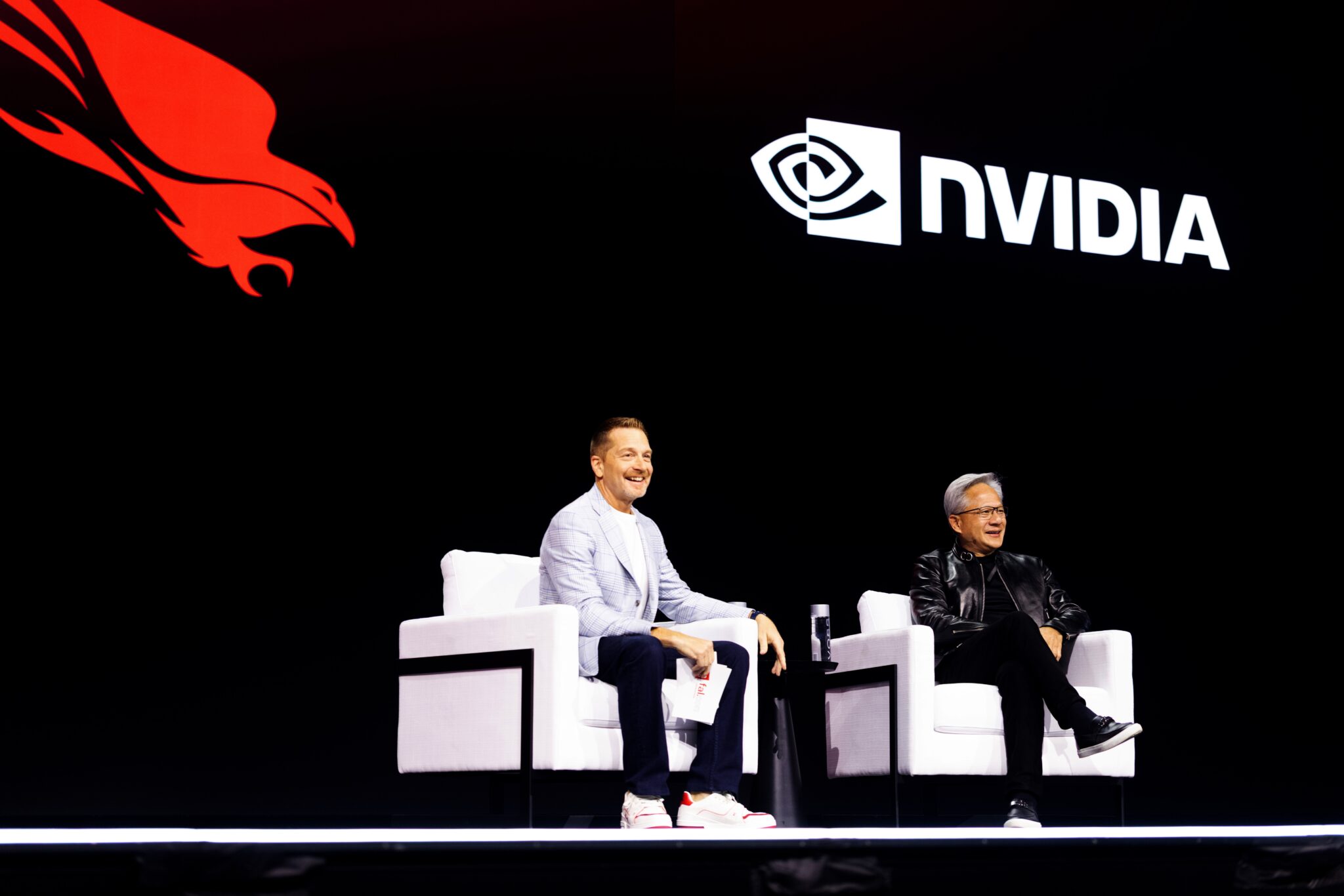
The latest cybersecurity-AI pitch is no longer that a model can spot a suspicious file. CrowdStrike’s SafeMind is meant to run an argument: one agentic side searches for an attack path, the other closes it, and the system turns the result into detections and remediation work.
Announced September 1 at Fal.Con, SafeMind is a family of purpose-built security models and agent harnesses from CrowdStrike’s Cyber Superintelligence Lab. CrowdStrike says it will operate natively in Falcon, while standalone models and harnesses will be offered through Project QuiltWorks. NVIDIA supplies the Nemotron foundation models and compute-side collaboration; CrowdStrike supplies the cyber data, tuning and control layer.
For security teams, that division is more important than the branding. A generic model can describe a phishing technique. A usable defensive system needs to understand an organization’s telemetry, test a plausible route to harm, propose a response, preserve evidence and stop before an automated change creates a second incident.
What SafeMind actually claims to do
CrowdStrike describes two launch models: Red Tempest for advanced offensive scenarios and Blue Solano for defending enterprise assets. Their harnesses are intended to keep the two in a closed loop, with the offensive side seeking weaknesses and the defensive side generating, validating and promoting detections.
| Layer | CrowdStrike’s stated job | The operational question |
|---|---|---|
| Red Tempest | Emulates sophisticated attack scenarios and looks for paths to compromise | Is it constrained to authorized environments and useful hypotheses? |
| Blue Solano | Builds defensive measures for enterprise assets | Can analysts inspect why a detection or response was proposed? |
| Agent harnesses | Coordinate the red/blue loop and work with other model choices | Which actions can happen automatically, and which require approval? |
| Falcon integration | Brings the system into existing security operations | Does it reduce the queue, or add another console and alert stream? |
NVIDIA says its Nemotron 3 Ultra orchestrates the defensive harness and a fine-tuned Nemotron 3 Super powers a rule-generation sub-agent. The important word is harness. Models generate and reason; a harness decides which tools they can use, what context they receive and where their work stops. In security, that boundary is the product.
The numbers are claims, not a buying signal
CrowdStrike says its internal comparison found 29% higher detection, six-times-faster end-to-end remediation and 99% lower detection-and-remediation cost than leading frontier and open-source baselines. NVIDIA separately repeats the lower-cost claim for Blue Solano after post-training on CrowdStrike data.
Those are vendor-provided evaluations, not independent field tests, and the announcement does not publish enough methodology to treat the figures as a universal forecast. A security operations center will care about the harder details: false positives, actions reversed by analysts, coverage gaps, incident evidence, model-routing cost and whether a response works in its own identity, endpoint and cloud estate.
Cyber Daily’s report usefully keeps the headline grounded: SafeMind is designed to identify and remediate threats at machine speed, but it is still a product launch based on CrowdStrike’s description of its own data and workflow. That is where healthy skepticism belongs—not in denying the value of automation, but in demanding evidence where it matters.
Why this is a more serious idea than a cyber chatbot
The hardest security failures are often handoffs. A scanner finds a weakness; a person has to decide whether it is reachable; another person owns the affected service; a change window passes; then a report has to explain what happened. AI can help most when it shortens those gaps without hiding the decision.
That makes SafeMind a natural next chapter after Microsoft’s Project Perception, which put red, blue and remediation-oriented agents into one security workflow. Both announcements understand that defenders need more than faster search. They need supervised systems that can carry context from discovery through action.
CrowdStrike’s red-versus-blue framing has a second appeal: it treats continuous testing as part of defense instead of a quarterly exercise. But there is an obvious limit. An offensive agent must run in a high-fidelity but safely bounded environment. An agent that has found a real production weakness must not be free to “prove” it in a way that exposes customers or interrupts a service. The press materials describe a digital-twin-style test environment at NVIDIA; customers should ask exactly how that separation works in their deployments.
The question buyers should ask first
SafeMind is not a consumer feature, and it will not make a small organization secure simply by being switched on. Its relevance is to the people who run the systems behind the services everyone relies on: hospitals, retailers, banks, public infrastructure and software companies. Faster defensive loops can make those systems more resilient. Uncontrolled ones can make mistakes faster, too.
Before treating the launch metrics as procurement criteria, security leaders should ask:
- Which model actions are advisory, which are pre-approved, and which require a human signoff?
- Can an analyst reproduce the agent’s evidence and roll back every change?
- How are red-team simulations contained and logged?
- What data leaves the customer environment, and what is retained for model improvement?
- What independent evaluations cover real deployments, not only a vendor-built benchmark?
Bottom line
SafeMind’s best idea is not that AI should replace a security team. It is that an AI system should make the defensive loop more complete: search for a route in, close it, show the evidence and keep learning within defined limits.
CrowdStrike and NVIDIA have the data, platform reach and infrastructure to make that proposition worth watching. The announcement’s performance claims still need independent validation, and the value will ultimately be measured in governed, reversible outcomes—not in how aggressively an agent is allowed to act. In cybersecurity, the most impressive automation is the automation a tired team can still explain at 2 a.m.