
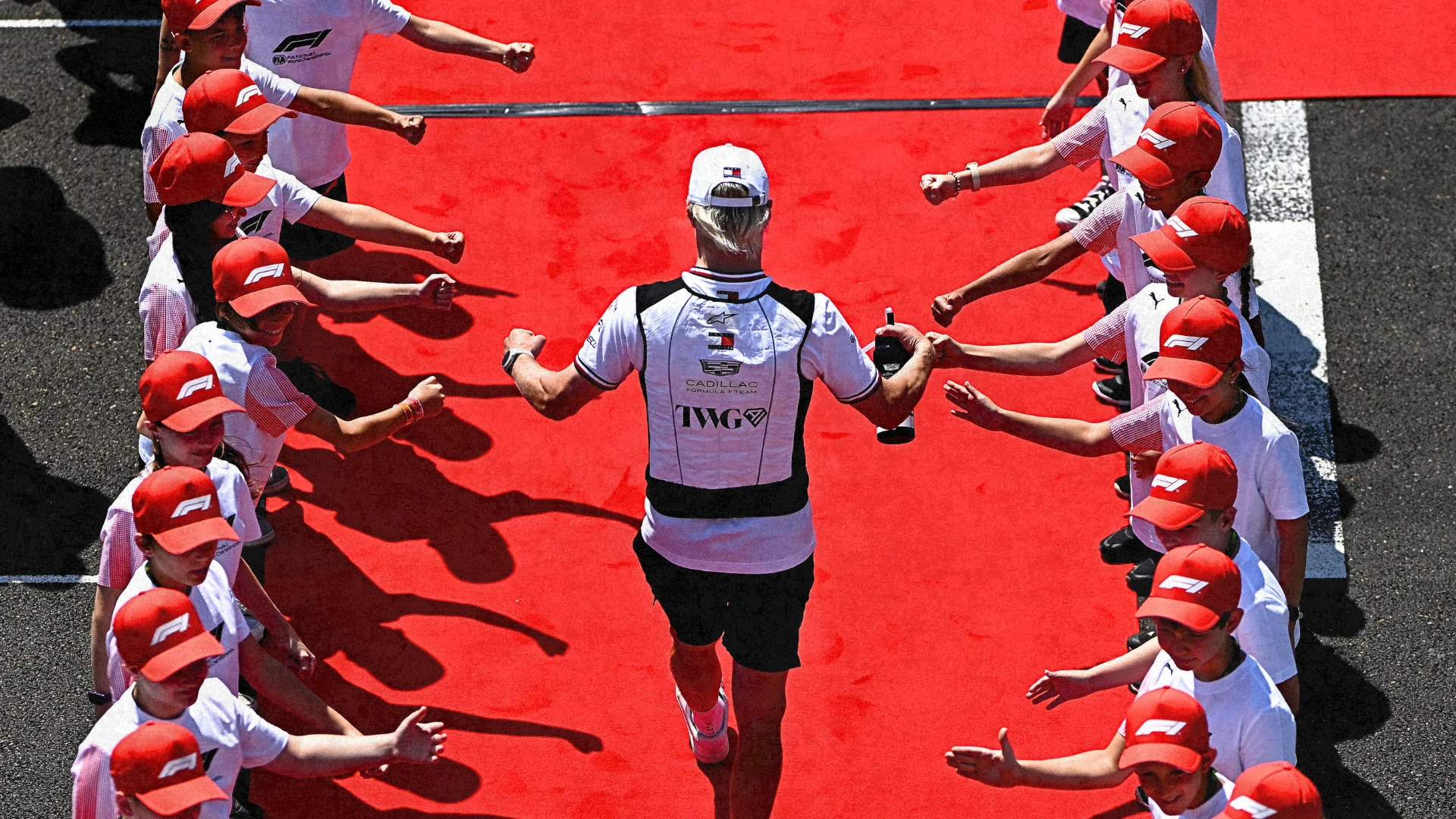
Cadillac’s most revealing Formula 1 number at the summer break is not the zero in the points column.
It is the gap between that zero and the way the team is now being discussed. Formula 1’s official Cadillac page lists the hard facts: 11 Grands Prix entered, no points, no top-10 finishes and nine team DNFs. Motorsport.com still gave the new American-backed team a respectable mid-season read today, arguing that Cadillac has mostly looked like a credible F1 entrant rather than a novelty act waiting to be exposed.
That tension is why this is today’s Daily Dose of F1.
Formula 1 also published fresh Bottas-Cadillac feature coverage on August 6, putting the veteran’s debut-team role back into the spotlight during the summer shutdown. Add Cadillac’s own launch framing, the official team statistics, and GM’s approved 2029 power-unit plan, and the story becomes more useful than another title-fight ranking: Cadillac is pointless, but the early evidence says it may not be directionless.
GearPulse’s view: this is the point in a new F1 team’s life where the jokes either become the story or fade into background noise. Cadillac has done enough for the second outcome to look more likely. Now it has to turn respectability into proof.
Why this rose today
Cadillac was not the loudest name in the paddock this week. Antonelli data, Norris title-chase analysis, Red Bull personnel chatter and F1 calendar uncertainty all had stronger instant hooks.
The Cadillac story won because it is the cleanest non-duplicate. GearPulse covered the team’s Austria upgrade in June, but that was a race-week development exam. Today’s source trail is a broader first-half audit. Formula 1 gave Bottas and Cadillac fresh official placement. Motorsport.com published a same-day mid-season grade. Formula 1’s team page supplies the uncomfortable statistics. Cadillac’s own source material explains why Bottas and Sergio Perez were hired as builders, not just drivers. Formula 1’s GM power-unit coverage shows why 2026 is a bridge year rather than the final version of the project.
That makes the angle sharper than “new team has no points.” The real question is whether Cadillac has built enough of a race team underneath the scoreboard.
Zero points can mean different things
Some zero-point seasons are empty. This one is not automatically in that category.
Formula 1’s team page says Cadillac’s highest race finish so far is 13th, with a best grid position of 17th. Bottas is 21st in the drivers’ standings, also on zero points, with five DNFs from 11 Grands Prix. Those are not good numbers. They are also not shocking numbers for a team entering F1 in a new regulation cycle, using a customer Ferrari power unit and trying to make a brand-new operation behave like a permanent paddock institution.
The useful comparison is not Mercedes, Ferrari or McLaren. It is the difference between a team that starts too far away to learn and a team that starts close enough to gather relevant data. Motorsport.com’s grade leans on that distinction: Cadillac avoided 107% embarrassment, met major deadlines, brought upgrades, and looked more professionally embedded than a fresh 11th team had any right to look.
That is progress, but it is not points. F1 does not award constructors’ money for looking organised.
Bottas is the right kind of boring
Bottas matters because Cadillac’s first season needs calm evidence more than heroic surprises.
Formula 1’s driver profile lists the scale of his experience: 257 Grand Prix entries, 10 wins, 67 podiums and 20 poles. Cadillac’s own launch announcement made the same strategic point when it paired Bottas with Perez. The team wanted two drivers who could separate car limitation from operational noise and help build the feedback loop.
That sounds dull until you remember how many new-team problems are self-inflicted. A rookie operation needs drivers who can tell engineers whether a weakness is aero balance, power delivery, braking confidence, tyre warm-up, procedural execution or simply an expected limitation of the package. Bottas has lived through Williams, Mercedes, Sauber and a reserve year. Perez has lived through midfield survival and front-running pressure. That is a useful diagnostic range.
The fun fact is that Bottas also qualified for the UCI Gravel World Championships during the summer break, as Motorsport.com reported today. It is not the core F1 story, but it does fit the pattern: he is treating this phase of his career less like a late-career holding pen and more like a full competitive reset.
The real target is the operating loop
Cadillac’s first half should be judged through four questions.
| Question | First-half signal | What has to improve |
|---|---|---|
| Can the car start close enough? | Yes, broadly. It has not looked like a non-F1 car. | The baseline still needs to move from survival pace to regular Q2 threat. |
| Can the team develop? | Some evidence. Motorsport.com notes a steady upgrade stream for the MAC-26. | Upgrades now need to translate into race finishes, not just cleaner weekends. |
| Can the drivers diagnose? | Strong on paper. Bottas and Perez were hired for exactly that. | Cadillac needs fewer DNFs so feedback comes from full-distance data. |
| Can the project bridge to GM power? | Strategically coherent. FIA approval puts GM Performance Power Units on the 2029 path. | The team cannot wait until 2029 to learn how to race sharply. |
That last point is the most important. Formula 1’s GM power-unit coverage confirms Cadillac is using Ferrari power until GM’s engine is homologated, with 2029 the planned step into true works-supplier status. That makes 2026 a founding season, but not a free pass. If Cadillac spends three years accepting last place because the “real” project starts with the GM engine, it will arrive in 2029 with bad habits.
The better read is that every pointless weekend is a factory systems test. Pit-wall decisions, reliability triage, freight, spares, simulator correlation, driver communication and upgrade timing all become part of the engine-era foundation.
The caveat is reliability
Nine team DNFs is the stat that stops this becoming a soft-focus startup story.
A new team can explain a lack of points. It cannot explain away too many weekends where the car does not finish. Retirements shrink the dataset, punish morale and make upgrades harder to judge. If a new floor or cooling adjustment arrives and one car stops early, the team loses the most valuable comparison: how the part behaves across tyres, fuel load, traffic and changing track temperature.
That is why the second half needs a boring target before a glamorous one. Cadillac does not have to score at Zandvoort or Monza to prove the project is working. It does have to reduce the number of incomplete races, keep both drivers in the same development conversation and find at least a few weekends where Williams, Haas, Alpine or Aston Martin are reachable on merit.
GearPulse’s probability read: Cadillac scoring before the end of 2026 is still a live 35-45% chance if reliability improves and a messy race opens the door. A top-eight finish on pure pace is much less likely, maybe 10-15%, because the midfield is also developing. That is editorial analysis, not betting advice.
Why the scoreboard still matters
There is one trap in praising Cadillac’s first half: F1 is brutal about weak targets.
If a team is 11th with zero points in August, the narrative can only carry it so far. Sponsors, engineers and future recruits need evidence that the curve points upward. Bottas and Perez need to feel that their feedback is changing the car. Lowdon needs to show that the team can make decisions faster than a startup committee. GM needs the F1 programme to look like a serious technology platform before its own power unit becomes the headline.
The next useful benchmark is not a podium. It is a weekend where Cadillac qualifies ahead of another team, finishes with both cars, and leaves with a clear upgrade direction. Do that often enough and the first point stops looking like a miracle. It becomes the next boring output of a team that is starting to work.
Skipped candidates
Formula 1’s new Antonelli data feature had the strongest official timing of the day, and Sky Sports F1 kept the same title-leader storyline alive. It was skipped because GearPulse published an Antonelli pressure-reset article on August 3 and a Mercedes title-risk upgrade article on August 5. The fresh numbers were useful, but the reader would feel the overlap.
Red Bull’s reported Gwen Lagrue/Marko succession story had broad pickup and obvious intrigue. GearPulse already covered Lagrue’s Red Bull move on July 28, so today’s version needed a stronger official development to justify another article.
Middle East calendar contingency stories remain important, especially with Qatar and Abu Dhabi still under scrutiny. The main Sky/Reuters/Domenicali trail is from last week, and GearPulse already covered the Sepang/Bahrain calendar test in late July. It stays on the watchlist for a formal FIA/F1 decision.
F1 energy-algorithm debate coverage is still technically rich, but GearPulse has published multiple recent pieces on Spa energy deployment and Domenicali’s battery-graphics defence. It needs a rule change, team protest or formal FIA clarification before another Daily Dose.
Bottom line
Cadillac is last. Cadillac is pointless. Cadillac has retired too often.
All true.
But the more interesting August 6 read is that F1’s newest team is beginning to look like a real operating project rather than a branding exercise. Bottas and Perez give it diagnostic credibility. Lowdon gives it new-team scar tissue. GM’s 2029 power-unit path gives it a long horizon. The first half gives it one urgent instruction: stop leaving data on the side of the track.
GearPulse’s bottom line: Cadillac’s debut season is not good yet, but it is useful. For a new F1 team, useful is the first step toward dangerous.