
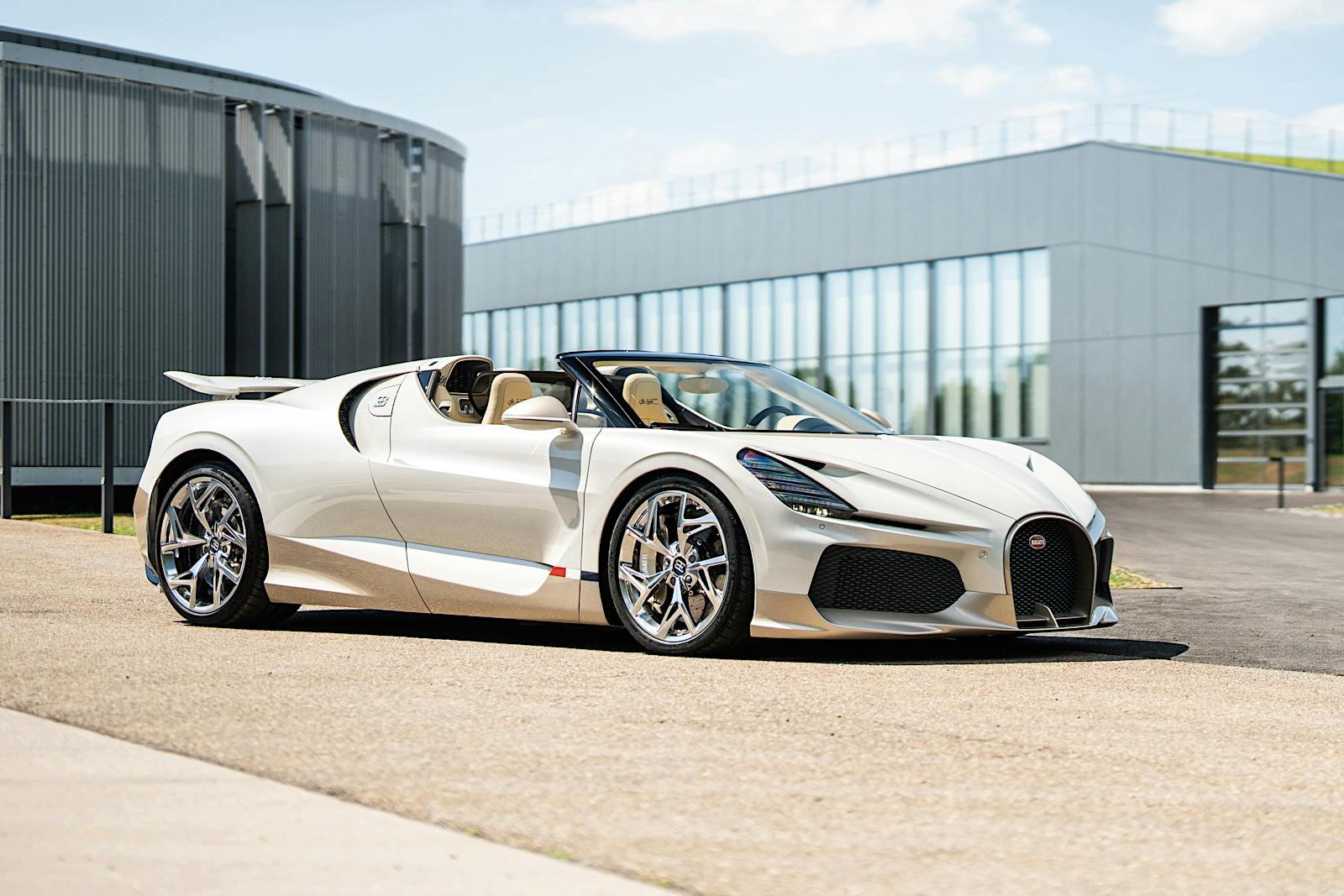
Bugatti has built the last W16 Mistral, and it feels like the right kind of theatrical ending.
Not subtle. Not sensible. Not apologetic.
The final car has left the Atelier in Molsheim in a two-tone Pearl and Sparkle finish, closing production of Bugatti’s open-top farewell to the W16 engine. Bugatti’s own framing is clear: the W16 Mistral is the road-going swansong for the quad-turbo 16-cylinder engine that turned the Veyron into an industry shockwave and kept the Chiron era operating in a different moral universe from normal cars.
GearPulse’s view: this is relevant because the W16 was never just a spec. It was a statement about what happens when a car company treats engineering difficulty as part of the product. As the Tourbillon era moves Bugatti toward a naturally aspirated V16 hybrid, the final Mistral makes the old age of brute-force combustion feel both absurd and weirdly precious.
What actually ended
Bugatti is not saying every possible W16-based special project has vanished from imagination. Carscoops correctly points out the world of ultra-exclusive commissions can be complicated. But series production of the W16 Mistral, the last road-going Bugatti model built around the W16, is done.
The Mistral was limited to 99 units. It used Bugatti’s 8.0-liter quad-turbo W16, officially rated at 1,600 PS, with an official top speed listed at 420 km/h for the model. In November 2024, Bugatti’s Andy Wallace drove the one-of-one W16 Mistral World Record Car to 453.91 km/h at ATP Automotive Testing Papenburg, which Bugatti says made it the fastest open-top production car in the world.
| Bugatti W16 Mistral detail | Official figure or context |
|---|---|
| Production run | 99 units |
| Engine | 8.0-liter quad-turbo W16 |
| Power | 1,600 PS |
| Official model top speed | 420 km/h |
| Open-top record run | 453.91 km/h in November 2024 |
| Assembly | Molsheim, France |
| Strategic successor era | Tourbillon production at La Manufacture |
The numbers are ridiculous in the best Bugatti way. But the more emotional detail is that the W16 Mistral was not a roof-cut Chiron. Bugatti dressed it as a finale, with design references to the Type 57 Roadster Grand Raid and a final-production specification that leans into elegance rather than track-day menace.
Why this goodbye lands
There is a temptation to mock every multimillion-euro hypercar as a toy for people who have run out of normal things to buy. Sometimes that is fair. The Mistral deserves a little more respect than that.
The W16 story mattered because it pulled the performance-car world upward. The Veyron made 1,000-horsepower road cars feel possible. The Chiron made absurd speed feel repeatable and polished. The Mistral made the final chapter open-top, bespoke and almost ceremonial.
That is different from the current wave of software-defined speed. EVs can deliver brutal acceleration with less drama. Hybrid hypercars can splice power sources together with enormous precision. Bugatti’s Tourbillon will have its own kind of theater, built around a naturally aspirated V16 and electrification. But the W16 represented another kind of ambition: solve the heat, packaging, transmission, tire, cooling and drivability problems until the impossible becomes a production car.
Recent GearPulse stories about the Hennessey Venom F5 LF manual and the Zenvo Aurora Tur touched the same nerve. Extreme cars are not interesting only because they are fast. They are interesting when they reveal what a brand believes driving should feel like when nobody is asking it to be rational.
The caveat: nostalgia can blur reality
The W16 deserves the send-off, but nostalgia should not make it cleaner than it was.
This was a heavy, thirsty, spectacularly complex engine in cars built for a tiny audience. Bugatti’s own fuel-consumption disclosures are a reminder that the old hypercar formula came with a cost. The Mistral’s combined WLTP figure is not something anyone buys for efficiency. The W16 era was glorious precisely because it was excessive, and excess looks different in 2026 than it did when the Veyron arrived.
That is why the Tourbillon pivot matters. Bugatti is not becoming modest. It is translating the same appetite for mechanical drama into a new powertrain era. A naturally aspirated V16 hybrid is not a surrender to restraint; it is Bugatti trying to keep theater alive without simply repeating the Chiron.
Bottom line
The final W16 Mistral works because it is honest about what it is: a beautiful, wildly expensive full stop.
It closes the road-going W16 chapter with speed, craftsmanship and just enough sentimentality to feel earned. In an industry increasingly defined by efficiency curves, software layers and battery chemistry, the Mistral is a reminder that some machines matter because they are gloriously difficult to justify.