
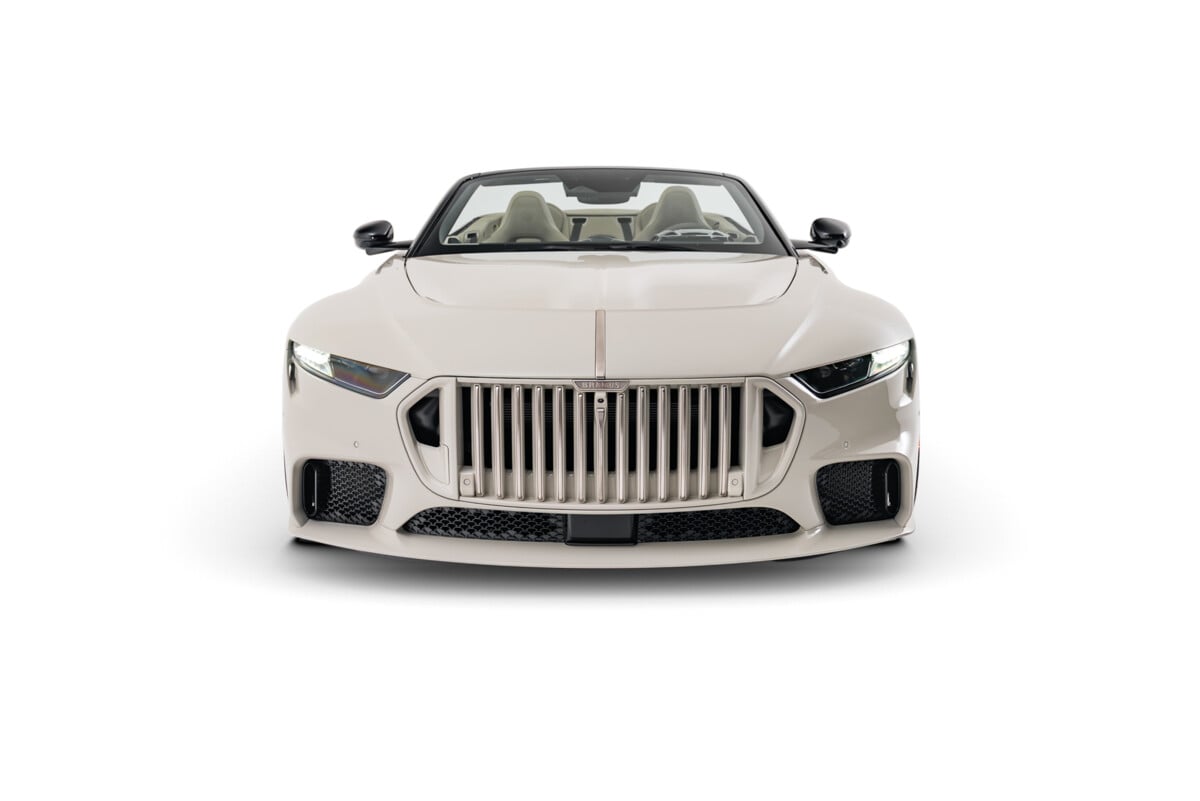
The Brabus Bodo Cabriolet is ridiculous in the way a million-dollar coachbuilt convertible should be ridiculous. It has a hand-built 5.2-liter twin-turbo V12, a carbon-fiber body, rear-wheel drive, 1,000 hp, a claimed 0-100 km/h time of 3.0 seconds and a 360 km/h top-speed limiter. It is limited to 77 cars, which is both a production number and a nod to 1977, the year Bodo Buschmann founded Brabus.
That would be enough for a normal supercar headline. The part that makes this one stick is the family angle.
Brabus frames the Bodo Cabriolet as the open-top counterpart to the Bodo Gran Turismo Coupe and a tribute from Constantin Buschmann to his father. Road & Track’s reveal coverage also leans into that origin, noting that the cabriolet arrived during Monterey Car Week as the drop-top evolution of the Bodo idea.
My take: the Bodo Cabriolet is relevant because the top end of the car world is no longer just chasing numbers. It is chasing provenance. At this price and rarity, buyers are not paying for speed alone. They are buying a story they can park.
The numbers are absurd, but not random
Brabus says the Bodo Cabriolet uses a hand-built 5.2-liter V12 biturbo engine producing 735 kW, or 1,000 hp, at 6,400 rpm, with 1,200 Nm of electronically limited torque. Power goes to the rear wheels through an eight-speed automatic and electronically controlled differential.
The official performance claims are suitably theatrical: 0-100 km/h in 3.0 seconds, 0-200 km/h in 8.5 seconds, 0-300 km/h in 23.9 seconds and a top speed limited to 360 km/h, or 224 mph on Brabus’s technical listing. Brabus also lists combined fuel consumption at 14.1 l/100 km and CO2 emissions of 321 g/km, with CO2 class G.
| Detail | Brabus Bodo Cabriolet |
|---|---|
| Engine | Hand-built 5.2-liter V12 biturbo |
| Power | 735 kW / 1,000 hp |
| Torque | 1,200 Nm / 885 lb-ft, electronically limited |
| Drivetrain | Rear-wheel drive, eight-speed automatic |
| 0-100 km/h | 3.0 seconds, claimed |
| 0-200 km/h | 8.5 seconds, claimed |
| Top speed | 360 km/h / 224 mph, electronically limited |
| Production | 77 Cabriolets, separate from the coupe run |
| WLTP CO2 | 321 g/km, CO2 class G |
Car and Driver adds useful context: the Bodo is based on Aston Martin Vanquish mechanicals but stretched into its own coachbuilt form, with bodywork nearly 199.3 inches long and 79.8 inches wide. Road & Track notes the convertible roof can open or close in less than 15 seconds.
The design is doing more than shouting
The easiest version of a Brabus article is “look at the horsepower.” The more interesting read is that the Bodo Cabriolet is Brabus trying to become a coachbuilder in the old-money sense, not just a tuner with a louder exhaust.
The body is carbon fiber. The Silk Stone version uses a two-tone black and gray Jacquard soft top with an inverted 77 motif woven into the fabric. The rear spoiler deploys in stages and can act as an air brake under heavy braking above 140 km/h. The rear lighting uses seven LED elements per side, another deliberate reference to the company’s founding year.
Inside, Brabus describes a Masterpiece cabin with color-matched leather, carbon trim, quilted surfaces and bespoke accessories including a Weekender bag. That is exactly the sort of detail wealthy buyers expect, but it also explains why this car cannot be judged like a normal performance coupe.
This is less about value and more about authorship.
The price is deliberately slippery
Brabus’s own sales listing says “price on request.” Road & Track and Car and Driver both report pricing starting around $1.24 million, while other coverage has cited European pricing in the seven-figure range before individual customization. Either way, this is not a car for rational comparison shopping.
That matters because ultra-limited cars often become spec-sheet objects online. People argue about horsepower per dollar as if anyone choosing between a Bodo Cabriolet and a conventional Aston Martin is solving a spreadsheet. They are not. They are buying scarcity, access, craftsmanship and a founder-legacy narrative that a normal configurator cannot provide.
The caveat is equally important: GearPulse has not seen or driven the car. Brabus’s performance figures are manufacturer claims, and Brabus’s technical listing itself notes that performance can vary with vehicle-specific equipment and conditions. Treat the numbers as official claims, not independent test results.
Who should care
| Reader | Why it is interesting |
|---|---|
| Supercar watchers | Brabus is pushing deeper into coachbuilt identity, not just power upgrades. |
| Aston Martin fans | The Vanquish base has been transformed into something far more extreme. |
| Design obsessives | The woven 77 roof detail and active aero show how personal this project is. |
| Collectors | A 77-car run gives the Cabriolet instant scarcity. |
| Normal humans | It is a useful reminder that car culture still has room for unreasonable dreams. |
Personally, I find the Bodo Cabriolet more compelling than another anonymous hypercar because it has a human hook. It is not subtle, efficient or sensible. It is a son building an outrageous open-top grand tourer around the memory of the father who made Brabus possible.
That does not make the car noble. It makes it memorable.
Bottom line
The Brabus Bodo Cabriolet is excessive by every normal measure, and that is the point. A 1,000 hp, 77-unit, carbon-bodied convertible with a seven-figure price tag is not trying to be useful transportation.
It is trying to turn power, grief, brand history and craftsmanship into a physical object. For the tiny audience that can buy one, that may matter more than another tenth of a second.
Support independent GearPulse articles at buymeacoffee.com/gearpulse.site.