
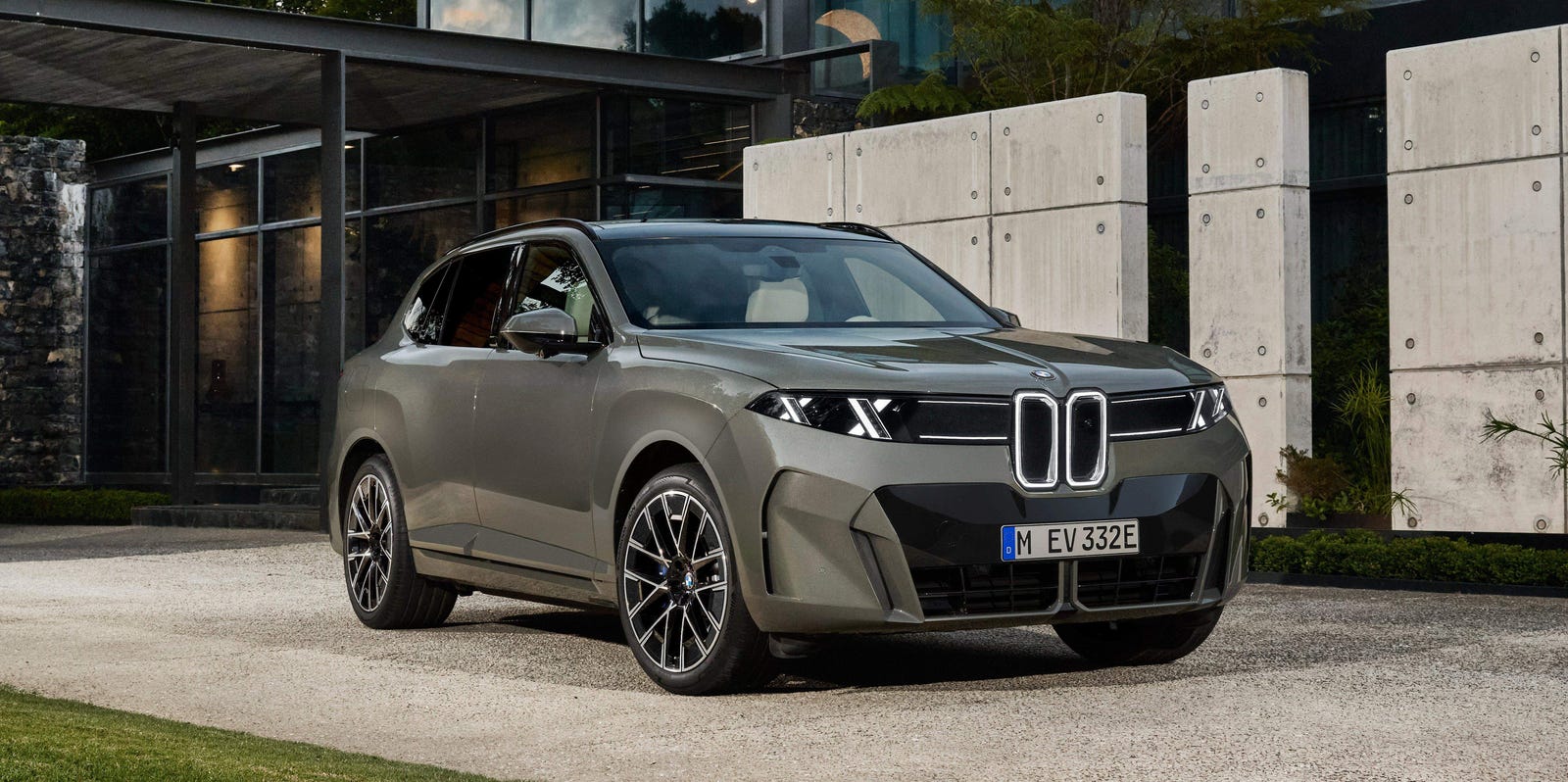
BMW did not just add a battery to the X5. It gave the electric X5 a very specific job: be the version normal luxury-SUV buyers can understand without needing to join an EV cult first.
That matters. The X5 is not a niche experiment in BMW’s lineup. It is one of the brand’s load-bearing products, built at Spartanburg, bought by families, executives, road-trippers, lease calculators and people who still expect a premium SUV to feel easy. If the 2027 BMW iX5 works, it makes the electric luxury SUV less of a statement and more of a default answer.
The numbers BMW has published are serious. The iX5 60 xDrive gets sixth-generation eDrive hardware, an 800V architecture, a standard NACS port, an estimated 435 miles of EPA-procedure range, up to 460 kW DC fast charging, a 10-to-80 percent charge target of 22 minutes, and bidirectional charging. It starts at $79,800 before the $1,450 destination charge.
The important word there is “estimated.” BMW says the range and charging claims are preliminary and based on BMW AG testing using EPA procedures. That is not the same as a final EPA certificate or an independent road-trip test. But it is still a very different kind of EV pitch from “look how strange our electric car is.”
The iX5 has the right kind of spec sheet
BMW’s official release says the new X5 family begins with gas, plug-in hybrid and electric variants, with hydrogen planned later. The X5 40 xDrive launches first in October 2026, while the rear-drive X5 40, X5 50e xDrive plug-in hybrid and iX5 60 xDrive follow in the first quarter of 2027.
That spread is the whole story. BMW is not forcing one drivetrain identity onto every buyer. It is using the X5 as a showroom fork: gasoline if you want familiar touring range, plug-in hybrid if your life is split between short electric trips and long weekends, battery-electric if you can use the charging speed and range, and eventually hydrogen for a different infrastructure bet.
| 2027 X5 version | BMW’s starting price | Useful angle |
|---|---|---|
| X5 40 | $69,800 | Rear-drive gas entry point, arriving after xDrive. |
| X5 40 xDrive | $72,100 | First launch model, with all-wheel drive and 48V mild hybrid tech. |
| X5 50e xDrive | $77,500 | Plug-in hybrid bridge for buyers not ready to go fully electric. |
| iX5 60 xDrive | $79,800 | First battery-electric X5, with Gen6 800V hardware. |
The iX5’s technical story is more interesting than the badge. BMW says the battery uses 46 mm diameter cylindrical cells, 120 mm tall, directly integrated in a cell-to-pack design. Net usable energy is listed at 144 kWh. Output is 570 hp and 593 lb-ft, split between a rear electrically excited synchronous motor and a front asynchronous motor. BMW estimates 0-60 mph in 4.4 seconds and a 130 mph limited top speed.
That is plenty quick, but speed is not the thing that makes the iX5 relevant. We already know electric SUVs can be quick. The iX5 is interesting because BMW is trying to make the boring parts excellent: charging, towing, route planning, cabin tech, app integration and bidirectional power.
Why the 435-mile claim matters
Luxury EV buyers do not all think like early adopters. Many do not want to study charging curves. They want to know whether a car can do school runs, airport runs, winter weekends, family luggage and a late-night diversion without making the driver manage the battery like a side job.
That is why 435 miles matters, if the final EPA result lands close. It gives BMW room for bad weather, bigger wheels, speed, heat, cold, roof boxes and imperfect chargers. It also gives BMW a cleaner answer to Mercedes EQE SUV, Audi Q8 e-tron replacement shoppers, Tesla Model X shoppers and the growing crowd of buyers who like EV smoothness but dislike EV compromise.
BMW USA adds a few practical details that are easy to miss: the iX5 is listed at 197.2 inches long, 78.7 inches wide and 68.9 inches tall, and BMW says maximum towing capacity is 6,000 lb. The official page also lists 570 hp, up to 435 miles of estimated range and a 22-minute 10-to-80 percent fast-charge target.
| iX5 60 xDrive item | BMW claim | Reader caveat |
|---|---|---|
| Range | Up to 435 miles estimated | Preliminary, not final EPA-certified range yet. |
| DC charging | Up to 460 kW | Real sessions depend on charger capability and battery temperature. |
| Fast-charge window | 10-80 percent in 22 minutes | BMW’s estimate assumes maximum charging rate conditions. |
| Quick range add | 170 miles in 10 minutes | Useful only when the charger and battery prep cooperate. |
| Towing | 6,000 lb maximum | Payload, trailer brakes and range loss still matter. |
| Power output | 570 hp, 593 lb-ft | Strong on paper; independent testing will matter. |
My read: this is the first electric BMW SUV spec that feels aimed at people who liked the X5 before EVs became a culture war. It is not asking them to love a new shape, a weird interior, or a science-project name. It says: here is the X5, now with a serious electric drivetrain.
The China story is not just a bigger back seat
The daily trend candidate came from the China long-wheelbase X5 and iX5 coverage, and that angle is useful because it shows how differently BMW has to sell the same family of vehicles around the world.
InsideEVs and Motor1 both picked up the China-focused long-wheelbase discussion, including rear-seat luxury features that matter more in chauffeur-heavy markets. BMWBlog previously noted BMW leadership had confirmed a next-generation China-specific X5 for 2027, with local advanced driver-assistance work tied to Momenta.
That does not mean U.S. buyers should wait for a giant rear-seat screen. It means BMW now has two overlapping X5 jobs: make the global iX5 a credible electric luxury SUV, and make the China version feel like a rear-cabin technology product. Those are not identical audiences.
This is where BMW can either look very smart or very scattered. A flexible X5 family can meet regional demand better than a one-size-fits-all EV. But too many variants can also blur the message. The electric X5 needs to stand on its own, not feel like one drivetrain tile inside a complicated configurator.
Connected GearPulse context
GearPulse has been circling the same problem from different brands. The electric BMW M3 badge story was about whether BMW can carry an emotional performance name into the EV era. The Range Rover GT piece looked at how luxury EVs need to become more interesting than quiet acceleration. The Porsche gas Macan endgame showed how hard it is to retire beloved combustion formulas.
The iX5 sits in the middle. It is not a sports badge, not a halo concept and not an entry-level EV. It is the practical heart of BMW luxury, and that makes it more revealing. If BMW can make the electric X5 feel normal, expensive and desirable at the same time, the brand’s EV transition gets a lot less abstract.
What I would watch before ordering
First, wait for final EPA certification. BMW’s estimate is promising, but official ratings and independent highway testing will tell buyers whether the iX5 is genuinely a 400-mile road-trip SUV or a spec-sheet hero on friendly assumptions.
Second, watch charging behavior at ordinary NACS stations. The 460 kW headline sounds fantastic, but the U.S. charging network is still a patchwork of power levels, reliability and stall layouts. The iX5 will be judged by boring sessions on busy travel days, not ideal lab conditions.
Third, compare the plug-in hybrid honestly. The X5 50e xDrive starts only $2,300 below the iX5 before destination. For a buyer with home charging and frequent long trips into poor DC-charging territory, the PHEV may be the calmer choice. For a buyer with reliable fast charging and a taste for quiet torque, the iX5 is finally compelling.
Bottom line
The BMW iX5 is relevant because it does not sound like an EV side quest anymore.
It has the range estimate, charging claim, towing number, price position and X5 familiarity to make electric luxury feel practical. The caveat is simple: BMW has published strong official numbers, but the real verdict waits for EPA certification, independent charging tests and normal owners using it outside launch photography. If those hold up, the iX5 may be the electric BMW SUV that finally stops explaining itself.