
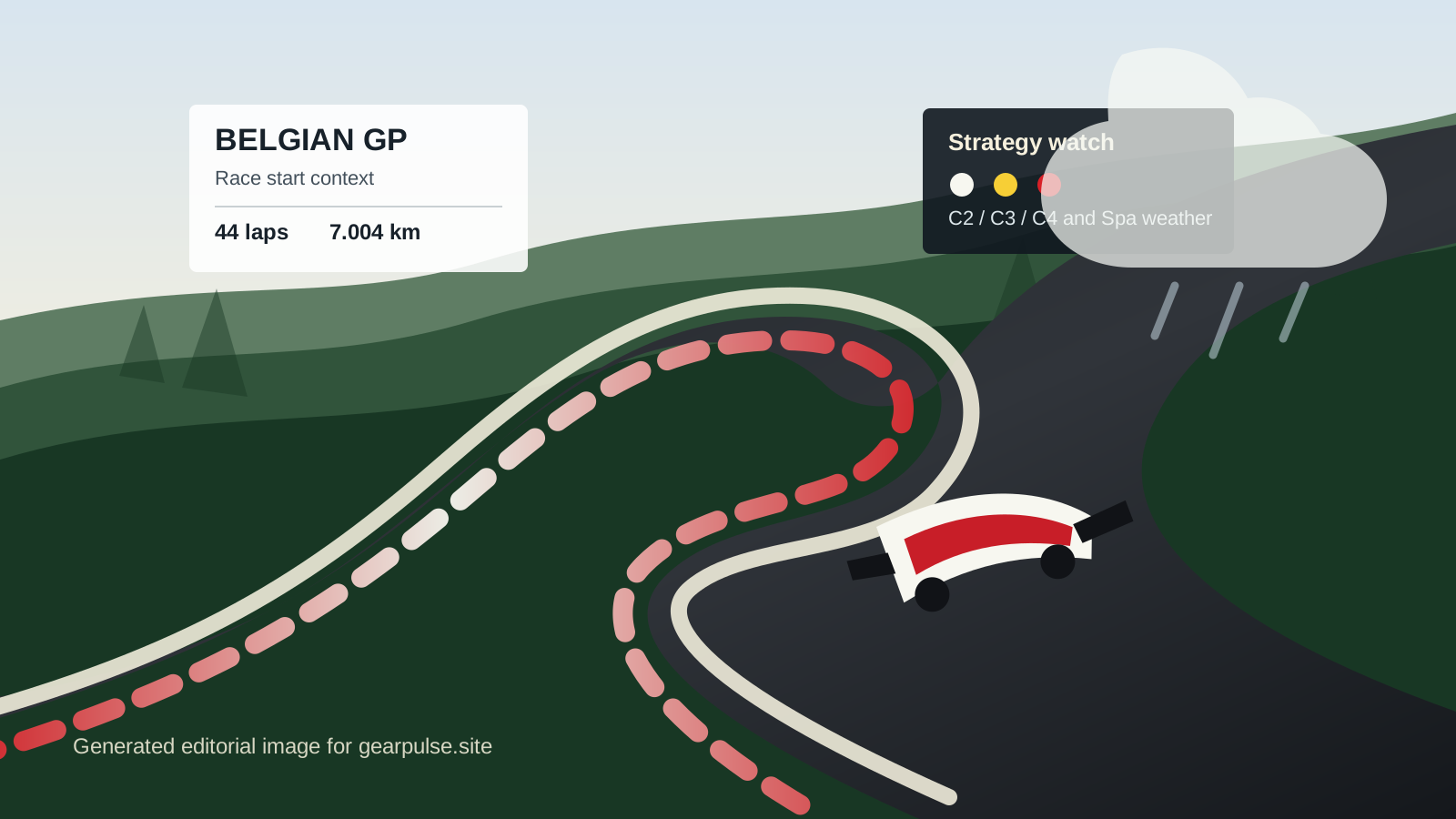
Belgian Grand Prix Race starts at 13:00 UTC on Sunday, July 19, which is 15:00 local time at Spa-Francorchamps. Formula 1’s official race page lists the same race window, and the event facts make the scale clear: 44 laps of a 7.004 km circuit, for 308.054 km through the Ardennes.
This is a preview, not a results article. GearPulse is not trackside, has no live telemetry and is not using live timing. It also does not publish the qualifying result, starting grid, pole position, sprint result, race result, podium, fastest lap, classification-revealing penalty or championship change.
That restraint is especially important at Spa. The race can be shaped by the run to Les Combes, the tyre choice after the first stint, energy deployment up the Kemmel Straight and one cloud bank arriving five minutes earlier than expected. The clean pre-race question is not who starts where. It is which team has built a car and strategy robust enough for F1’s longest lap.
Why Spa is a race puzzle
Spa-Francorchamps is not only long. It is uneven in character. Formula 1’s race hub notes the circuit’s 7.004 km length, 19 corners and 44-lap race distance, while Pirelli describes three sectors that ask different things from the same car: a fast first sector, a technical middle sector and a flowing uphill final sector.
The result is a race full of compromises. Too much wing protects the tyres and gives drivers confidence through Pouhon, Fagnes and Blanchimont, but it can leave a car exposed on the long straights. Too little wing helps in attack or defence, but it can make the middle sector expensive and overwork the tyres.
| Race variable | Spa consequence |
|---|---|
| Downforce level | Sector two wants grip; sectors one and three punish drag. |
| Energy deployment | The 2026 cars make recharge discipline and straight-line modes part of race craft. |
| Tyre warm-up | Cooler air and long laps can make the out-lap and first timed sector decisive. |
| Pit timing | A stop costs less in track-position terms if the new tyre finds clear air quickly. |
| Weather drift | Spa can remain dry overall while individual sectors feel different. |
The fun fact still matters: Formula 1 says the original Spa road circuit was about 14.9 km, built around the Francorchamps, Malmedy and Stavelot triangle. The modern layout is less than half that, but it is still the longest lap on the F1 calendar.
Tyres and weather set the ceiling
Formula 1 and Pirelli list C2 as the hard, C3 as the medium and C4 as the soft for Belgium. If the race stays dry, every driver must use at least two slick compounds, so the key decision is whether teams trust the medium-hard route, want to attack earlier with the soft, or need flexibility if the first stint gets messy.
Pirelli’s preview adds two useful caveats. First, Spa is among the most demanding circuits for tyre loads, even if it does not quite reach Suzuka or Silverstone levels. Second, the resurfaced track can begin with relatively low grip before rubber from recent running improves it. That makes degradation data more fragile than it looks, because a stint run on Friday may not perfectly describe race-day asphalt.
Weather should be more stable than the circuit’s reputation suggests, but not irrelevant. Formula 1’s Sunday forecast puts the high at 19C, the rain chance at 10% and track temperature potentially only in the low 30s Celsius. Sky Sports also notes that race day is expected to stay dry with temperatures in the high teens, while still warning that the Ardennes can hold moisture and create surprises.
The likely strategic bias is therefore dry-race management rather than wet-race chaos. But at Spa, a “dry” race can still punish the team that forgets about wind, cooler track temperature or a damp patch left in the shade.
Mercedes, Ferrari, McLaren and Red Bull
Mercedes carries the strongest season baseline into the race. Formula 1’s driver standings list Kimi Antonelli on 179 points and George Russell on 154, with the team standings putting Mercedes on 333 points. The Guardian’s Spa feature frames that as a narrowing intra-team title fight after Antonelli’s earlier run of wins and Russell’s recent gains. The race comparison is direct: Antonelli has the stronger championship lead, Russell has the better opportunity to keep turning pressure into points.
Ferrari is the closest constructor-level threat. Formula 1’s standings put Lewis Hamilton third on 147 points and Charles Leclerc fourth on 108, while Ferrari sits second in the teams’ table. Spa asks whether that recent Ferrari momentum is efficient enough on a circuit where straight-line speed and high-speed stability both matter. Hamilton’s season has made him the more consistent points force; Leclerc remains the sharper single-lap and clean-air volatility card.
McLaren is the efficiency case. Lando Norris and Oscar Piastri sit fifth and sixth in the official standings, and Spa gives a strong car chances to pass if it can use the long straights without burning the tyres in the middle sector. The caveat is that McLaren’s weekend context has included reliability and penalty management, so Oscar Piastri may be the cleaner race read while Norris remains a recovery and pace reference.
Red Bull is harder to price. Max Verstappen is seventh in the official standings, well below the championship lead, but Spa is one of the tracks where commitment, braking confidence and straight-line efficiency can lift a driver beyond the tidy model. Isack Hadjar gives Red Bull a second car for strategy pressure, yet Verstappen is still the reason rivals cannot treat Red Bull as midfield.
Editorial probability board
These are non-betting GearPulse editorial ranges for likely Belgian GP race standouts at lights-out. They are not odds, advice or a claim about the actual result. They deliberately avoid using or revealing the starting grid.
| Race standout candidate | Editorial probability | Pre-race case |
|---|---|---|
| Mercedes driver | 24-34% | Best season baseline, two title-relevant drivers and strong constructor form. |
| Ferrari driver | 18-28% | Closest team challenger, Hamilton-Leclerc points pressure and improving race-day threat. |
| McLaren driver | 14-24% | Efficient car traits should help at Spa, though penalty and reliability context complicates the route. |
| Max Verstappen | 13-23% | Lower season baseline than usual, but Spa rewards commitment and opportunistic race craft. |
| Strategy-led surprise | 8-15% | Safety-car timing, tyre offset, traffic and weather can move a long-lap race quickly. |
| Midfield points swing | 6-12% | Alpine, Racing Bulls and Haas have enough points context to make clean execution valuable. |
The caveat is that Spa can turn probability upside down without needing a wild forecast. A car that looks merely solid can become dangerous with a tyre offset. A faster car can lose the race by committing too early to the wrong compound. A team with clean air can make the same lap time look calmer than it really is.
What to watch
Watch the first stint for tyre honesty. If the C3 medium holds on a cool track, teams can keep the race under control. If it grains, overheats or refuses to switch on, the second stint becomes a much bigger question.
Watch the Kemmel Straight against sector two. The fastest race car may not be the one with the best straight-line number. It may be the one that can stay close through the loaded corners without paying too much drag tax in attack or defence.
Watch Mercedes versus Ferrari as a championship comparison, not just a podium comparison. Mercedes has the points lead, Ferrari has enough score pressure to make every swing meaningful, and Spa’s layout can expose both engine deployment and tyre management.
Watch McLaren and Red Bull for different reasons. McLaren needs efficiency plus patience. Red Bull needs Verstappen to keep the ceiling high without asking the tyres to cover a setup weakness.
And watch the weather without over-selling it. The official forecast is mostly favourable, but Formula 1 and Pirelli both emphasize Spa’s microclimate. The risk is not necessarily a wet race. It is the timing of cloud, wind, track temperature and any moisture left in the wrong place.
Bottom line
The Belgian GP race start is a strategy stress test. The official facts are fixed: 13:00 UTC start, 15:00 local time, 44 laps, 7.004 km, C2-C3-C4 tyres and a low rain risk. Everything else is a contest between pace, tyre life, energy deployment and nerve.
Mercedes starts with the best championship platform. Ferrari is close enough to turn pressure into damage. McLaren has the efficiency profile for Spa if the weekend complications are contained. Verstappen keeps Red Bull in the conversation on driver ceiling alone.
Spa rarely rewards a one-note car. It rewards the team that can be quick, efficient and adaptable for two hours without pretending the Ardennes is predictable.