
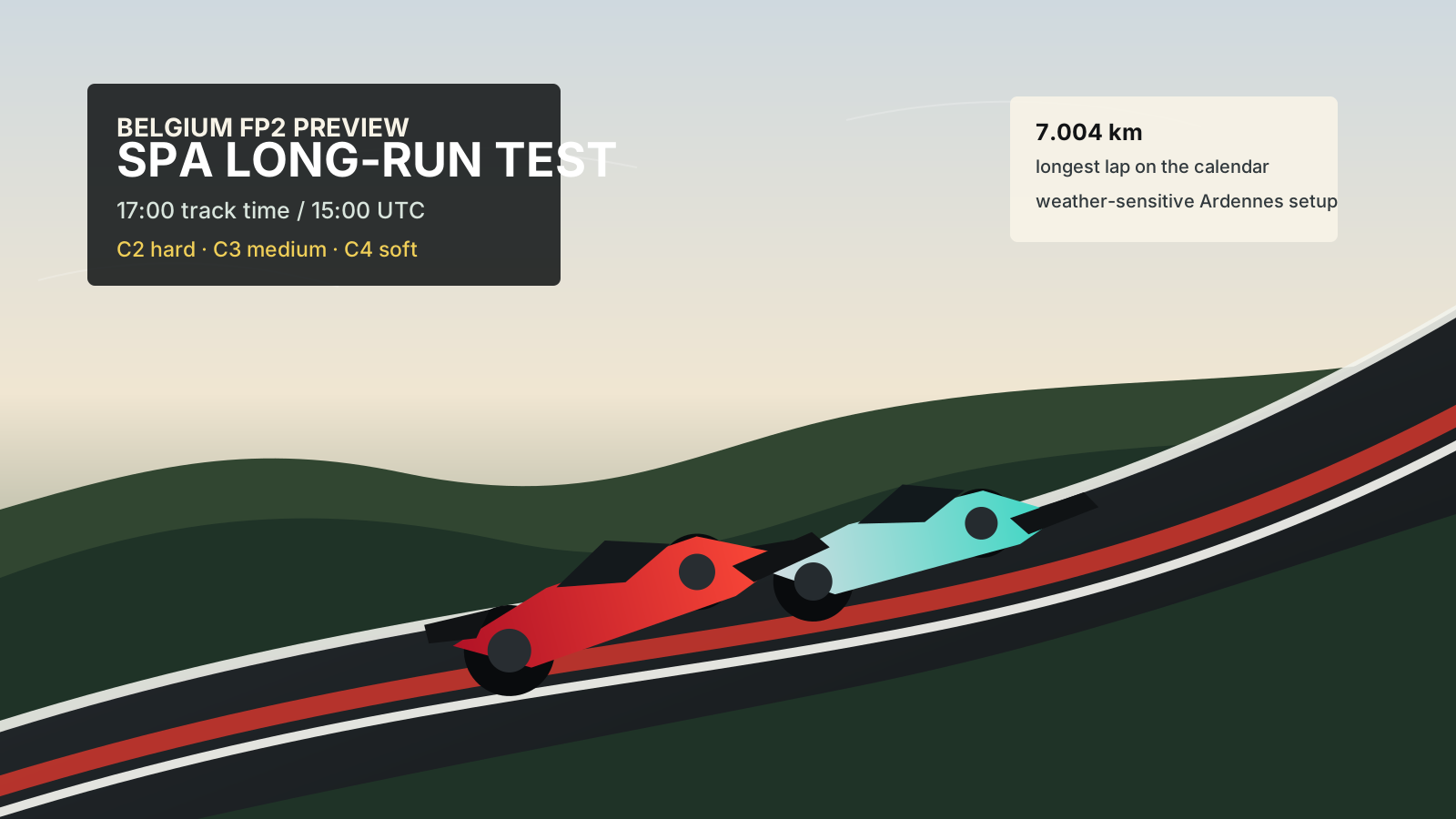
Belgian Grand Prix Practice 2 starts at 15:00 UTC on Friday, July 17, which is 17:00 local time at Spa-Francorchamps. Formula 1’s official race page lists the same session window, and the track facts explain why this hour matters: Spa is 7.004 km long, has 19 corners, and turns Sunday’s grand prix into 44 laps over 308.054 km.
This is a preview, not a results article. GearPulse is not trackside, has no live telemetry and is not using live timing. It also does not publish the Practice 1 order, Practice 2 result, qualifying result, grid, pole position, sprint or race result, podium, fastest lap, classification-revealing penalty or championship change.
That restraint is useful at Spa because FP2 can look more important than it really is. It is the first session where the Friday picture starts to harden, but fuel loads, engine deployment choices and tyre age can still distort the timing screen. The better question is not who wins Friday. It is which team leaves the garage with believable long-run data before Saturday compresses the weekend into FP3 and qualifying.
Why FP2 carries more weight here
Spa’s lap length makes every experiment expensive. A small balance change takes longer to test than it would at a shorter circuit, traffic can ruin a representative lap for more than two minutes, and a driver who spends too much electrical energy early in the lap can be exposed before the finish line.
That makes Practice 2 the most valuable Friday hour. Teams can compare short-run setup against heavier-fuel work, check whether the car is stable through the middle sector, and decide how much downforce they can afford before the Kemmel Straight and final sector punish drag.
| FP2 checkpoint | Why it matters at Spa |
|---|---|
| Long-run tyre drop | The 7.004 km lap turns small degradation into large stint-time swings. |
| Energy deployment | The 2026 power units make battery use and recharge discipline a visible performance variable. |
| Downforce compromise | Sector two wants confidence; sectors one and three punish excess drag. |
| Weather reaction | Formula 1’s weekend forecast gives Friday a 40% rain chance, so teams need dry data without ignoring shower risk. |
| Driver trust | Eau Rouge, Raidillon, Pouhon and Blanchimont expose cars that are fast only when the driver is managing around them. |
The fun fact is that Spa is still living off its old road-circuit personality. Formula 1 says the original triangle between Francorchamps, Malmedy and Stavelot was about 14.9 km. The modern circuit is much shorter, but it remains the longest lap on the current F1 calendar.
Tyres and weather are the real story
Pirelli’s allocation is the middle range: C2 hard, C3 medium and C4 soft. Formula 1’s tyre guide lists the standard weekend supply as two hard sets, three mediums and eight softs, plus intermediates and full wets if needed.
FP2 should therefore split into two useful questions. First, does the C4 soft give a clean single-lap read, or does it overheat before the lap is complete? Second, can the C3 medium hold together well enough to become the main reference tyre for race simulation?
Pirelli’s preview adds the caveat that Spa’s resurfaced track can begin a weekend with relatively low grip, even if recent GT racing may have left useful rubber behind. The same preview highlights the three-sector setup puzzle: a fast first sector, a more technical middle sector and a flowing uphill final sector. Formula 1’s weather guide makes the tyre problem less tidy, with Friday carrying mild temperatures, possible showers and track temperatures that can still rise into the mid-40s Celsius between bursts of cloud or rain.
So the most valuable FP2 car may not be the one that looks dramatic on the soft tyre. It may be the one that turns medium-tyre laps into repeatable data while staying calm when the track temperature moves.
Mercedes, Ferrari, McLaren and Red Bull
Mercedes starts FP2 with the strongest championship baseline but not a comfortable one. Formula 1’s Thursday paddock story says Kimi Antonelli’s lead over George Russell is down to 25 points, while the team has also had to talk openly about reliability. That creates a direct Mercedes comparison: Antonelli needs clean, controlled data after lost points, while Russell needs the car to keep rewarding his recent pressure.
Ferrari’s case is momentum versus proof. Formula 1 reported Lewis Hamilton entering Spa 32 points behind Antonelli and seven behind Russell, with Ferrari’s recent run putting pressure on Mercedes. Charles Leclerc gives Ferrari another high-upside benchmark. FP2 should show whether that form travels to a track where straight-line efficiency and high-speed confidence both matter.
McLaren has the most awkward split. Oscar Piastri can be judged on pure pace and balance. Lando Norris has to evaluate recovery potential because McLaren’s power-unit component change means a 10-place grid penalty later in the weekend, a point also covered by The Guardian. Spa is one of the better places to absorb that kind of hit, but FP2 still needs to prove the car has enough efficiency to overtake rather than just qualify well.
Red Bull remains the volatility pick. Max Verstappen’s Spa record and high-speed commitment make him hard to dismiss, while Isack Hadjar’s role gives Red Bull a second read on whether the car is genuinely settled or simply sharp in one driver’s hands. If the car is nervous through the loaded sections, FP2 will make that visible before Saturday.
Editorial probability board
These are non-betting GearPulse editorial ranges for likely FP2 standouts at session start. They are not odds, advice or a claim about the actual session result.
| FP2 standout candidate | Editorial probability | Pre-session case |
|---|---|---|
| Mercedes | 25-35% | Best season baseline, two strong drivers and a need to convert pace into cleaner weekends. |
| Ferrari | 23-33% | Recent momentum, Hamilton-Leclerc pressure on Mercedes and a car that could suit Spa if drag is controlled. |
| McLaren | 16-25% | Efficient traits should matter, but Norris’s penalty makes Piastri the cleaner form read. |
| Red Bull | 13-23% | Verstappen keeps the ceiling high, though car-trust and platform questions widen the range. |
| Midfield surprise | 7-13% | Weather, tyre preparation, tow and run-plan differences can flatter a car over one Spa lap. |
The caveat is simple: FP2 probability is about session visibility, not Sunday certainty. Long runs can be hidden by fuel load. Soft-tyre laps can be helped by timing. And at Spa, one sector can make a car look better or worse than the full stint reality.
What to watch in the hour
Watch the second and third timed laps on a tyre, not only the first. A car that lights up the C4 quickly but loses the rear before the lap is complete may be less useful than one that is slower at first and steadier later.
Watch the battery story. If a driver is quick early but weak after the middle sector, the lap may be too expensive. Spa rewards cars that spend energy in the right places rather than everywhere.
Watch the steering through Pouhon and Blanchimont. Drivers can hide a lot on a straight; they cannot hide a car that needs constant correction in the high-speed loaded corners.
And watch how teams react to clouds. Motorsport.com’s Friday guide expects warm, mostly cloudy conditions and says rain is not the main Friday issue, while Formula 1’s own forecast keeps a stronger shower risk on the table. That difference is exactly why Spa is tricky: the best plan has to survive both dry data gathering and sudden weather interruption.
Bottom line
Practice 2 is Belgium’s first proper long-run audit. The official schedule, tyre allocation and circuit facts are clear; the competitive order is not.
Mercedes has the title baseline, Ferrari has the chase momentum, McLaren has efficiency plus a Norris complication, and Red Bull has the highest-variance question. FP2 will not crown a Belgian GP favorite. It should tell us which teams have a setup they can trust when Spa stops being a postcard and starts being a seven-kilometre engineering exam.