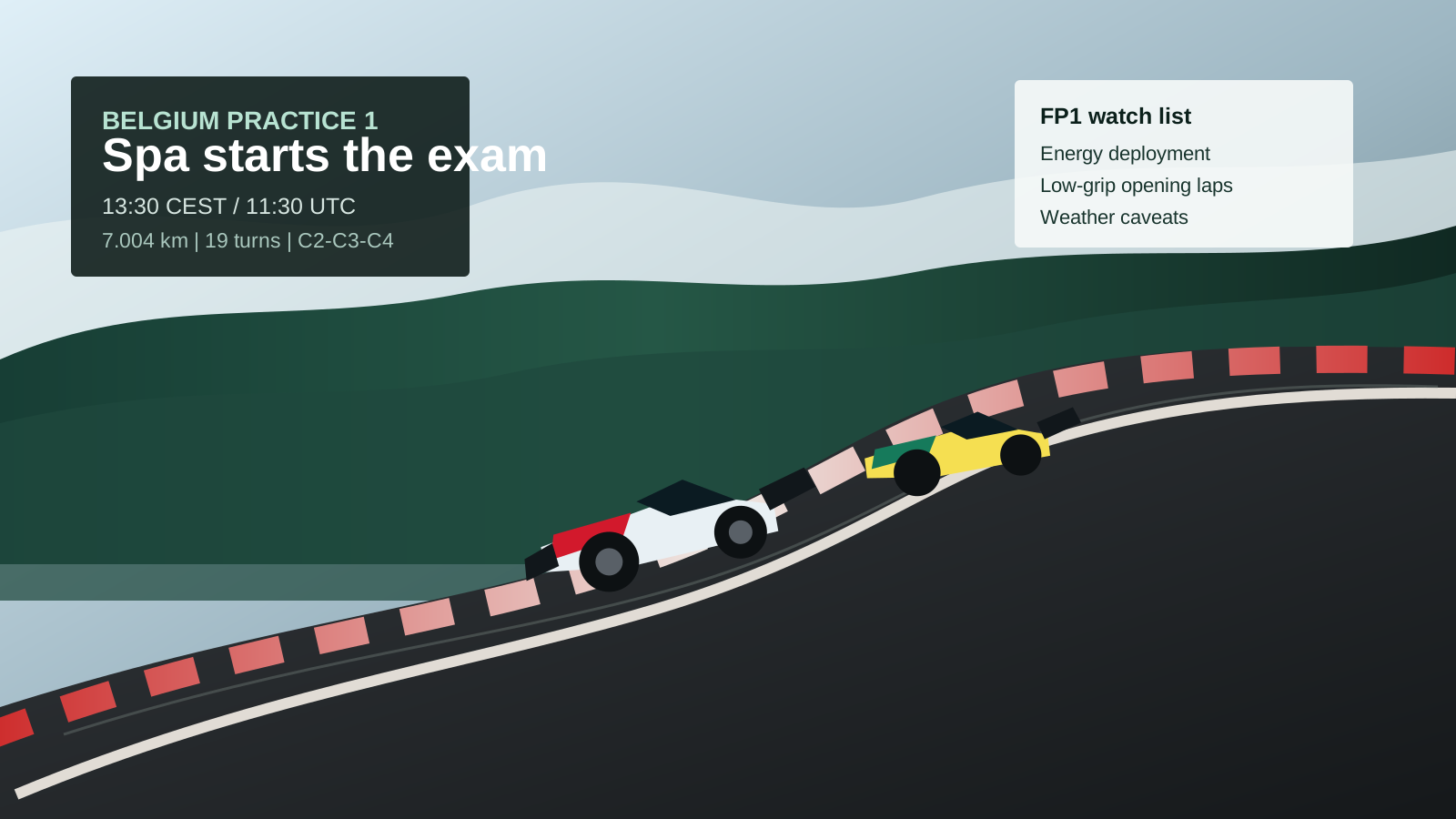
Belgian Grand Prix Practice 1 starts at 11:30 UTC on Friday, July 17, which is 13:30 local time at Spa-Francorchamps. Formula 1’s official race hub lists the same session window and gives the weekend its core track numbers: 7.004 km, 19 turns, 44 race laps and a 308 km grand prix distance.
This is a preview, not a results article. GearPulse is not trackside, has no live telemetry and is not using live timing. It also does not reveal any Practice 1 order, Practice 2 order, qualifying result, grid, pole position, race result, podium, fastest lap, classification-revealing penalty or championship change.
That matters because FP1 at Spa can produce misleading headlines. The first hour is less about crowning a favorite than finding out which cars can breathe on the longest lap of the season, which drivers trust the 2026 aero package through compression and elevation, and which teams have a usable tyre model before the weekend becomes more serious.
Why the first hour matters
Spa-Francorchamps is a setup compromise in plain sight. Formula 1’s circuit guide points to a lap that rewards straight-line efficiency in the first and final sectors while demanding confidence through the more technical, flowing middle sector. Pirelli frames it the same way: three sectors with very different personalities, low early-weekend grip after resurfacing, and an Ardennes microclimate that can leave one part of the circuit wetter than another.
For Practice 1, that makes the checklist more important than the headline time.
| FP1 variable | Why it matters at Spa |
|---|---|
| Energy deployment | The 7.004 km lap gives drivers more time to run short on electrical help if they spend too much early. |
| Tyre warm-up | Pirelli expects relatively low grip early in the weekend, so the first runs may flatter cars that switch tyres on quickly. |
| Downforce compromise | Teams need enough platform for sector two without giving away the Kemmel Straight and final-sector attack. |
| Weather sensitivity | Motorsport.com expects Friday to be warm and mostly cloudy, but Spa’s local weather still deserves caution. |
| Driver confidence | Eau Rouge, Raidillon, Pouhon and Blanchimont ask whether the car gives a driver trust, not just peak speed. |
The track’s fun fact is also its sporting point. The original Spa road circuit was roughly 14.9 km, using public roads between Francorchamps, Malmedy and Stavelot. The modern version is much shorter, but it remains the longest lap on the current F1 calendar. That length makes every deployment, tyre-temperature and traffic mistake linger.
Tyres are not just a Sunday problem
Formula 1 and Pirelli confirmed the middle slick range for Belgium: C2 hard, C3 medium and C4 soft. The standard allocation is two hard sets, three mediums and eight softs, with intermediates and full wets available if required.
For FP1, the question is not simply which compound is fastest. Teams need to learn whether the soft gives a clean qualifying-style read, whether the medium is stable enough to anchor long-run work, and how quickly either tyre comes alive on a circuit that can be cooler, greener or damper than the model expected.
Pirelli’s own Belgian preview adds two caveats. First, Spa is among the highest tyre-load circuits even if it is not quite at Suzuka or Silverstone levels. Second, recent 24 Hours of Spa running saw track temperatures exceed 55C, which raises the risk that thermal degradation becomes more influential if heat returns. Formula 1’s tyre guide makes the weather angle sharper: rain can leave mixed grip across the lap, turning slick-versus-intermediate calls into a judgement test rather than a simple forecast read.
Practice therefore has a practical target. The best FP1 is not necessarily the one with a purple final lap. It is the one that gives engineers a trustworthy map of how C3 and C4 behave when fuel, battery use and traffic change.
Mercedes, Ferrari and the title picture
The front of the field arrives with a tighter championship shape than it had a month ago. Formula 1’s race-week preview says Kimi Antonelli’s lead over George Russell has fallen to 25 points, while Lewis Hamilton is close enough that Ferrari cannot be treated as a distant third storyline. Sky Sports makes the same broad point: Mercedes still has the lead, but the pressure has increased after the British GP.
That gives FP1 three different front-pack reads.
Mercedes needs operational calm. Antonelli and Russell do not have to dominate the opening hour, but they do need a car that looks predictable across the whole lap. If the Mercedes is strong only where energy deployment is easy, Spa will expose it later.
Ferrari needs repeatability. Charles Leclerc and Hamilton both have enough upside to be credible Spa threats, but the useful Friday sign is whether Ferrari can keep the car stable through the middle sector without paying too much on the straights. A car that looks balanced on both tyre compounds would make the Mercedes fight feel more durable.
McLaren needs a cleaner weekend narrative. Lando Norris is already carrying a 10-place grid penalty for new Mercedes power unit components, a call McLaren and multiple outlets have framed around reliability management and Spa’s recovery potential. Oscar Piastri gives McLaren the cleaner benchmark. If the car looks efficient early, McLaren can still shape the weekend even before Norris’s penalty complicates Sunday.
Red Bull is the wider-range case. Max Verstappen at Spa is always a serious variable, but recent Red Bull context has been about car trust and rear-platform confidence. FP1 will not answer the future-talk noise. It can answer whether the car looks calm enough through the high-speed loaded sections to be a proper weekend threat.
Editorial probability board
These are non-betting GearPulse editorial ranges for likely Practice 1 standouts at session start. They are not odds, advice or a claim about the actual session result.
| FP1 standout candidate | Editorial probability | Pre-session case |
|---|---|---|
| Mercedes | 26-36% | Best season baseline, two-driver pressure and a title lead that still makes it the default benchmark. |
| Ferrari | 22-32% | Recent momentum and strong driver ceiling, with Spa likely to reveal whether the progress travels. |
| McLaren | 16-26% | Efficient car traits should matter, but Norris’s wider weekend is complicated by the confirmed penalty. |
| Red Bull | 12-22% | Verstappen keeps the upside alive, while car-trust questions make the range broader. |
| Midfield surprise | 8-14% | Low grip, traffic, weather variation and practice programs can put an outsider near the top of FP1. |
The caveat is important: FP1 probability is not race probability. Fuel loads, run plans and sensor work can distort the order. A team can look quiet in FP1 and still be dangerous once the weekend narrows.
What to watch instead of the fastest lap
Watch who repeats a clean second lap. At Spa, one good launch lap can come from tyre preparation, tow or timing. Repetition says more.
Watch the exits from La Source and the climb to Raidillon. A car that deploys hard early but fades before the end of the lap may look exciting without being efficient. A car that is disciplined early and strong late may be closer to the real weekend answer.
Watch the middle sector body language. Pouhon and the fast direction changes tell you whether drivers trust the car. If they are adding steering correction or lifting in places where rivals are settled, the stopwatch may not show the full problem yet.
And watch the weather restraint. Motorsport.com’s Friday guide says rain is not expected to be the main issue for the opening day, while Sky still flags Spa’s habit of making forecasts fragile. The smart teams will bank dry data without assuming the whole weekend stays dry.
Bottom line
Spa FP1 is the first public test of Belgium’s real 2026 question: which team can make this rules generation feel efficient, predictable and durable across the longest lap of the year?
The session starts with official timing clarity, a middle-range tyre allocation and a title fight that has tightened enough to make every clean run matter. The fastest FP1 lap will get attention. The more useful signal will be which car looks least surprised by Spa.