
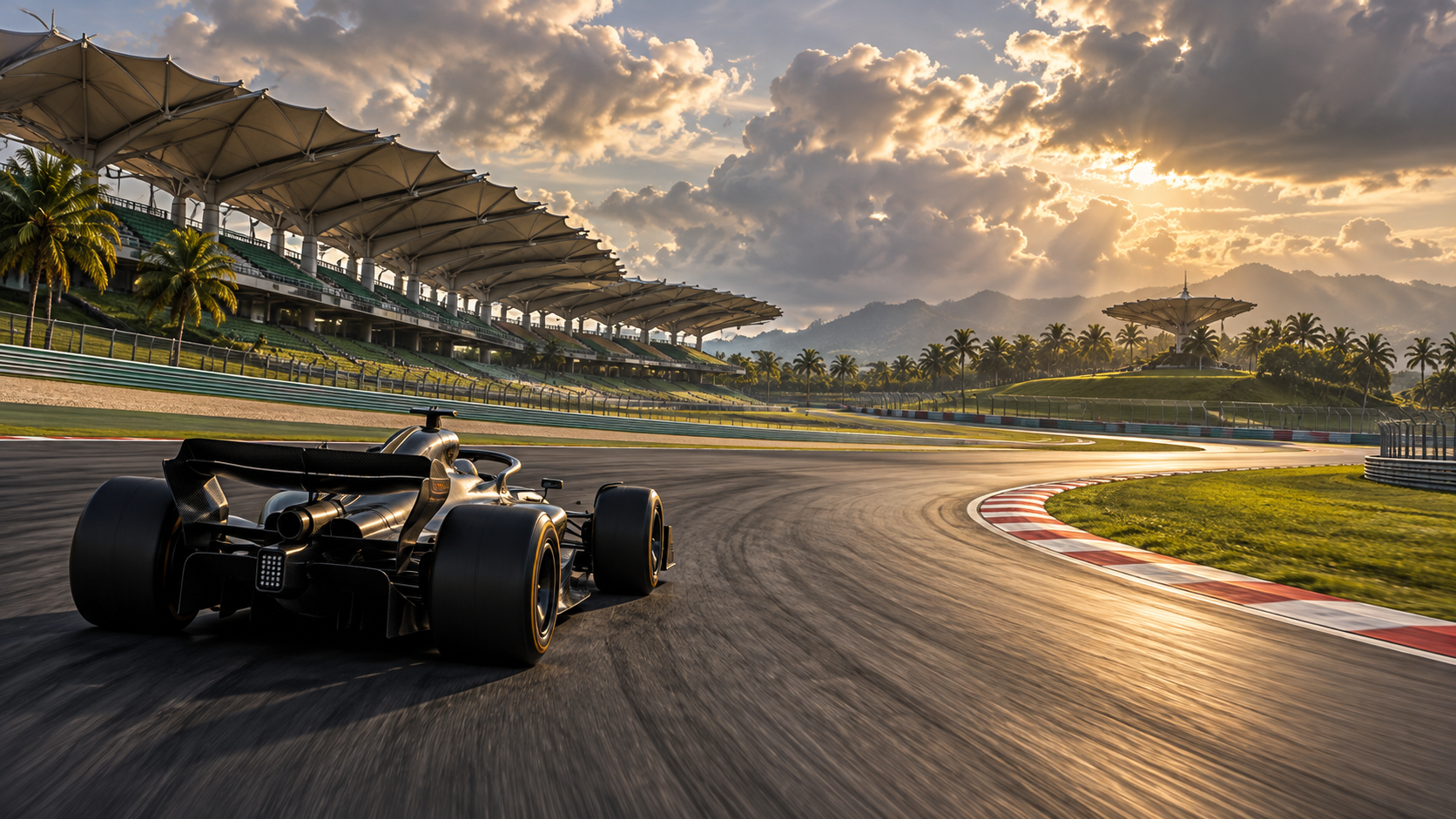
The Formula 1 Gulf Air Bahrain Grand Prix in Malaysia starts at 07:00 UTC on Sunday, October 4 — 15:00 local time in Kuala Lumpur. The official timetable sets the race at 56 laps or 120 minutes at the 5.543km Sepang International Circuit.
This is a start-of-race preview, not a live report. GearPulse is not trackside and does not have live timing or telemetry access. It does not reveal or imply any earlier-session result, starting order, pole sitter, race result, fastest lap, penalty, podium or championship outcome.
The unusual name is deliberate: Bahrain remains the nominal Grand Prix host while the event is staged at Sepang in Malaysia. Motorsport.com’s pre-race explanation and Formula 1’s circuit guide both describe it as F1’s first visit to the 15-turn circuit since 2017. That nine-year break matters more than nostalgia. The surface, the weather and the 2026 cars combine to make the afternoon an exercise in adapting rather than retrieving a familiar baseline.
A long race built from conflicting demands
Sepang’s 56 laps cover 310.398km. Its fast middle section asks for a settled, loaded car; long acceleration phases and heavy braking points ask for straight-line efficiency and dependable stopping performance. Formula 1’s circuit guide highlights the fast Turns 5 and 6, then the difficult braking approaches to Turns 11 and 14. A car that turns well there but is unsettled on traction will pay for it over a full distance.
| Race variable | Why it matters at Sepang |
|---|---|
| Tyre temperature | Heat, humidity and repeated traction loads can turn a small slide into a longer stint-management problem. |
| Aerodynamic balance | Fast direction changes need a stable platform, while the long runs still reward low drag. |
| Energy deployment | The new electrical and active-aero tools make exit quality relevant at more than one part of the lap. |
| Weather timing | A warm, humid forecast with a chance of showers makes flexibility more useful than a narrowly optimised plan. |
The key comparison is not simply which car looks quickest on a fresh tyre. It is which package can protect the rear tyres out of slow corners without giving away too much confidence through the faster sequence. That is a much more useful measure for a GearPulse reader: hardware performance is the result of the whole system — cooling, aero state, traction and energy use — working together repeatedly, not a single peak figure.
There are no DRS zones to count in 2026
Calling Sepang a two-DRS-zone circuit would use an old map for a new ruleset. Formula 1’s 2026 circuit guide says Straight Mode replaces the former DRS-style setup with active front- and rear-wing operation in dry conditions. Sepang has four designated Straight Mode zones: the start-finish straight, Turns 3–4, Turns 8–9 and Turns 14–15.
Overtake Mode is separate. It is an electrical-energy tool, with detection at the exit of Turn 15 and activation at the start of the pit straight when the following driver meets the prescribed gap. That distinction is important because it turns the final corner into a systems problem: a clean exit preserves both acceleration and the chance to convert a close run into an attack on the next lap.
The track therefore offers more than one way to gain time, but none is free. Less drag improves acceleration, yet the car still needs a predictable balance when the wings return to their cornering configuration. The best race setup should be the one that lets the driver use those transitions without overworking the tyres or sacrificing braking references.
Strategy starts with the C2, C3 and C4 range
Formula 1 and Pirelli have selected C2 hard, C3 medium and C4 soft compounds. In a dry race, drivers must use at least two slick compounds. Pirelli places Sepang in a medium tyre-energy range comparable to Spa-Francorchamps and Shanghai, while warning that ambient and track temperatures make thermal degradation a central variable.
That makes a simple one-stop plan tempting but conditional. It relies on controlled tyre temperatures, clean air at the right time and a car that does not slide its rear tyres when the driver asks for early power. A two-stop can become attractive if a team cannot keep the surface temperature in range, if traffic turns a long stint into wasted time, or if a weather interruption changes the grip picture.
There is another reason to distrust overconfident models: Pirelli says teams have no truly relevant reference set for the current Formula 1 cars at this historic venue. Sepang’s recent resurfacing and levelling work add further uncertainty. Historical knowledge helps drivers anticipate the shape of the lap, but it cannot substitute for current tyre and aero data.
Tropical weather rewards optionality
Formula 1’s pre-race forecast calls for warmth, humidity, sunny spells, light winds and a chance of a rain shower. Sky Sports similarly flags the familiar Sepang threat of thunderstorms. Neither forecast is a claim about conditions during the race; at a tropical circuit, the useful planning assumption is that conditions can change faster than a long-run model does.
That makes tyre choice and pit-window discipline connected decisions. Staying out can be right if a shower is brief and the track stays warm; stopping early can be right if the tyre surface is already beyond its working window. Teams will be looking for a strategy that retains options, rather than treating the first preferred plan as a contract.
Experience is useful, but not decisive
The return gives some drivers a memory of the circuit, but the 2026 machinery means that memory is only part of the input. The current cars use active aerodynamics and a different energy-management framework, while drivers who were not racing at Sepang in 2017 have had time in modern simulators and a full weekend to establish references.
The more revealing driver context is feedback quality. A remark about instability through Turns 5 and 6, a lock-up into Turn 14 or a weak exit from Turn 15 can point to different linked causes: aero balance, ride behaviour, tyre surface temperature or the way electrical deployment changes the car’s attitude. Translating that feedback into a stable race car is likely to matter more than any old lap-time memory.
Bottom line
Sepang’s return gives the Bahrain Grand Prix in Malaysia a rare kind of race-start question. The fixed facts are clear — 07:00 UTC, 56 laps, 5.543km, four Straight Mode zones and the C2/C3/C4 tyre range. The uncertain part is whether a team can make pace survive the heat, active-aero transitions and possible weather shifts.
For GearPulse readers, that is the value of this race: it is a practical comparison of systems integration. The car that is easiest to keep in its tyre window while still deploying its aero and electrical advantages should have the most useful performance, lap after lap.