
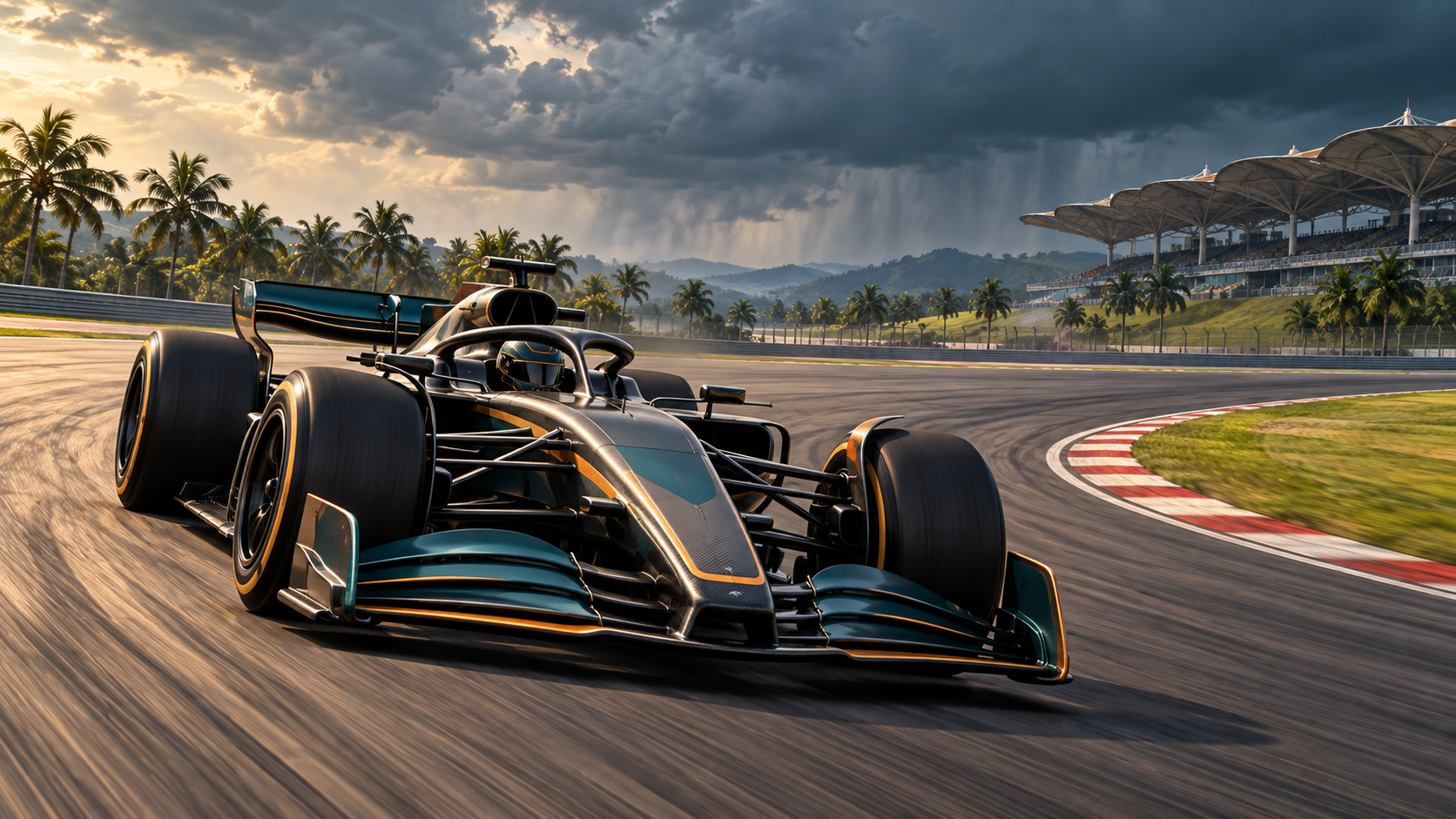
Qualifying for the Formula 1 Gulf Air Bahrain Grand Prix in Malaysia begins at 08:00 UTC on Saturday, October 3 — 16:00 local time at Sepang. Formula 1’s official race hub schedules the one-hour session at Sepang International Circuit. This is a start-of-session preview, not a live report: GearPulse is not trackside, has no live timing or telemetry access, and does not disclose or imply any session outcome.
The Bahrain name is accurate, but the setup question is Malaysian. This is a one-off Sepang event rather than a visit to Sakhir, with a 5.543km, 15-turn lap and a 56-lap, 310.417km race context. Qualifying itself is one lap, yet the longer distance still matters because it tells engineers which compromises are likely to be too expensive to carry into Sunday.
One lap has to solve several opposing jobs
Sepang has long straights, heavy braking zones and fast, flowing corners. Formula 1 highlights the sweeping Turns 5 and 6 and the Turn 15 hairpin; the official circuit guide identifies four Straight Mode zones. That mix puts a premium on a car that can switch between low-drag efficiency and a dependable cornering platform without making the driver guess at the brake release.
| Qualifying variable | Why it matters at Sepang |
|---|---|
| Tyre temperature | A lap that arrives at Turn 1 with underworked rubber may not recover its peak grip later in the lap. |
| Aerodynamic state | Four Straight Mode zones reward drag reduction, but the flowing sections still demand a stable loaded car. |
| Brake confidence | Long acceleration phases feed heavy stops, so a nervous rear axle costs time and margin together. |
| Electrical energy | A large deployment early can produce an impressive sector and leave the final acceleration phases short of response. |
That is the GearPulse lesson in the session. The fastest-looking subsystem is not necessarily the quickest car. A low-drag configuration only pays if the tyres arrive ready for the first braking event; aggressive energy use only pays if it does not compromise the next two corners. Qualifying compresses those connected decisions into a single attempt.
DRS shorthand misses the 2026 Sepang picture
It would be inaccurate to count conventional DRS zones for this weekend. Under the 2026 regulations, cars use active front- and rear-wing operation in designated Straight Mode zones to reduce drag in dry running. The FIA describes Overtake Mode separately as an electrical-energy mechanism for race use, not a qualifying button.
At Sepang, Formula 1 identifies Straight Mode sections on the start-finish straight and between Turns 3–4, 8–9 and 14–15. The important qualifying comparison is therefore not a familiar old-zone map, but how cleanly a car moves between its high-downforce and low-drag jobs. An engineer can chase straight-line speed, but a driver needs a predictable car through the fast middle portion before that efficiency becomes usable.
Heat, rough asphalt and rain risk change preparation
Pre-session reporting from Motorsport.com describes Sepang’s open-texture surface, heat and humidity as central constraints; its analysis expects degradation and tyre-temperature management to shape the weekend. Sky Sports likewise flags tropical heat, humidity and the threat of thunderstorms. Those are forecasts and venue characteristics, not a claim about conditions while qualifying runs.
The useful distinction is between weather uncertainty and tyre uncertainty. A shower can reset grip quickly. A rough surface can push tyre temperatures up even in stable weather. Teams should therefore value an out-lap that builds temperature evenly and a balance that remains intact after the rear tyres have taken several traction loads. The headline lap is only useful if it can be reproduced without turning the final sector into a temperature-management exercise.
The race’s 56-lap context raises the cost of an extreme choice. A qualifying setup need not be a race setup, but a car trimmed too aggressively for one lap can create braking, cooling or tyre-life debt for the following day. The most practical compromise is not necessarily conservative; it is a configuration with enough straight-line efficiency to matter and enough platform stability to give the driver the same reference twice.
Driver feedback is the real separator
Sepang last hosted Formula 1 in 2017, so historical familiarity is useful but incomplete. Motorsport.com’s pre-weekend reporting notes that the current cars bring different active-aero and energy-management demands to the venue. A remembered racing line cannot answer whether the new car will hold its rear temperature or leave enough electrical energy for the final acceleration zones.
That makes driver feedback unusually valuable. A note about a small correction through a fast transition can point to a much larger systems issue: ride behaviour, aerodynamic balance, tyre surface temperature or a deployment plan that changes the car’s attitude at the wrong time. Conversely, a calm car lets a driver place the braking point later and unwind steering earlier, which is often the cleanest route to speed at a circuit with long exits.
Bottom line
Sepang qualifying starts with fixed facts: 08:00 UTC, a 5.543km lap, 15 turns, four Straight Mode zones and a weather-aware tyre-preparation task. The unknown is which cars can join those elements into one repeatable lap.
For GearPulse readers, this is an engineering test with no separate easy answer. The team that best matches tyre temperature, aero state, braking confidence and electrical deployment will give its driver a lap that feels simpler than it is — exactly what qualifying at Sepang demands.