
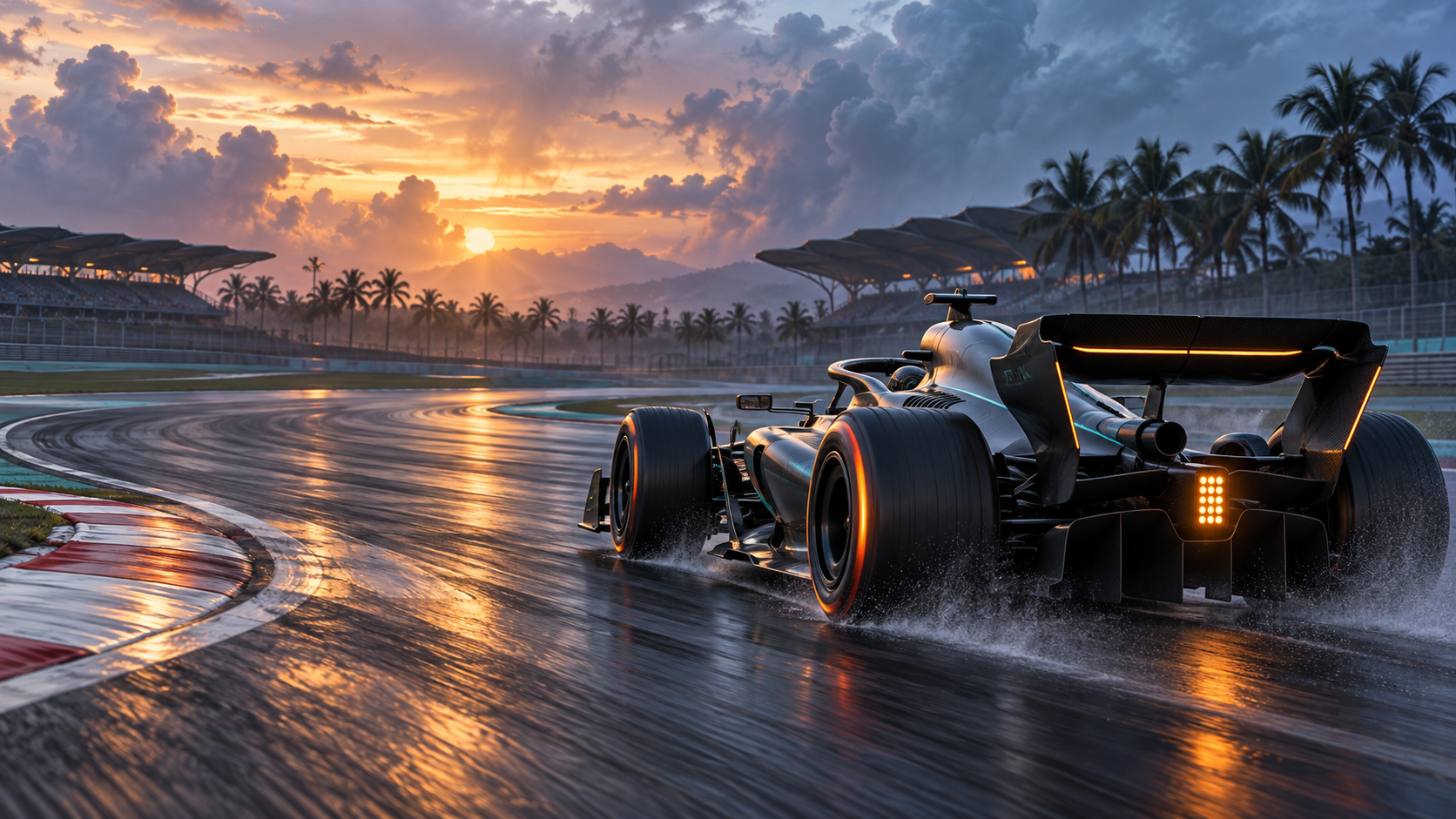
Practice 3 for the Formula 1 Gulf Air Bahrain Grand Prix in Malaysia starts at 04:30 UTC on Saturday, October 3, and runs for one hour. At Sepang, that is 12:30 local time; qualifying follows at 08:00 UTC. Formula 1’s official race page confirms both the session timing and the unusual but accurate event name: this is a Bahrain-branded Grand Prix held at Malaysia’s Sepang International Circuit, not a trip to Sakhir.
This is a start-of-session preview, not a report from the circuit. GearPulse has no trackside or live-telemetry access. It does not report or suggest any timing order, result or classification from a prior session, and it makes no prediction about qualifying.
For readers who care about how a racing car works, FP3 is the final chance to turn a promising setup into a repeatable one. The key question is not who finds one clean lap. It is whether the car can preserve its tyre behaviour and braking confidence across a long, varied circuit while the engineers decide how much active-aero efficiency they can trade for cornering security.
Sepang makes compromise visible
Formula 1 lists Sepang as a 5.543km, 15-turn circuit. Sunday’s race is scheduled for 56 laps and 310.398km. That scale matters in the final practice hour: a small balance fault can recur through enough loaded corners, big braking events and acceleration zones to become a much larger weekend problem.
The circuit combines two long straights with fast direction changes and low-speed rotation demands. A low-drag car may relieve the straights, but it has to arrive at the big stops with a stable rear axle; more wing can make the high-speed sections easier while raising the cost of drag and tyre load. This is the core GearPulse relevance of FP3: the session is a rapid systems check, where aero platform, brakes, tyre temperature and electrical deployment have to agree.
| Final-practice check | What it can establish before qualifying |
|---|---|
| Entry stability | Whether drivers can release the brake without the rear moving unpredictably at Sepang’s heavy stops. |
| Mid-corner load | Whether the car accepts the fast, linked corners without scrubbing the tyres into an early temperature problem. |
| Straight-line efficiency | Whether the active-aero and energy plan preserves enough speed without forcing a compromised wing level. |
| Repeatability | Whether the second representative lap behaves like the first as the surface and tyre temperatures change. |
Sepang last hosted Formula 1 in 2017. The circuit’s geometry is familiar from history, but the current cars are not: the 2026 technical era brings a different balance of electrical energy, active aero and reduced mass. Old references can explain a corner sequence; they cannot substitute for current-car data.
The old DRS-zone shorthand no longer fits
It would be misleading to frame this weekend with a legacy DRS-zone map. Under the 2026 rules, the FIA says the Drag Reduction System has been replaced by active front- and rear-wing operation. Straight Mode reduces drag for all cars in the designated parts of the lap, while Overtake Mode adds a following car’s electrical-energy opportunity under the relevant gap condition.
That distinction is more than a terminology update. At a circuit with long full-throttle sections, the quickest setup is not automatically the one with the smallest wing. A team needs enough downforce and predictability to make the fast corners and braking zones usable, then needs a recovery-and-deployment plan that does not leave the driver managing energy at the wrong point of the lap.
FP3 cannot settle the racing picture, but it can help a team choose its qualifying compromise. If a car is calm on entry and can change direction without sliding the rear tyres, engineers can be more confident that its straight-line configuration is an asset rather than a tax elsewhere.
Abrasion and weather make a clean plan conditional
Independent weekend reporting identifies heat, humidity and rough asphalt as the main preparation constraints at Sepang. Motorsport.com’s Saturday forecast calls for around 32–33°C, possible thunderstorms earlier in the day and a potentially drier afternoon; that is a forecast, not a claim about the running conditions at this moment. Autosport’s pre-FP3 analysis likewise describes low grip and high degradation as central issues.
For the teams, the useful comparison is between two kinds of uncertainty. Weather can change the track’s grip level quickly. Surface roughness can change the tyre’s temperature and life even when the sky stays clear. In both cases, the response is not just selecting another compound. It can mean adjusting ride height, brake cooling, wing level, pressure targets and the length of the run needed to understand the car.
That is why a tidy short run is only one piece of evidence. A car that produces a good first lap but overheats the rear tyres or loses braking confidence a few corners later may have a narrow operating window. One that is fractionally less dramatic but predictable gives its driver more latitude when the circuit evolves.
Team and driver context: learn fast, then commit
The return to Malaysia is a shared learning exercise. Formula 1’s current grid includes drivers with very different levels of historical familiarity with Sepang, but every pairing must translate that knowledge to modern active-aero cars and a track surface that has become a primary variable. The driver who recalls a braking marker still needs a car that permits a repeatable brake release; the engineer with a good simulation still needs the tyre behaviour to match it.
The immediate team advantage is therefore correlation, not a headline from a timing screen. When both sides of a garage identify the same limitation — rotation, rear temperature, front bite or energy consistency — the final hour can be spent refining. When the drivers need opposite balances, the engineers have to choose a compromise before qualifying exposes it.
There is also a useful historical comparison. Sepang’s 5.543km layout and 56-lap race distance make it a very different engineering problem from the permanent circuit usually associated with the Bahrain name. The continuity is in the Grand Prix branding; the real setup task is tropical Malaysia: a broad, high-speed circuit where tyre load and weather can rewrite the plan.
Bottom line
Practice 3 begins with fixed facts: 04:30 UTC, a 5.543km lap, 15 turns, 56 race laps and active aero rather than legacy DRS. The variable is how well each car joins those pieces together.
The best final-practice result for any team is not a dramatic claim. It is a setup that makes the driver trust the braking zones, keeps the tyres inside a workable range and carries its energy strategy cleanly through the long Sepang lap. That is the engineering foundation qualifying demands.