
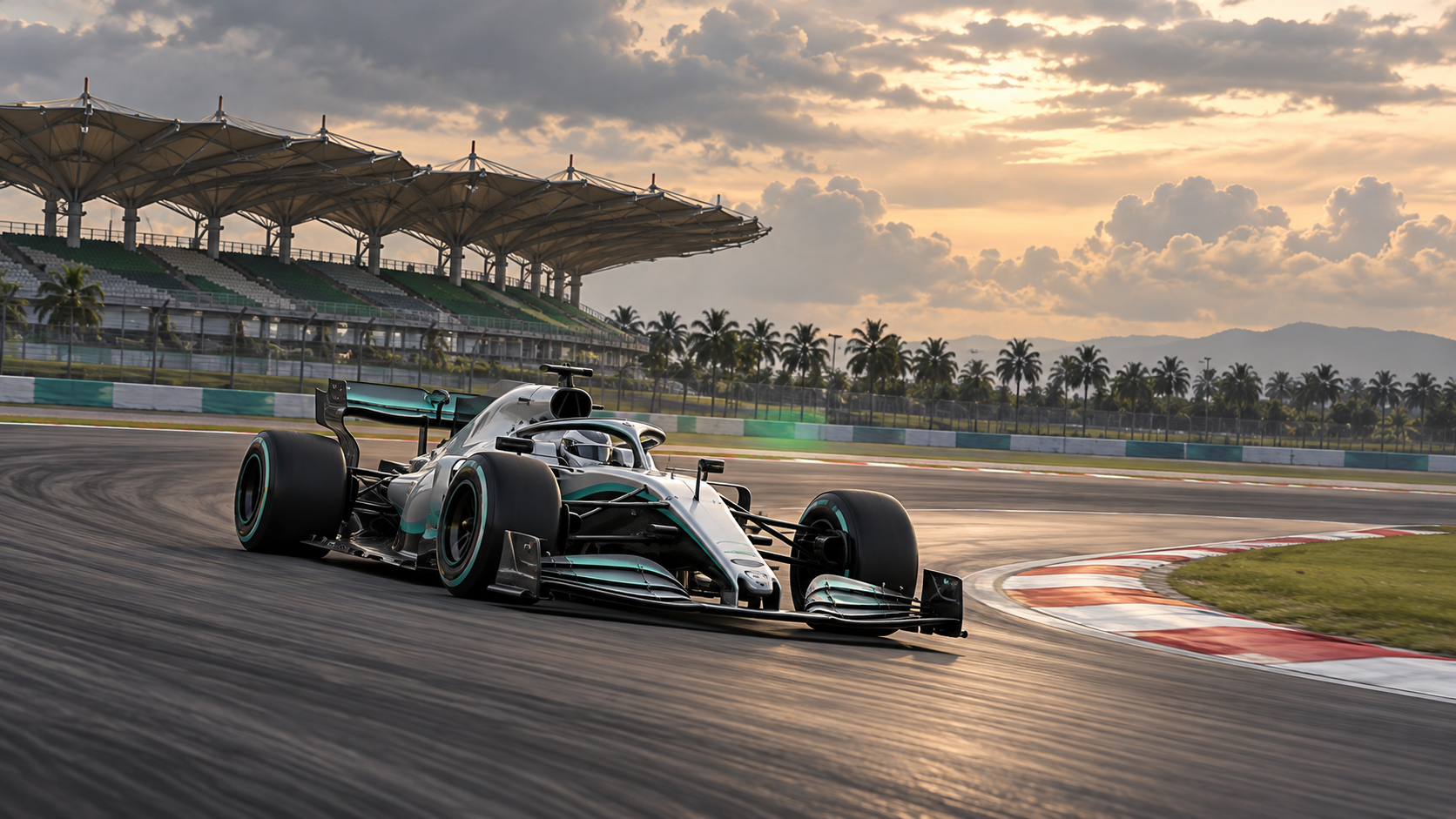
Practice 2 for the Formula 1 Gulf Air Bahrain Grand Prix in Malaysia starts at 08:00 UTC on Friday, October 2 — 16:00 local time at Sepang. Formula 1’s official race page lists the one-hour session at that time, while the full timetable places it after Friday’s first practice and ahead of Saturday practice and qualifying.
This is a preview, not a results report. GearPulse is not trackside, does not have live telemetry and is not using live timing. Nothing here reports or hints at a Practice 1 classification, an FP2 outcome, qualifying, the grid, pole position, a sprint or race result, or a championship outcome.
That distinction matters at a circuit returning to F1 for the first time since 2017. A quick lap can be useful, but it can also be a misleading mix of tyre age, fuel load and a generous run-plan. The higher-value question in this hour is whether a car can keep its balance, temperature and electrical deployment consistent over more than one representative lap.
Sepang makes the full lap the test
Sepang International Circuit is 5.543km long, has 15 turns and hosts a 56-lap, 310.398km Grand Prix. Formula 1’s circuit guide calls out a fast middle sector broken up by heavy braking zones and switchback opportunities. Motorsport.com’s track assessment adds two long straights to the medium- and high-speed-corner mix.
That is an awkward package to tune around. A low-drag choice helps the straights, but the car still needs a planted front end through the longer corners and enough rear stability for the big stops. A setup that looks clever in one phase of the lap can become expensive across the whole 5.543km.
| FP2 checkpoint | Why GearPulse readers should care |
|---|---|
| Repeatable braking | Sepang’s large stops punish a rear axle that changes character as tyres heat up. |
| Mid-sector confidence | The flowing middle section reveals whether a car can carry load without the driver continually correcting it. |
| Straight-line efficiency | The two long straights turn drag and energy deployment into a tangible lap-time trade-off. |
| Tyre temperature | A rough, abrasive surface and humid heat can convert a promising first lap into a short-lived one. |
The historical comparison is useful but needs restraint. Sepang’s last F1 visit was nine years ago, while the cars, tyres and power-unit rules have moved on substantially. The circuit’s DNA remains — wide entries, long loaded corners and two major acceleration phases — but old lap-time or tyre-life expectations are not a model for this weekend.
C2, C3 and C4 give FP2 a clear job
Pirelli has selected the C2 hard, C3 medium and C4 soft for the event. Formula 1 says each driver has two hard sets, three medium sets and eight soft sets available, with intermediates and full wets also available if conditions require them.
That allocation makes the session more than a one-lap rehearsal. The C4 should be the natural short-run reference, but the C3 is likely to be the more instructive tyre for repeated laps and race-simulation work. If the surface is hot and abrasive, teams will want to understand not only peak grip but how quickly the rear tyres change after a few hard traction zones.
Strategy at Sepang is therefore a temperature-management problem as much as a compound-choice problem. A car that warms the soft tyre immediately may look sharp at the beginning of a run; a car that preserves the medium tyre may have learned more. In a dry Grand Prix, the requirement to use two slick compounds ensures that cross-compound behaviour matters even before anyone begins formal race preparation.
Weather is part of the engineering brief
The independent reporting and driver comments agree on the broad forecast risk: Sepang’s heat, humidity and late-afternoon showers can change the track quickly. Motorsport.com describes daily late-afternoon downpours as a familiar part of the venue, while the FIA’s Thursday press-conference transcript records drivers preparing for an unpredictable, potentially wet weekend.
For FP2, that means a changing track is not a nuisance around the data; it is the data. Teams must decide whether to chase a clean dry baseline, prepare an intermediate-tyre plan, or split the difference. Sepang’s open-texture surface was built with wet-weather drainage in mind, but the uncertainty is still meaningful: rain affects grip, tyre warm-up, visibility and how confidently drivers can test the aggressive braking zones.
Overtake Mode replaces the old DRS framing
It is important not to describe Sepang as if it were using the old DRS-zone map. Formula 1’s 2026 circuit guide says Overtake Mode replaces DRS. There is one detection point per lap, expected on many laps to sit out of the final corner; a driver within one second there can use the additional electrical-power profile on the following lap.
This changes the setup conversation. Energy is not just a straight-line button; it has to be earned through recharge and spent where it protects or creates a passing opportunity. FP2 cannot settle that question, but it can show whether a car’s energy use leaves it exposed after the middle sector or lets it accelerate cleanly onto the main straight.
One update story, many unknowns
Mercedes arrives with a newly reworked floor and sidepod package, according to Motorsport.com, including changes around the floor board, leading edge, rear corner and diffuser area. Sepang is a stern early test because those parts have to generate downforce without turning the car into a drag penalty on its long straights.
The driver context is broader than one team. Formula 1 notes that only 10 drivers on the current grid have previously raced in Malaysia, and even they face a circuit whose surface and modern car characteristics make prior experience an imperfect shortcut. For newer drivers, FP2 is a chance to build references for brake release, kerb use and energy deployment. For experienced ones, it is a chance to separate remembered lines from what the 2026 car actually accepts.
That is why the most revealing sign is unlikely to be a single number. Look for a team that can run the same tyre twice, hit similar braking points, keep the car calm through the fast changes of direction and still carry enough energy onto the straights. At a hot, humid Sepang, those are the ingredients that make the rest of the weekend easier.
Bottom line
FP2 at Sepang is a baseline-building session disguised as a pace shootout. The facts are fixed: 08:00 UTC start, 5.543km, 15 turns, 56 race laps, C2-C3-C4 tyres and a one-detection-point Overtake Mode framework. The useful unknowns are how the new cars handle the surface, how the weather interrupts the plan, and which setup can preserve tyre behaviour without sacrificing energy efficiency.
Treat the hour as evidence gathering, not a verdict. The best preparation may be the least dramatic: a car that returns to the garage with repeatable tyre, balance and energy data.