
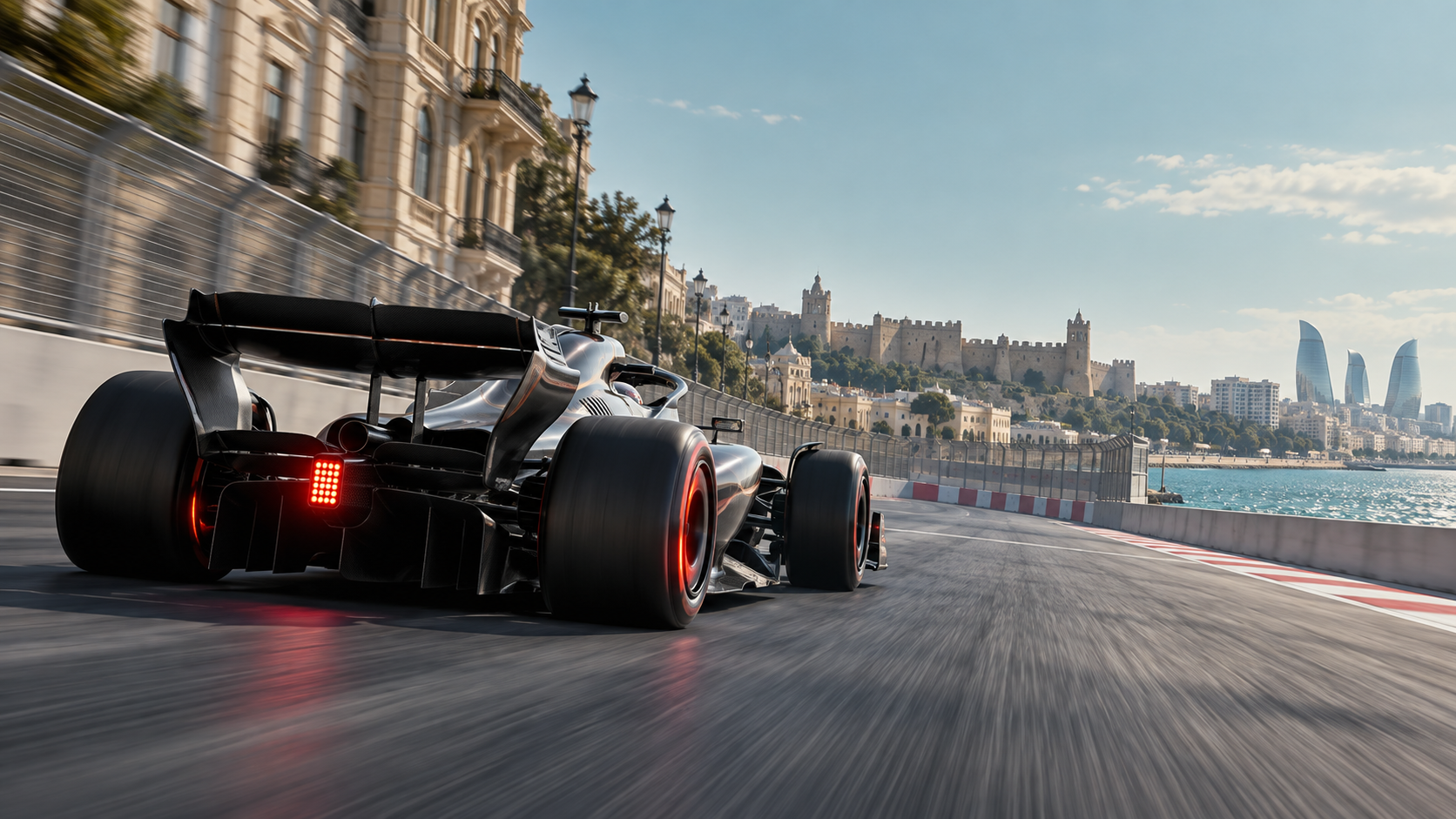
The Azerbaijan Grand Prix starts at 11:00 UTC on Saturday, September 26. Formula 1’s official race hub lists a 51-lap, 306.049 km race at Baku City Circuit. This is a start-of-session preview, not a live report: GearPulse is not trackside, does not have live telemetry, and does not disclose or imply any earlier-session result, grid or race outcome.
The compelling Baku question is not who is quickest in a vacuum. It is whether a car can carry low-drag efficiency through a 2.2 km waterfront straight, then repeatedly stop and turn accurately once the lap compresses around the old city. That is a systems problem GearPulse readers will recognise: the part that looks most efficient in isolation can be the wrong answer if it leaves too little control at the next constraint.
A 6.003 km lap with two very different demands
Formula 1 lists Baku as a 6.003 km, 20-corner street circuit. The same official guide calls out the 2.2 km main straight, while the Turn 8/9 old-town complex narrows to 7.6 metres. Big braking zones, low walls and the change from open waterfront to tight streets mean a setup has to solve conflicting jobs, not merely chase terminal speed.
| Race variable | The useful comparison |
|---|---|
| Straight-line efficiency | Less drag helps the long acceleration phases, but cannot come at the expense of a stable car when braking hard into Turn 1. |
| Mechanical confidence | A predictable rear axle gives a driver margin beside walls; an edgy one turns every brake application into a compromise. |
| Tyre preparation and wear | The low-abrasion street surface can begin with limited grip, then improve as rubber goes down. That makes an early assumption less valuable than an adaptable plan. |
| Electrical energy | In 2026, deployment and recovery have to serve the whole lap, not just a single top-speed number. |
There are 51 opportunities to repeat that compromise. Over a race distance, the better package is not automatically the one with the biggest speed advantage on the longest straight; it is the one that lets its driver brake consistently and exit the slower sections without wasting tyres or energy to correct the car.
DRS is history; Baku has two Straight Mode zones
The old DRS shorthand no longer describes the 2026 machinery. Formula 1 says Straight Mode reduces drag by changing both the rear wing and the upper front-wing elements in designated dry-running areas. At Baku, the designated zones run between Turns 2 and 3, then from the exit of Turn 19 along the start-finish straight to Turn 1.
For racing, Overtake Mode is the separate energy tool. F1 places the Baku detection point shortly after Turn 16 and the activation line at the entry to Turn 17. The practical implication is more nuanced than the old picture of a rear flap opening: aero state, available electrical energy and a clean final-sector exit all feed the next braking event. A car cannot treat efficiency and control as separate departments.
Strategy starts with the track surface, not a prediction
Pirelli has nominated its softest 2026 trio for Baku: C3 as Hard, C4 as Medium and C5 as Soft. It also notes resurfacing around Turns 2, 3 and 4, expecting initially low grip in those areas and meaningful track evolution as the weekend develops.
That information is more useful than declaring a one- or two-stop answer before the race has unfolded. A conservative baseline needs to protect the tyres through traction and braking, preserve a workable energy state for the long acceleration phases and leave the pit wall room to react to the conditions it actually sees. On a street circuit, a plan that can survive a change in grip is more valuable than a plan that only works in its ideal window.
The tyres also turn the setup decision into a feedback loop. A low-drag car that slides under braking or struggles to put power down can erase the efficiency it gained on the straight. Conversely, a car that carries enough stability to make repeatable exits may protect its tyres and give its driver a more usable overtaking opportunity later in the lap.
Weather favours calm decisions, but not complacency
Motorsport.com’s pre-weekend forecast described a clear race day near 24C at the scheduled start, with rain unlikely. Forecasts are not live conditions, and Baku’s exposed waterfront and building-lined sections can still make wind direction relevant to braking references and balance.
The right reading is not that weather has been solved. It is that dry-track preparation should dominate the opening assumptions, while teams keep enough setup and strategy flexibility for a shift in wind or grip. That is particularly important at Turn 1: F1’s circuit guide describes the approach as a heavy braking opportunity after the long run, where a small confidence deficit can carry into the rest of the lap.
Team context: Baku rewards useful development
The 2026 rules make efficiency unusually visible at a circuit with so much sustained acceleration. Autosport’s pre-weekend analysis highlighted Baku as a place where the balance between energy use and the low-speed castle section becomes acute. The Race, meanwhile, reported that McLaren arrived with a substantially revised bodywork package aimed in part at cooling and straight-line efficiency.
That does not make any single package a verdict before the race. It does sharpen the test. Development that produces a cleaner airflow or lower cooling drag only pays off if the driver still has a trustworthy platform under braking and on traction. Baku is a useful stress test precisely because it exposes whether an upgrade helps the whole operating window rather than one glamorous number.
There is historical perspective too. The circuit first appeared in 2016 as the European Grand Prix and returned in 2017 as the Azerbaijan Grand Prix; the 2026 event is held on Saturday after Formula 1 and the FIA moved it to avoid Azerbaijan’s September 27 Remembrance Day. Ten years on, the layout’s basic engineering argument remains the same: speed matters, but it has to arrive with enough control to be used.