
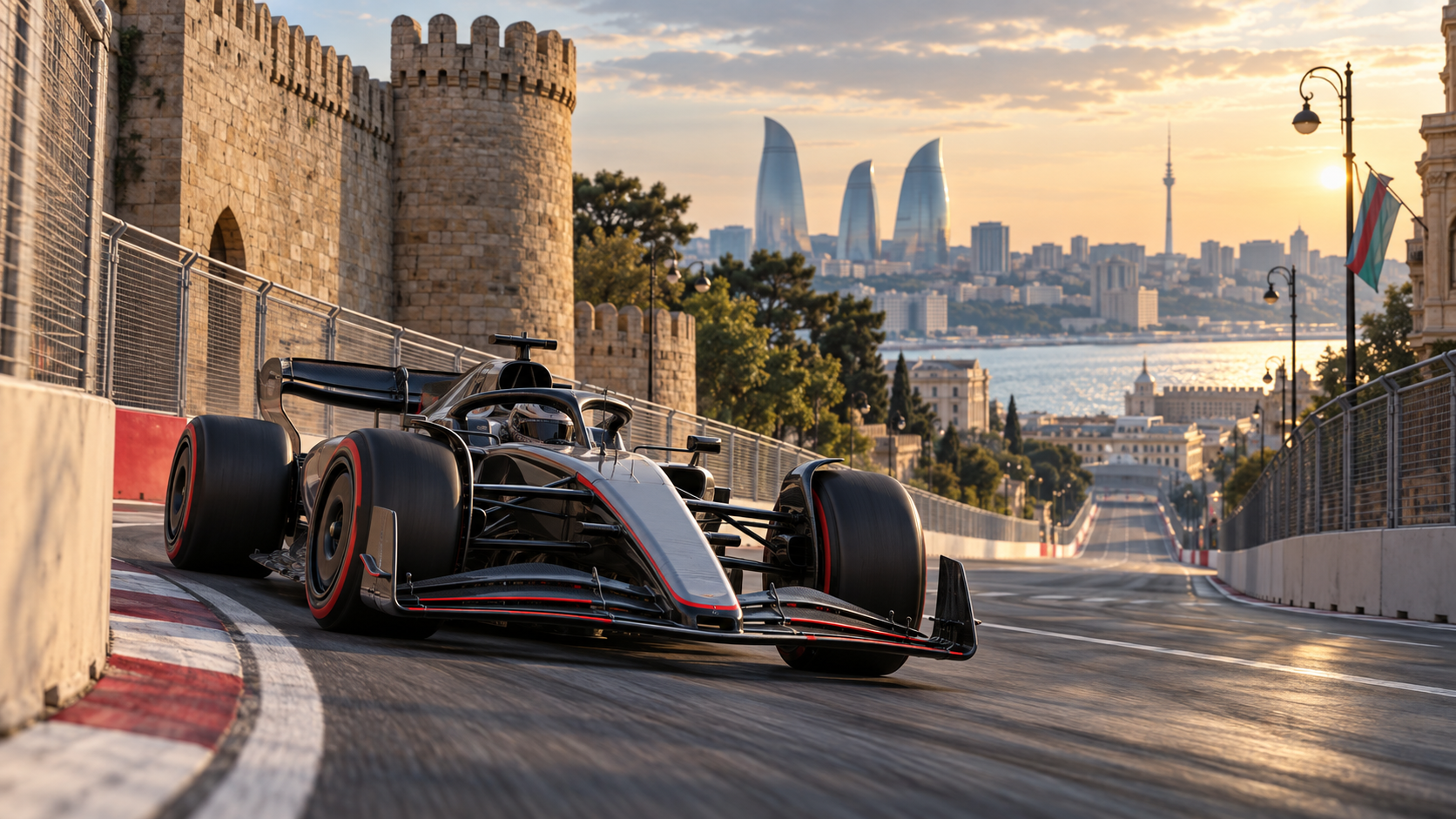
Azerbaijan Grand Prix Qualifying starts at 12:00 UTC on Friday, September 25 — 16:00 local time in Baku. Formula 1’s official race hub schedules a one-hour session at the Baku City Circuit. This is a start-of-session preview, not a live report: GearPulse is not trackside, has no live timing or telemetry access, and does not disclose or imply a qualifying, Sprint or race outcome.
The useful way to read this session is as a systems problem. Baku’s 6.003 km, 20-corner lap asks one car to be low-drag enough for a 2.2 km flat-out run, then accurate enough to work around the old city walls. Under the 2026 rules, the answer is not simply “less wing”: active-aero state, battery deployment, tyre temperature and braking confidence all have to arrive in the right order.
One lap, two opposite jobs
Formula 1 lists 51 laps and 306.049 km for Saturday’s Grand Prix, but the race distance matters here only as setup context. Qualifying is a one-lap task. The car must still stop consistently at Turn 1, rotate through the slow middle section and put power down cleanly enough to make its next long acceleration useful.
| Baku qualifying variable | The compromise it creates |
|---|---|
| Low-drag aero | Protects speed on the long run, but can reduce the driver’s confidence through the wall-lined sector. |
| Tyre preparation | A slow out-lap can leave the tyres too cool for Turn 1; too much energy early can spoil the later corners. |
| Brake stability | Big stops arrive after sustained acceleration, so a nervous rear axle costs both confidence and margin. |
| Electrical energy | Deployment on the long straight must not leave the rest of the lap without a usable response. |
That is why Baku is especially revealing for GearPulse readers. It exposes whether an intricate system can make connected decisions under a hard constraint. Peak straight-line speed only counts if the driver can use it at the next braking point; a stable cornering platform only counts if it does not give back too much over the following two kilometres.
No conventional DRS count — two Straight Mode zones instead
The familiar DRS framing is no longer the right description for 2026. Formula 1 says the cars use Straight Mode, with both front and rear wing elements changing configuration to reduce drag in designated dry-running sections; Overtake Mode is a separate, race-use energy aid.
For Baku qualifying, F1 identifies two Straight Mode zones: between Turns 2 and 3, and the longer section from the exit of Turn 19 to Turn 1. Baku City Circuit’s official track update also records two traditional DRS reference zones for the venue, with activation after Turn 2 and after Turn 20. The comparison is helpful historical context, not a reason to mistake a qualifying lap for an old-style DRS exercise. The 2026 test is how cleanly the car changes aero state and how predictably its energy system supports the acceleration that follows.
Wind can change the sensible setup
Motorsport.com’s Friday forecast calls for dry, sunny conditions but stronger wind, while The Race reports a forecast of gusts around 39 km/h for qualifying. Those are forecasts, not a claim about conditions once the session is under way. They are still material to the decision: crosswinds between Baku’s buildings can change turn-in load abruptly, and a street circuit offers little room to absorb a correction.
The practical response is restraint, not a generic weather warning. A team seeking minimum drag needs the driver to trust the car under braking and through the old-city section; gustier conditions raise the value of a predictable platform. Tyre warm-up compounds the problem. F1’s circuit guide notes that the relatively low-abrasion surface can punish an overly slow out-lap with a Turn 1 lock-up. The best preparation lap is therefore one that delivers tyre temperature without spending too much electrical energy or exposing the driver to an uncertain balance.
The strategy is to protect repeatability
There is no race strategy to execute in qualifying, but there is a one-lap strategy. Teams must choose when to bring tyres into range, where to use their energy most aggressively and how much aerodynamic margin to retain near the walls. A slightly slower-looking approach that gives a driver the same braking reference twice can be more valuable than a maximum-speed configuration with no repeatable entry point.
Autosport’s pre-weekend assessment makes the wider historical comparison: Baku debuted in 2016 as the European Grand Prix, became the Azerbaijan Grand Prix in 2017, and the new regulations may make its low-load, high-energy demands feel sharper than in the later ground-effect era. The layout has not changed its central question. It still rewards a car that can switch from full commitment to precise control without losing coherence.
Driver and team context: usable power, not just more power
The Race’s pre-session reporting captures the driver-facing version of the challenge: a long straight can force unusually deliberate energy use, leaving large differences in response between corner exits if the deployment plan is wrong. That makes feedback about throttle shape, brake confidence and preparation laps unusually useful. It is not merely a complaint about drivability; it tells the engineers whether the lap’s separate systems are working as one.
Across the teams, the distinguishing choice is likely to be how much confidence each package can buy without sacrificing too much efficiency. A driver with a calm rear axle can brake later and carry a cleaner exit. A driver who has to hedge against a gust, a cold front tyre or an inconsistent energy phase may lose time long before the timing line. The session begins with the same engineering question for everyone: can the Baku configuration be quick enough to matter and stable enough to trust?