
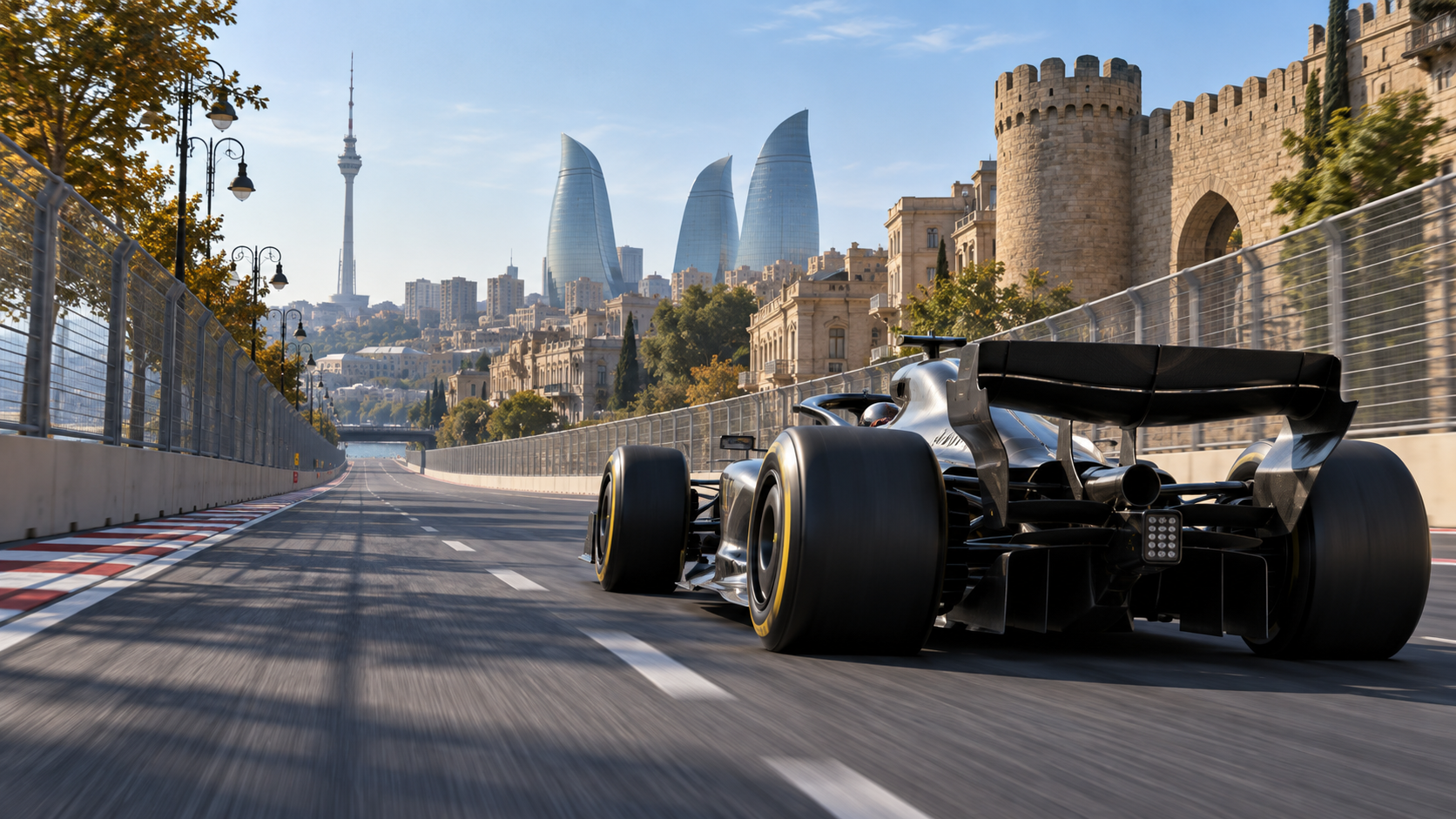
Formula 1’s official Azerbaijan hub schedules Practice 3 for 08:30–09:30 UTC on Friday, September 25. It is the final hour before qualifying at 12:00 UTC, and Baku makes that hour unusually valuable: teams must settle a low-drag/high-downforce compromise while learning how the 2026 cars spend and recover electrical energy across a 6.003 km street circuit.
This is a session-start preview, not a report. It does not reveal or imply any Practice 3 timing, qualifying outcome, grid, pole sitter, race result, podium, fastest lap, penalty classification or championship outcome. GearPulse is not trackside and does not have live telemetry. The useful question is what a clean final practice run can establish before the cars are committed to qualifying.
The Baku equation: speed at one end, precision at the other
Formula 1 lists Baku at 6.003 km, with 51 laps and a 306.049 km Grand Prix distance. The lap begins with the long waterfront run and a major braking demand into Turn 1, then changes character through the tight old-city sequence. F1 describes the circuit as both wide and open and tight and twisty—exactly the reason a single wing setting rarely solves the whole lap.
For GearPulse readers, it is a familiar engineering trade-off. Reducing drag preserves speed and overtaking potential on the main straight; adding wing load gives the driver a more dependable front end through the narrow, wall-lined section. The best compromise is not necessarily the sharpest single-corner car. It is the one that can stop repeatedly, rotate without sliding and still arrive at the long straight with enough usable energy.
| Final-practice check | Why it matters before qualifying |
|---|---|
| Brake stability into Turn 1 | Heavy deceleration and close barriers punish a nervous rear axle. |
| Low-drag balance | The waterfront straight rewards clean exit speed, but too little wing hurts the old-city sector. |
| Energy state at Turn 16 exit | The long full-throttle run magnifies a weak deployment plan. |
| Kerb and wall confidence | On a city track, small corrections can cost a lap before the driver reaches the braking zone. |
Energy management is the 2026-specific test
The Race reports that Baku’s flat-out waterfront run exceeds two kilometres and that drivers expect the new cars’ energy behaviour to become especially conspicuous here. Its pre-weekend reporting describes the practical consequence: a car reaching the main straight with insufficient battery state can lose speed for a long time, rather than only at the very end of a short burst.
Motorsport.com makes the same strategic point from the team side. It identifies the long straight and the need to harvest between the early corners as a central Baku problem, with a long-straight mode intended to limit the worst effects. In final practice, teams are therefore checking more than peak power: they are testing whether the lap’s harvesting and deployment sequence produces a repeatable qualifying lap without making the middle sector feel compromised.
That makes driver feedback unusually actionable. A complaint about power arriving late is not simply a drivability note; at Baku it changes the speed reached before a heavy braking zone and can push engineers toward a different wing, differential or energy-map choice.
Two DRS zones, but the latest event notes still matter
The FIA’s published Baku event notes from 2025 specify two DRS activation zones, one around the Turn 3–5 sequence and the other spanning the final sector into the start-finish straight. The 2026 event’s final notes can still change operational details, so teams and viewers should treat those published 2025 locations as circuit context rather than a substitute for this weekend’s official instruction.
The same caution applies to strategy. Baku has historically rewarded flexibility because track interruptions can rewrite a tyre plan, but a preview cannot assume that one will happen. The practical baseline is to preserve optionality: avoid overheating the tyres while building a stable braking platform, then keep enough straight-line efficiency that a driver is not forced to overreach in the narrow sector.
Weather is part of the setup, not a forecast verdict
Motorsport.com’s current Baku weekend guide carries a weather forecast alongside Friday’s altered schedule, while the official hub confirms this is an early-morning Practice 3 rather than the usual Saturday slot. Conditions can change quickly between the first practice run and qualifying; this article does not claim access to local live weather data. The final practice task is to establish tyre warm-up, brake temperatures and balance for the conditions teams actually encounter, with wind direction particularly relevant on the exposed waterfront run.
That is a different decision from choosing for a normal permanent circuit. A minor shift in temperature or gust strength can affect braking confidence and the amount of wing a driver is willing to carry through the old city. The valuable sign in FP3 will be repeatability across several laps, not a single headline lap.
The team context: upgrades need a clean baseline
One pre-session storyline is development. Motorsport.com reports that Red Bull has brought a significant five-part package, including a revised floor, and says both Max Verstappen and Isack Hadjar have it available. That makes this hour a correlation test: do the changes provide a calmer platform without taking away the speed needed for Baku’s defining straight?
The wider comparison is useful even without declaring a favourite. A package that produces dependable braking and energy behaviour lets a team use FP3 to refine the last few per cent; a car that forces drivers to chase balance through the lap spends the hour finding a safe baseline. At a street circuit with little margin, that distinction can matter more than an isolated time-sheet position.
What to watch before qualifying
Watch the shape of runs rather than their rank. Longer sequences on one compound can reveal whether a car stays composed under braking; repeated preparation laps can show whether its energy state is predictable before the main straight. Also look for whether two team-mates converge on the same setup direction. Agreement is valuable evidence that a team has found a usable operating window.
Baku first hosted Formula 1 in 2016 as the European Grand Prix and has run as the Azerbaijan Grand Prix from 2017. A decade on from that first visit, its essential challenge remains intact: high speed, tight walls and a lap that rewards disciplined compromise. Practice 3 is the last low-stakes opportunity to make that compromise work before qualifying turns every imbalance into a permanent record.