
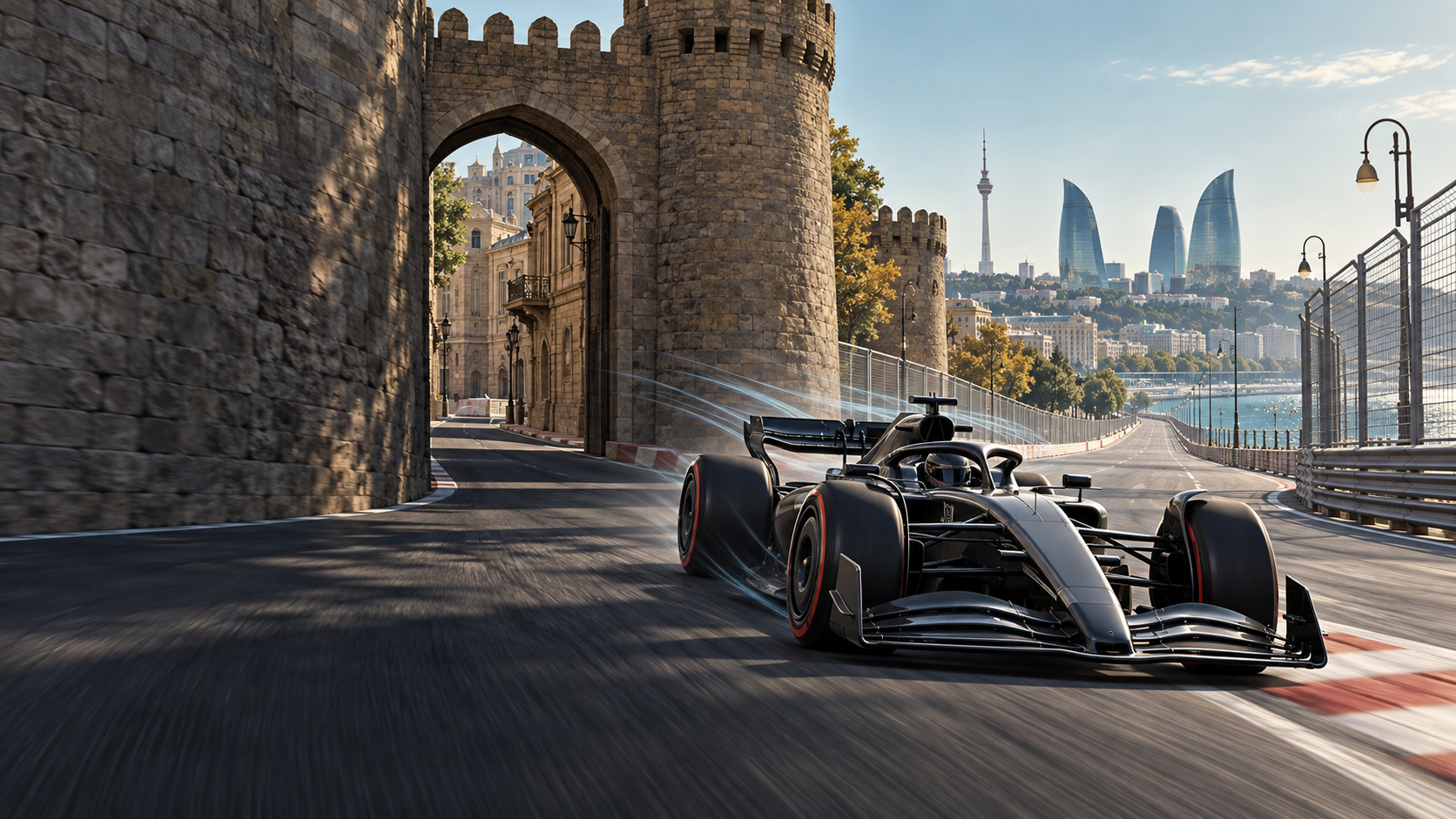
Azerbaijan Grand Prix Practice 2 begins at 12:00 UTC on Thursday, September 24 — 16:00 AZT in Baku — and runs for one hour. Formula 1’s official race hub sets that slot; Motorsport.com independently lists the same Thursday timetable. This is a start-of-session preview, not a report from the circuit: GearPulse is not trackside, does not use live timing or telemetry, and does not include any completed-session information.
The 6.003 km Baku City Circuit has 20 turns and turns the Grand Prix into 51 laps (306.049 km). Those race figures are context rather than a target for FP2, but they explain why this hour matters. Baku compresses a car through the narrow old-city sequence, then asks it to preserve speed and electrical energy along one of F1’s longest full-throttle runs. The useful comparison is not a single headline lap; it is whether the same setup works on consecutive laps and longer runs.
Baku rewards a balanced low-drag compromise
The circuit’s central trade-off is unusually clear. Less drag helps along the waterfront and into Turn 1; stability and mechanical grip matter when the barriers narrow and braking points arrive. The Race’s technical preview describes aero efficiency as the key Baku requirement, but that efficiency is only valuable if the car is predictable when the driver comes off the straight and into the heavy stops.
For 2026, that question is not about the old DRS system. The FIA confirms that DRS has been replaced: moveable front and rear wings switch between Straight Mode, to lower drag and conserve energy, and Corner Mode, to restore downforce. Overtaking assistance instead comes from the separate electrical Overtake Mode for a close-following car. In practical FP2 terms, teams need to confirm that those transitions leave a settled platform for braking rather than merely producing an impressive top-speed trace.
| FP2 check | Why it matters in Baku |
|---|---|
| Straight Mode and energy use | The long acceleration zones reward drag reduction, but a saving is useful only if the car arrives at the next braking zone under control. |
| Braking repeatability | Heavy stops and close barriers make a stable pedal and front axle more valuable than one optimistic entry. |
| Rotation in the old city | A car tuned only for the straight can lose time and driver confidence where the circuit becomes narrow and slow. |
| Long-run temperature control | Repeatable tyre and brake behaviour is more informative than a low-fuel peak. |
That makes FP2 a GearPulse kind of engineering test. It is a systems problem: aero state, energy deployment, cooling, brakes, tyres and driver confidence all affect one another. The quickest-looking configuration is not automatically the one that survives a representative programme.
Dry weather helps, while wind complicates the baseline
Motorsport.com’s pre-session forecast calls for mostly sunny to partly cloudy conditions around 22–25C, with rain unlikely. That should make this a cleaner comparison than a wet or mixed session, because teams can evaluate changes without a large rain variable obscuring them.
It does not make the circuit static. The same forecast highlights breezes from the Caspian Sea, which can become more noticeable between the buildings and in the narrow sections. Crosswinds can change the load a driver feels at turn-in, while surface evolution and tyre warm-up can shift the balance between a low-drag setting and the stability needed near the walls. The sensible conclusion is conditional: dry conditions should make correlation easier, but wind can still change what a “repeatable” lap looks like.
Tyres make the race-distance question visible early
Formula 1’s Pirelli briefing says the 2026 event uses the C3, C4 and C5 compounds — designated hard, medium and soft — and notes resurfacing on parts of the city streets. The race is likely to reward strategic flexibility more than a fixed script: Baku’s low-energy street surface can support longer stints, but a Safety Car or Virtual Safety Car can alter the value of any planned pit window. That is historical context, not a prediction for this weekend.
FP2 cannot decide Saturday’s 51-lap strategy. It can establish the inputs: how readily a compound warms up, whether braking and traction stay consistent over a longer run, and whether the car needs a setup compromise to protect temperature. A team that finds stable behaviour across several laps has learned more than one that produces a single fast-looking number on a different run plan.
Team context: upgrades must correlate before they matter
The Race reports that the long straights make Baku a poor place for a generic downforce upgrade and a good place to measure efficiency, with teams focusing on optimisation. It also flags Williams’ weight-reduction and aerodynamic package as a significant Baku evaluation. That makes FP2 especially useful as a correlation exercise: not a verdict on competitiveness, but a chance to see whether a revised car behaves as the simulation expected in braking, balance and energy use.
The same restraint applies across the field. A team may change cooling, wing state targets or mechanical settings between runs. Without comparable tyre condition, fuel load and programme information, a single lap cannot settle the argument. What matters for observers is the pattern: clean braking into Turn 1, tidy traction from the slower corners, and a car that can repeat its balance as the wind and track condition evolve.
FP2 will not establish a grid or an outcome. It should reveal which technical compromises are usable on a circuit that asks a car to be both a low-drag straight-line machine and a precise street-circuit tool in the same 6.003 km lap.