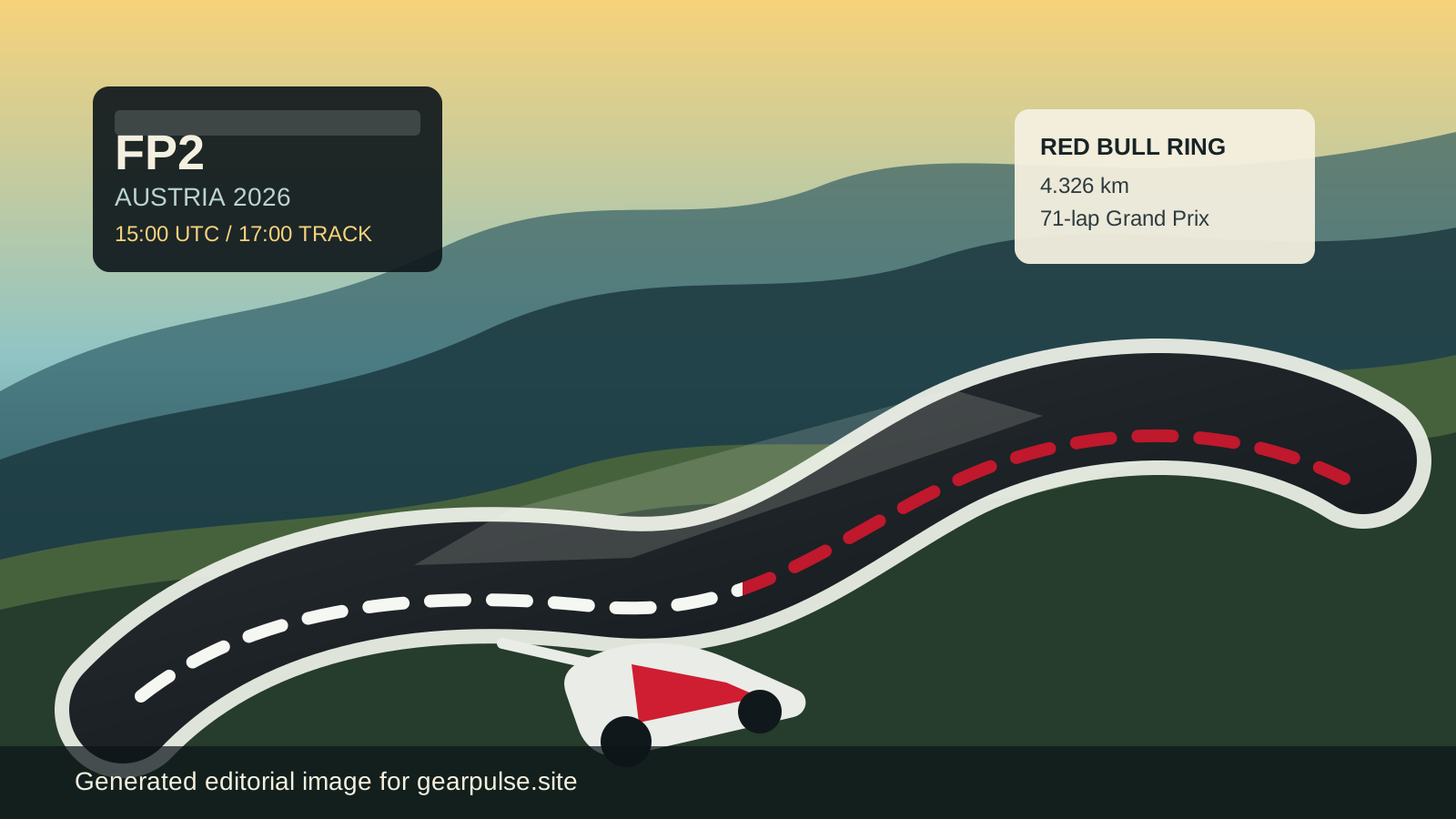
Practice 2 for the 2026 Austrian Grand Prix starts at 15:00 UTC on Friday, June 26. At the Red Bull Ring, that is the hour that should begin separating real pace from early-session housekeeping.
The official Formula 1 race hub lists FP2 as a one-hour Friday session at Spielberg, with Practice 3 and qualifying still to come on Saturday. The same race page puts the current Red Bull Ring at 4.326 km, with a 71-lap Grand Prix distance of 307.018 km. Those numbers explain why this session matters: the lap is short, the field can compress quickly, and a setup miss is harder to hide because there are fewer corners in which to claw time back.
FP2 is still not a result. It is a better question.
Why FP2 matters more here
Austria is a compact lap with three obvious stress points: braking stability, rear traction and kerb confidence. Pirelli’s weekend notes, published through Formula 1, describe Spielberg as a stop-start layout at roughly 660 metres above sea level, with elevation change, heavy braking and traction zones all feeding into tyre temperature.
That makes FP2 the most useful Friday comparison. Teams can run closer to representative fuel loads, track temperature is more relevant than the opening hour, and the softest Pirelli range is in play: C3 as hard, C4 as medium and C5 as soft. Pirelli also notes that degradation here is mainly thermal rather than pure wear, with old, rough asphalt generating heat and rear tyres taking stress out of the traction zones.
In plain English: one lap can flatter a car, but repeated laps should reveal who is sliding and who has margin.
| FP2 question | What it tells us |
|---|---|
| Can the car stop cleanly downhill? | Front locking and instability can wreck confidence before the final sector. |
| Does the rear tyre survive a short run? | Spielberg’s traction zones can make a quick car fade fast. |
| How much wing can teams carry? | The altitude and straights reward efficiency, but the final corners still need trust. |
| Are upgrades behaving consistently? | New floors, wings and bodywork need correlation before qualifying trim. |
The form guide, without pretending it is settled
The official driver standings before the weekend put Kimi Antonelli on 156 points, Lewis Hamilton on 115, George Russell on 106, Charles Leclerc on 75, Lando Norris on 73 and Oscar Piastri on 68. That frames the main comparison: Mercedes has the points lead, Ferrari has the nearest single-driver challenger, and McLaren is trying to convert development work into a less fragile weekend.
For FP2, the most interesting comparison is not just Mercedes versus Ferrari. It is Mercedes’ braking and traction platform against Ferrari’s recent momentum, with McLaren and Red Bull testing whether new parts change the shape of the fight.
Here is a non-betting editorial probability board for likely FP2 standouts, using only pre-session form, track fit and published team context:
| FP2 standout candidate | Editorial probability | Why |
|---|---|---|
| Mercedes | 25-35% | Antonelli and Russell enter Austria first and third in the drivers’ standings, and the Red Bull Ring rewards braking confidence and traction repeatability. |
| Ferrari | 20-30% | Hamilton and Leclerc have enough points and pace context to make Ferrari a serious Friday threat if tyre temperature stays under control. |
| McLaren | 15-25% | Norris has been frank that McLaren is behind in the development race, but Friday running is exactly where an experimental rear-wing direction can show whether the gap is narrowing. |
| Red Bull | 15-25% | Verstappen has talked up the importance of Red Bull’s home event and the team is running updates, but the value of those parts still has to show across a full Spielberg lap. |
| Cadillac or another midfield improver | 5-15% | Short laps reward a clean starting setup, and a team with new parts can look sharper than expected if correlation is good. |
The ranges are wide by design. FP2 programmes are not identical, and the fastest lap does not always belong to the best-prepared car.
Red Bull and McLaren are both upgrade stories
Red Bull’s home weekend is more than atmosphere. Formula 1 reported that Max Verstappen expects the RB22 upgrade package to bring more performance, while still treating it as part of the normal development cycle rather than a guaranteed reset. That is the right tone for FP2: the stopwatch can hint, but balance across the lap matters more.
The Red Bull Ring should expose whether a new package gives Verstappen and Isack Hadjar enough confidence in the fast final corners without giving away straight-line performance. If the car is only strong in one sector, qualifying can become awkward because the lap is too short to make up for a weak phase elsewhere.
McLaren’s question is different. Norris has said the team is still months behind its rivals in the current development race, and Formula 1’s Austria build-up says he is set to try an experimental rear wing during Friday practice while Oscar Piastri has indicated it is a test item rather than a race-ready assumption. That makes FP2 useful even if McLaren does not top anything. The key is whether the new direction improves the car’s efficiency without hurting tyre life.
Cadillac’s upgrade gets a sharper test
Cadillac is the midfield story to watch because its Austria package is concrete, not just vague optimism. RACER and Motorsport.com both reported a substantial upgrade package for the team’s MAC-26, including new sidepods and floor work, with the aim of closing the gap to the midfield.
Spielberg is a useful place to test that claim. A new floor has to work when the car is braking hard, changing elevation and riding kerbs. New bodywork has to manage cooling and drag without making the rear tyres harder to protect. Sergio Perez and Valtteri Bottas do not need an FP2 headline as much as they need agreement between simulator expectation, driver feedback and lap-repeat quality.
If Cadillac looks cleaner over a sequence of laps, Austria becomes a real progress marker. If the car still struggles with braking support or rear thermal degradation, the package may need more weekends before it translates into points pressure.
Strategy clues start now
Pirelli’s note that Austria can move closer to one-stop territory with the current tyres is important, but it comes with caveats. High late-June temperatures, rough asphalt and sudden Styrian weather shifts can all push teams away from a neat Friday model.
That is why FP2 long runs matter. The C5 soft may be the headline tyre for pace, but the medium and hard will shape race thinking if the surface temperature stays high. The useful clues are not just lap times. They are whether drivers can repeat braking points, whether rear degradation builds gradually or suddenly, and whether teams appear comfortable switching between qualifying and race balance.
Fun fact for context: the Red Bull Ring’s modern layout comes from the mid-1990s Tilke redesign of the old Osterreichring, but Formula 1’s own venue guide still leans into the same identity that makes the place tricky today. It is short, scenic and deceptively simple, with the first half rewarding power and the downhill second half asking for precision.
What to take from the hour
Treat FP2 as the first serious evidence session of the Austrian weekend, not a verdict.
If Mercedes and Ferrari both look settled, Saturday starts with a genuine front-row fight. If Red Bull’s upgrades make the RB22 calmer across the lap, Verstappen’s home-race probability rises. If McLaren’s test parts give Norris and Piastri a cleaner efficiency trade-off, the team may be closer than its public caution suggests. And if Cadillac’s new floor and sidepods behave, the back of the midfield gets more interesting.
The caveat is simple: Friday practice is still practice. Fuel loads, run plans and tyre age remain hidden, and GearPulse has no live telemetry or trackside access. The best FP2 read is therefore disciplined: look for repeated balance, stable tyres and upgrades that behave the same way twice.