
Audi’s 2030 Formula 1 title target is easy to mock because it is so far away.
That is also why it matters.
Motorsport.com reported today that Mattia Binotto has again framed 2030 as the point by which Audi wants to be fighting for the world championship. Audi’s own Formula 1 page says the same thing in corporate language: the team aims to improve every year and, from 2030, should be in a position to compete for world titles.
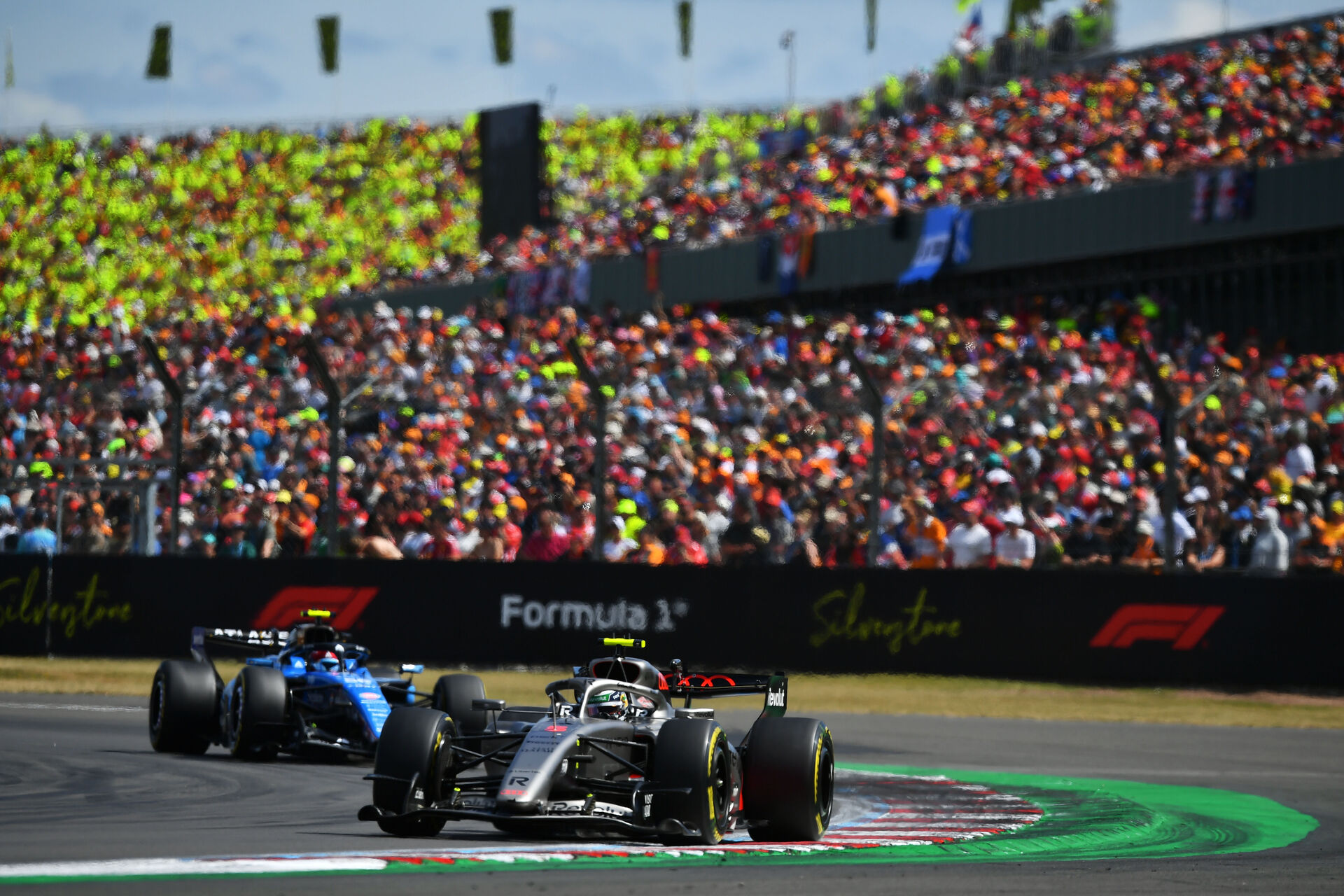
Usually, that would be a future-plan story and not much more. But Gabriel Bortoleto’s eighth place at Silverstone has given the claim a first on-track checkpoint. Audi’s own British Grand Prix report says it was the team’s first points finish since the season opener in Melbourne. Formula 1’s follow-up made the same point and framed Bortoleto’s drive as proof of potential after several near misses.
That is why this is today’s Daily Dose of F1. GearPulse has spent the past week on Red Bull’s trust problem, Williams’ upgrade-correlation worry, McLaren’s customer-engine squeeze and Ferrari’s Madring milestone. Audi is a different story: a new works team trying to prove that a five-year target is not just a launch-deck number.
GearPulse’s view: Audi is not close to a title fight. It is not even close to regular front-running contention. But Silverstone matters because the first honest test of a long-term F1 project is not whether it wins early. It is whether the trend line starts moving before the patience runs out.
Why this story rose today
The fresh hook is Binotto’s 2030 target. The substance is that Audi now has a result to place against it.
Formula 1’s official team page lists Audi ninth in the constructors’ standings after nine grands prix, with six points, two Grand Prix top-10 finishes and no Sprint points. That is not glamorous. It is also not a disaster for a first-year works operation entering during one of the largest regulation resets in modern F1.
The important detail is the spacing. Audi scored at Melbourne, then went through a run of near misses before Bortoleto finished eighth at Silverstone. Audi’s report says he lost places at the start, recovered with a composed drive, and gave the team its first points since Australia. Nico Hulkenberg retired with a gearbox issue, which keeps the weekend from being clean, but it does not erase the direction.
In F1, progress is rarely linear. For a new factory team, the early signal is not just peak pace. It is whether the team can identify mistakes, fix the repeatable ones, and turn chaotic weekends into points when the midfield opens up.
That is what Silverstone offered.
The 2030 target is ambitious, not absurd
Audi’s roadmap gives itself roughly five seasons to become a title-level team. That sounds long to fans and short to people who have watched F1 factories being rebuilt.
The project is spread across three locations: Hinwil for the chassis operation, Neuburg for the power unit, and Bicester for a UK technology base. Audi’s corporate page highlights that three-site structure and the logic behind entering in 2026: new power units, new chassis rules, sustainable fuels, cost control and a chance for all manufacturers to start from a reset.
That is the optimistic case. The skeptical case is just as clear.
| Audi 2030 requirement | Why it is hard |
|---|---|
| Make the power unit competitive | Works control helps, but 2026 hybrid deployment is already exposing big learning curves. |
| Build a sharper chassis operation | Hinwil has strong heritage, but title-winning factories need depth, not nostalgia. |
| Keep Bortoleto developing | A rookie can become a cornerstone, but only if the car gives him enough meaningful races. |
| Extract more from Hulkenberg | Experience is valuable, but Audi needs two-car points, not only mentoring value. |
| Reduce reliability noise | Gearbox and operational failures are expensive when points chances are rare. |
| Recruit and retain elite staff | Bicester helps access the UK talent market, but every front-running team is fighting for the same people. |
So no, Audi is not “on schedule” for a championship just because Bortoleto finished eighth once. But the target is not fantasy either. Mercedes, Red Bull and Ferrari are not unbeatable institutions in this regulation cycle. They are teams trying to solve the same new-car, new-power-unit, new-active-aero puzzle under a cost cap.
Audi’s advantage is that it can align the whole project around one long plan. Its disadvantage is that everyone can see how long the plan is supposed to take.
Bortoleto’s result matters because it was earned
Bortoleto did not score because Audi suddenly became a front-runner.
He scored because he kept the car alive, recovered from a poor start, and took advantage when the British Grand Prix became messy. Formula 1 said he converted an 11th-place grid slot into eighth, while Audi’s own report described a drive built on determination and composure.
For a rookie in a new works team, that is the right kind of result. It does not require exaggerated hype. It shows he can operate when the team has a narrow window.
The comparison with other 2026 midfield stories is useful. Carlos Sainz left Silverstone worried that Williams’ upgrade path was not matching expectations. McLaren left Silverstone with a bigger question about why a Mercedes customer could not exploit the power unit like Mercedes itself. Red Bull left Silverstone with trust issues around active aero. Audi left with one car retired and one rookie in the points.
That is not a perfect weekend. It is a clearer weekend.
The fun fact with an edge: Audi’s first modern F1 points came at Melbourne, the very first race of its works era. Its next points came at Silverstone, the home of F1’s first world championship race in 1950. For a brand using history, engineering and patience as its public pitch, that is a neat coincidence. The harder question is whether the next points arrive because of pace rather than opportunity.
Binotto knows what the hard part looks like
Binotto is not selling a dream from outside the sport. He has lived the Ferrari pressure cycle, where every technical promise gets pulled through politics, Italian media scrutiny and championship expectation.
That context cuts both ways.
On one hand, he understands that a works team has to become more than a factory badge. Ferrari has proved many times that resources alone do not guarantee execution. On the other hand, Binotto’s Ferrari years also showed how quickly long-term engineering plans become vulnerable when race operations, reliability or driver confidence wobble under pressure.
Audi will face a quieter version of the same test. The first season can be framed as a build year. The second can still be framed as consolidation. By the third, “2030” will start sounding much closer. Every missed upgrade, recruitment delay or reliability issue will be measured against that date.
That is why Silverstone is helpful but not decisive. It gives Audi a small proof point. It does not yet prove the organization can compound gains.
GearPulse’s probability read, as editorial analysis rather than betting advice: Audi becoming a regular points team by the end of 2026 feels realistic, around 55-65%, because the car has already shown enough midfield flashes. Audi fighting for podiums before 2028 feels much lower, around 20-30%, unless the power unit or aero concept has hidden upside. A genuine championship challenge by 2030 is plausible but still a long shot, roughly 25-35% from today’s evidence.
Those numbers can move quickly if the team starts scoring with both cars before the summer break.
Why this is not just another manufacturer promise
F1 has heard plenty of big manufacturer promises before. Some became dynasties. Some became expensive exits.
Audi’s case is interesting because the project entered at the exact moment when works-team integration became more valuable again. The 2026 rules tie chassis, power unit, energy deployment, active aero and software behavior tightly together. That is painful for teams learning from scratch, but it also rewards teams that own the full loop.
That is why Audi’s works status matters. McLaren’s recent Silverstone problem showed the awkward side of being a customer in a complex hybrid era: equal hardware does not always mean equal understanding. Audi does not have that problem. It has a harder one instead: if the engine, software or chassis is lacking, there is no supplier to blame.
The upside is control. The downside is accountability.
What Spa can tell us
The next race is Spa-Francorchamps, and it is a useful Audi checkpoint.
Spa’s long lap, high-speed sections and heavy deployment demands will expose whether Silverstone was a one-off result or part of a broader performance step. It will also test reliability, because a gearbox issue on Hulkenberg’s side was exactly the kind of weekend-limiting problem Audi cannot afford if points are still rare.
Do not watch only the final classification. Watch the shape of the weekend:
| Spa signal | What it would suggest |
|---|---|
| Both cars reach Q2 on merit | The baseline is improving, not only Bortoleto’s race execution. |
| Race pace holds up on long straights | The Audi power unit and deployment maps are no longer obvious weaknesses. |
| One car scores again | Silverstone becomes a trend, not a spike. |
| Another reliability failure | The 2030 target remains credible, but the 2026 learning year gets messier. |
For a new team, repeated small confirmations are more valuable than one headline result. Audi needs to make points weekends feel less surprising.
Bottom line
Audi’s 2030 title target is still a promise, not a forecast.
But Bortoleto’s Silverstone points finish gives the promise a first piece of evidence. The team has scored twice in its first nine grands prix, has an official long-term roadmap, and now has a rookie who can turn a narrow opening into a top-eight result.
That does not make Audi a sleeping giant yet. It makes Audi a project worth tracking with a stopwatch rather than a press release.
The honest read is simple: 2030 is far enough away for Audi to build something real, and close enough that every missed step will matter. Silverstone was one small step in the right direction. Spa will tell us whether it was the start of a pattern.