
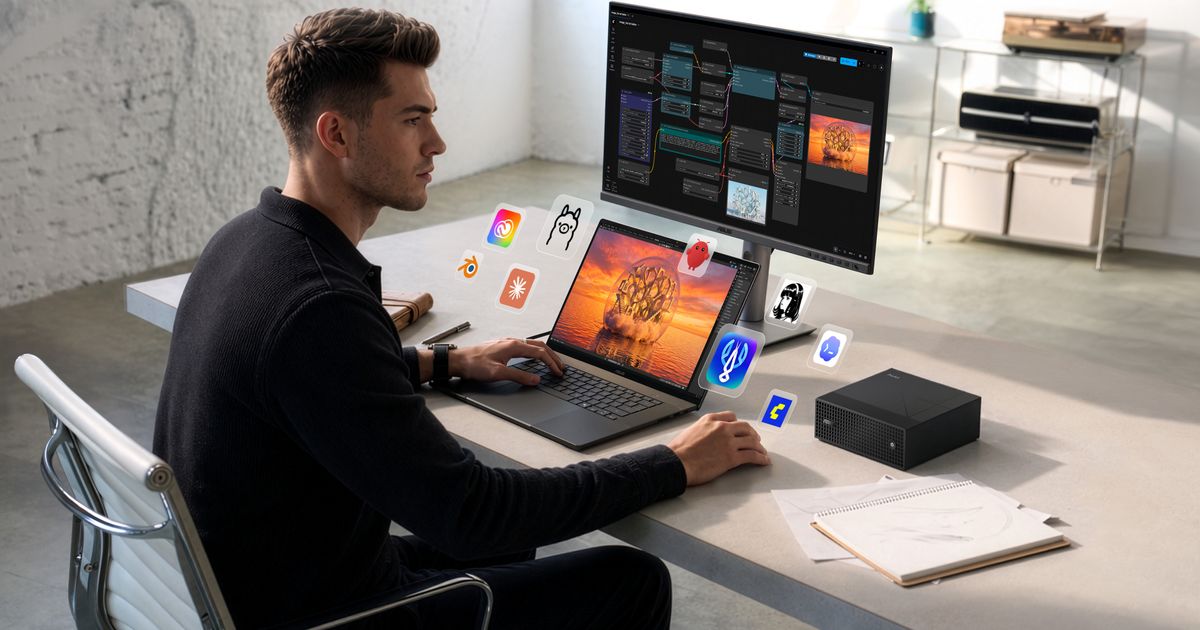
AI PCs have spent two years promising that creative work will become more personal, private and immediate. ASUS’s new ProArt P14, ProArt P16 and compact GR1X are a more concrete version of that pitch: machines built around NVIDIA RTX Spark, with enough unified memory to attempt substantial local AI work rather than merely run a small assistant beside a browser.
The important word is attempt. ASUS says the systems can be configured with up to 128GB of unified memory and can support workloads such as local agents, large language models, 4K AI video generation and large 3D scenes. Those are manufacturer claims, not independent performance results, and the company has not put final pricing in the announcement. But the hardware direction is worth watching because it addresses a real creator problem: cloud AI is powerful, but uploads are slow, recurring costs add up, and many projects are simply not files you want leaving your workstation.
ASUS first showed the P14, P16 and GR1X at its IFA showroom in Berlin on September 2, then included them in its IBC 2026 creator lineup on September 11. Independent reporting from Tom’s Hardware Italia and Igor’sLAB corroborates the core configuration and the local-AI focus. That makes this a product story with a clear use case, not a vague announcement about “AI creativity.”
The useful distinction is where the work runs
Most creative AI workflows are still hybrid by default. A laptop may edit video locally, then send a clip, prompt, image or project metadata to a cloud model. That can be absolutely sensible; it can also be a poor fit for a production house handling embargoed footage, client material or a large archive.
RTX Spark is ASUS’s bet on bringing a heavier class of model work onto the device. The company lists up to 6,144 Blackwell RTX GPU cores, a 20-core NVIDIA Grace CPU and up to 128GB of unified memory for the P14 and P16. The GR1X mini PC is positioned as the desk-bound alternative. Unified memory is significant here because a model and its working data need room to coexist; it does not, by itself, tell us how quickly a given model will respond or render.
| System | ASUS’s stated role | Standout published specification | The question that still matters |
|---|---|---|---|
| ProArt P14 RTX Spark | Portable creator and local-agent laptop | Up to 128GB unified memory; 14-inch 3K 120Hz OLED; 1.48kg | How will sustained performance, battery life and compatibility hold up away from a desk? |
| ProArt P16 RTX Spark | Larger mobile workstation | Up to 128GB unified memory; 16-inch 4K 120Hz OLED; 1.77kg | Can its thin 12.9mm chassis sustain demanding video and model workloads? |
| ProArt GR1X | Compact desktop for local creative AI | RTX Spark-based mini PC | What the final cooling, ports, memory configurations and price look like in retail systems |
Those published specifications explain the appeal, but they are not a buying verdict. A creator choosing between a MacBook Pro, a conventional Windows workstation and an RTX Spark system still needs tests in the actual applications they use: Resolve, Blender, Adobe tools, local model runners and plug-ins. Claimed model-parameter capacity is a particularly bad shortcut for that decision. Quantization, context length, memory bandwidth, model architecture and software maturity all change the result.
Local is valuable only if the workflow is ready
There is a healthy temptation to read “runs locally” as a complete answer to privacy and cost. It is not.
Local inference can reduce the need to upload source material and give a creator more control over what stays on the machine. It does not grant permission to use a model trained on material a user has not licensed; it does not replace backups; and it does not make an AI output accurate. A local workflow also needs model files, storage, updates, a usable interface and a practical way to move results back into the editing or design environment.
That is why ASUS’s emphasis on an ecosystem matters as much as the silicon. Its IBC material mentions ComfyUI workflow verification and demonstrations of on-device generation, while the IFA announcement points to its own creative applications and CUDA-accelerated software. The promise is a machine that keeps the job close to the project, not a machine that magically eliminates the work of configuring a toolchain.
For people who already use local models, this could be welcome simplification. For everyone else, the first question should be less glamorous: does the application you depend on run well on the platform, with the plug-ins and codecs you need? We made a similar distinction in our look at why AI safety sandboxes need production-grade boundaries: capability without reliable controls is not the same thing as a dependable system.
Why creators, rather than gamers, are the target
ASUS is not presenting these as generic high-frame-rate laptops. The ProArt framing is deliberate. A video editor, VFX artist, 3D generalist or developer can value large addressable memory and private inference even when it does not translate neatly into a conventional gaming benchmark.
The P14 and P16 also bring OLED displays, while the IBC lineup extends the idea with production-oriented monitors carrying 12G-SDI connections. That makes this more than a chip launch: ASUS is trying to sell a workflow where the screen, laptop or mini PC and local model can sit on the same side of the studio’s trust boundary.
There is a caveat in that ambition. The more specialised the platform, the more its buyers need clarity on compatibility, support and price. ASUS has shown the hardware and stated its capabilities, but has not published a price in the IFA release. The company’s event material and regional stores should be the source of truth for launch timing and configurations, rather than early listings or extrapolated comparisons.
Bottom line
ASUS’s ProArt RTX Spark machines are interesting because they turn “local AI” into a credible creator-PC design brief: large shared memory, workstation-class graphics, strong displays and a compact desktop option.
They are not yet an automatic recommendation. Until independent tests establish how these systems handle real models, sustained renders, applications and battery life—and until ASUS publishes the price—the responsible view is promising hardware with an unproven workflow. But if the software lands cleanly, local AI may finally become less about a novelty chatbot and more about keeping serious creative work under the creator’s control.