
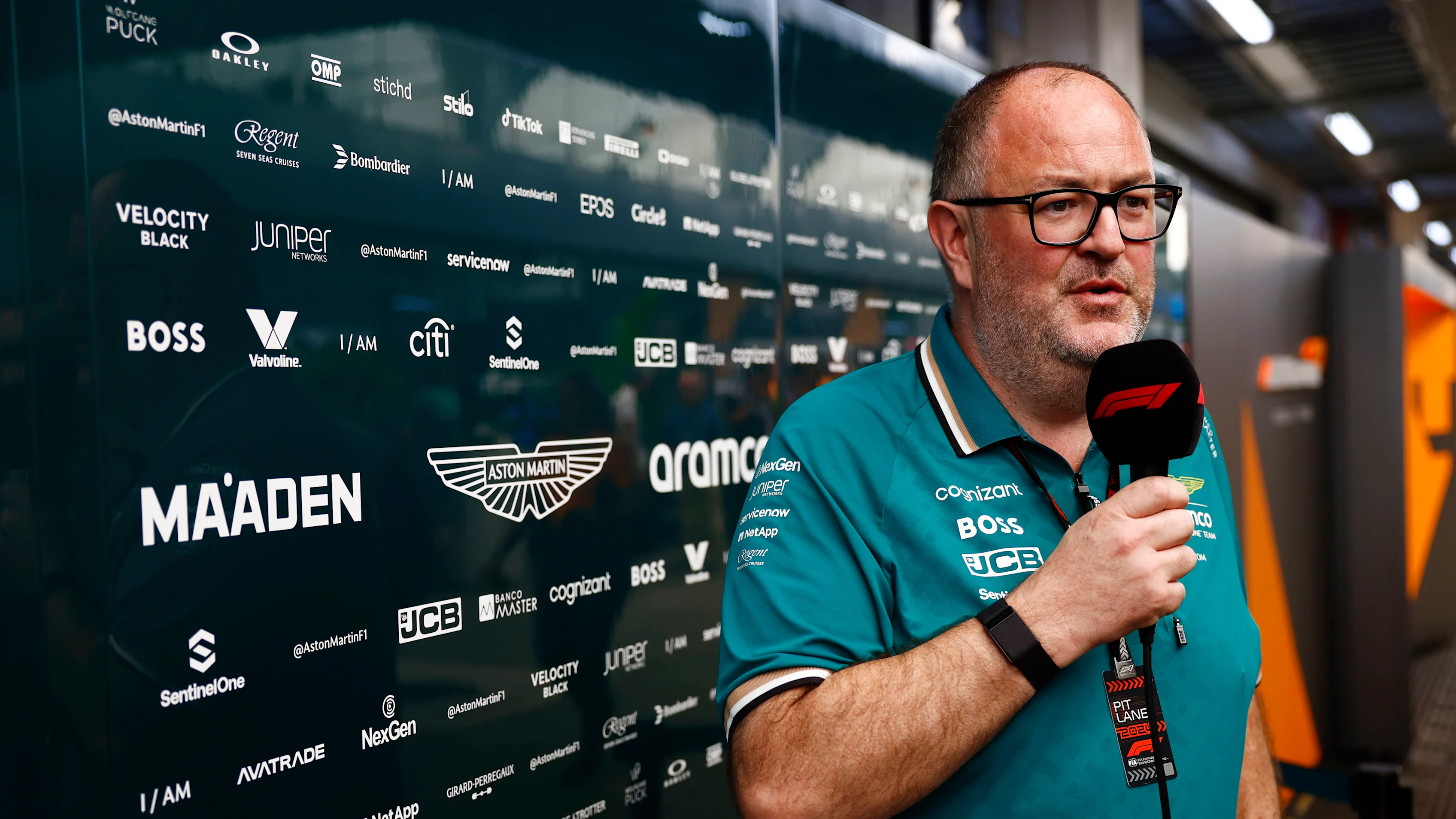
Aston Martin’s most interesting summer-break story is not only about another senior name leaving the Silverstone operation. It is about whether the team has finally stopped being halfway between eras.
Formula 1 reports that Tom McCullough, a long-time Aston Martin engineer, is set to leave at the end of the 2026 season. McCullough spent more than a decade with the same organisation through its Force India, Racing Point and Aston Martin identities, and his trackside-performance brief was already shifted at the start of 2025 when Mike Krack took on the Chief Trackside Officer role.
That is why this is today’s Daily Dose of F1. GearPulse covered Aston Martin’s Hungary upgrade credibility test in July and Honda’s first updated power-unit run later that month. McCullough’s planned exit is the organisational version of the same question: can Aston Martin turn a heavily rebuilt structure into a car-development rhythm before 2027 decisions start hardening around Fernando Alonso, Honda and Adrian Newey?
GearPulse’s view: McCullough leaving is not automatically a crisis. The more precise read is that Aston Martin is now all-in on the Newey-era chain of command. That can be clarifying. It also removes one of the team’s institutional memory holders at exactly the point where the car, the power unit and the leadership model all need to converge.
Why this rose above the rest
This story had the cleanest new angle of the day because it connected a fresh personnel development with Aston Martin’s bigger competitive reset. Formula 1’s report is the key source, and it says McCullough is set to depart after the season, with his next role unclear. PlanetF1 and Yahoo picked up the same leadership-change thread, while Formula 1’s own recent Aston coverage keeps the competitive context live: the team is 10th in the Teams’ Championship, brought a B-spec car to Hungary, plans more chassis work at Monza and Baku, and expects Honda’s first upgraded 2026 power unit at Zandvoort.
The timing matters. August could have produced another general summer-break feature, another first-half ranking, or another 2026-regulation debate. Those are useful, but several overlap with recent GearPulse pieces on development freezes, battery graphics and energy-deployment trust. Aston Martin’s engineering change is narrower, but it gives the day a sharper non-duplicate story: one team’s reset is moving from theory into personnel consequences.
McCullough was part of the continuity
McCullough’s CV is why this is more than a routine departure notice.
Formula 1 notes that he joined Williams in 2002, worked as a data engineer and race engineer, had a stint at Sauber in 2013, then returned to the Silverstone-based team to lead trackside engineering during the Force India years. That was not a ceremonial period. Force India finished fourth in the Constructors’ Championship in both 2016 and 2017, and the Racing Point version of the team won a Grand Prix in 2020 while finishing fourth again.
Those facts matter because Aston Martin’s modern problem is not ambition. It has the campus, Newey, Honda, Alonso and owner-backed patience. The unresolved question is translation: whether the infrastructure can turn resources into predictable lap time.
McCullough represented the old continuity inside a team that has repeatedly changed name, budget level and leadership model. Losing that continuity may make the Newey structure simpler. It may also make the short-term feedback loop thinner if the new group has to relearn why certain Silverstone habits existed in the first place.
Newey’s reset gets less ambiguous
Adrian Newey is now listed by Formula 1 as Aston Martin’s Team Principal and Managing Technical Partner. That is a huge concentration of technical authority, and it makes Aston Martin easier to judge.
Under the old version of the team, underperformance could be explained through split responsibilities: trackside execution here, design direction there, corporate expansion somewhere else. The McCullough move does not mean those boundaries vanish overnight, but it does suggest that Aston Martin’s F1 project is becoming less tolerant of legacy overlap.
The upside is obvious. If Newey’s group wants a specific car philosophy, Honda integration path and race-weekend operating model, the organisation should not need three layers of historical compromise before a decision lands. Aston Martin has been too slow for much of 2026, so clarity has value.
The caveat is just as important. F1 teams do not become faster simply by drawing cleaner org charts. The next proof points are on track: Zandvoort for Honda’s first upgraded power unit, then Monza and Baku for the next chassis developments. If those steps correlate, the McCullough departure will look like part of a painful but coherent reset. If they do not, it will look like another senior movement inside a team still searching for a repeatable technical process.
The Alonso factor raises the stakes
Fernando Alonso is the practical pressure gauge here.
Formula 1’s recent Newey interview framed Aston Martin’s chances of keeping Alonso for 2027 as part of the team’s wider direction, not just a contract formality. That is the right lens. Alonso does not need a polished corporate story; he needs evidence that Aston Martin’s next car and Honda partnership can give him something worth extending for.
That is where McCullough’s exit becomes strategically interesting. Aston Martin can pitch a cleaner future: Newey leading the technical project, Honda updating the power unit, Krack running the trackside brief, and more developments arriving after the break. But Alonso has enough experience to know that a cleaner pitch is not the same as a faster car.
My probability read is cautious. It is more likely than not, say 60-70%, that this departure is part of a planned reshaping rather than a sudden panic response. McCullough had already been moved away from the core F1 trackside role in 2025. But there is also a real 30-40% risk that Aston Martin is still changing its operating model faster than it is improving the AMR26.
What to watch after the break
The next few races should tell us whether this is healthy pruning or another sign of friction.
| Checkpoint | Why it matters |
|---|---|
| Zandvoort Honda update | The first upgraded power unit should show whether the Aston-Honda integration path is improving usable performance, not just headline deployment. |
| Monza chassis step | Low-drag efficiency will expose whether Aston Martin has fixed more than slow-corner balance. |
| Baku package | Street-circuit traction, braking and confidence should test whether the Hungary B-spec gain travels. |
| Alonso messaging | If Alonso starts talking in concrete progress markers rather than patience, the reset will sound more credible. |
The fun historical wrinkle is that Aston Martin is now trying to rebuild the kind of lean effectiveness that Force India once had, but with the opposite resource profile. Force India punched above its budget. Aston Martin has to prove a bigger budget has not made it slower to learn.
Bottom line
Tom McCullough’s planned exit is not the whole Aston Martin story. It is a marker.
The team has moved from buying credibility to having to demonstrate it. Newey, Honda, Krack and the late-season updates now carry a clearer burden because there is less room to blame the leftovers of an old structure. If Aston Martin’s next three technical steps work, this will look like the moment the reset sharpened. If they do not, McCullough’s departure will feel less like simplification and more like another symptom of a team still trying to make its ambition behave like lap time.