
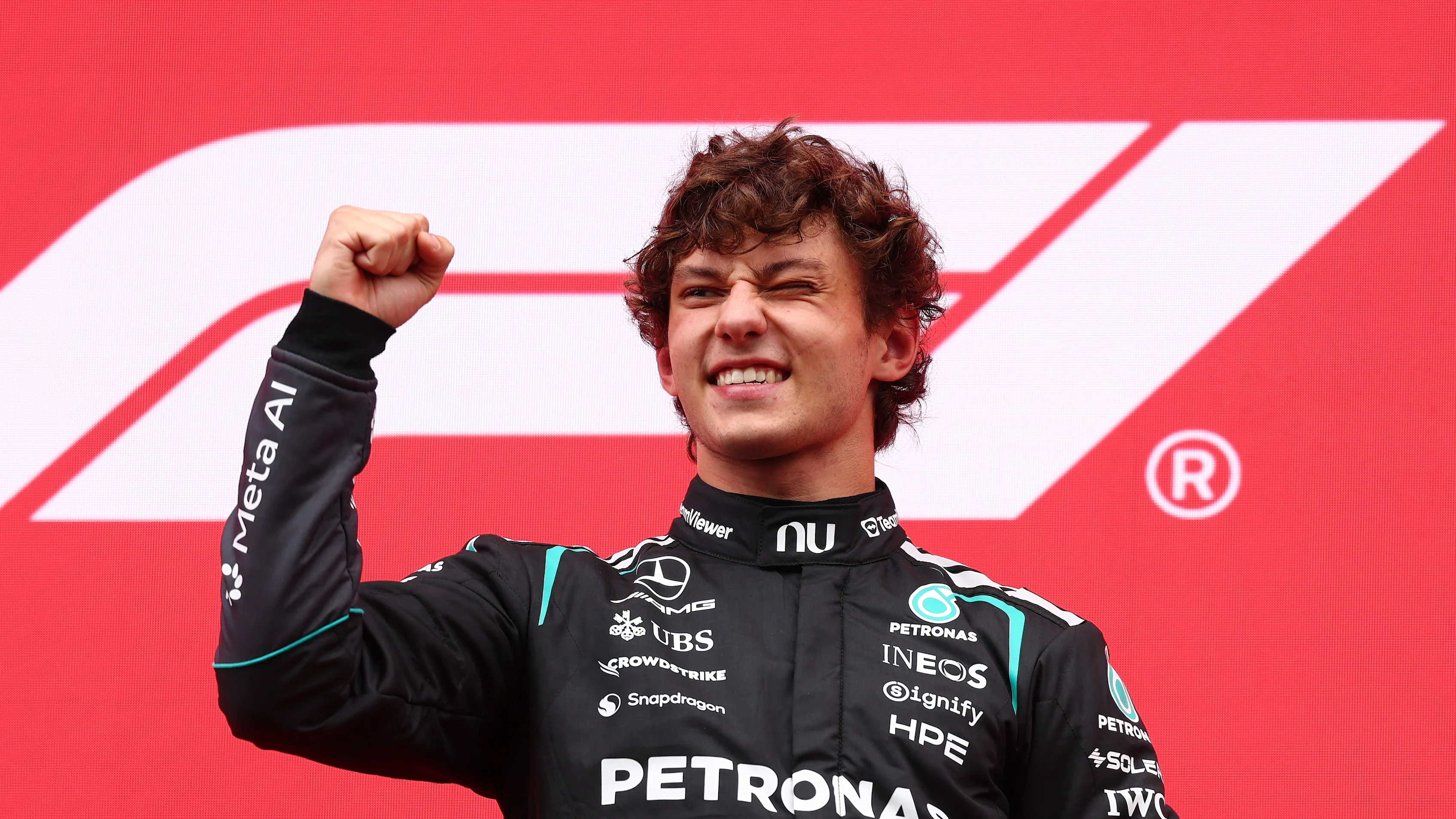
Kimi Antonelli did the clean champion-in-waiting thing at Spa-Francorchamps. He won from pole, recovered from a Virtual Safety Car swing that handed Charles Leclerc track position, passed the Ferrari again with the race running out, and left Belgium with his sixth win of the season.
Mercedes did the less comfortable thing at the same time. Its own race report says both cars suffered from a lack of boost on the opening lap, with George Russell hit harder, swamped on the Kemmel run and then eliminated after contact with Lewis Hamilton at Les Combes. The FIA’s final classification records Antonelli first after 44 laps and Russell as a lap-zero DNF.
That is why this is today’s Daily Dose of F1. The headline result is Antonelli’s win, but the more useful story is what sat underneath it: Mercedes has the car to beat, the championship leader to protect it, and a 2026 energy-management problem that can still turn a front-row race into a zero before the first lap is complete.
GearPulse’s view: Belgium made Antonelli look more like the title favourite. It also made Mercedes look less in control than the points table suggests.
Why this story rose today
This was not just a race recap story. It had every signal a Daily Dose pick needs: official classification from the FIA, a full FIA race report, Formula 1’s official race coverage, a primary Mercedes post-race report, and immediate specialist/mainstream pickup from The Guardian, AP, Motorsport.com, Autosport, RaceFans, Sky Sports F1 and The Race.
It also moved the championship narrative. Before Spa, Russell still had a plausible route back toward Antonelli after the momentum swings of Silverstone and Belgium qualifying. After Spa, Antonelli is on 204 points. Hamilton’s fourth place puts him second on 159, while Russell remains on 154 after scoring nothing. That means Antonelli’s cushion is 45 points over Hamilton and 50 over his Mercedes team mate.
The number matters because it changes the burden of proof. Russell no longer only needs to out-drive Antonelli. He needs Mercedes to make the car repeatable enough that his side of the garage stops losing weekends to opaque deployment behavior, reliability trouble and compromises that are hard to separate from driving style.
The race was won twice
On paper, Antonelli’s Spa win looks tidy: pole, victory, 25 points. On track, it was more useful than that because he had to solve the two things that made the weekend dangerous.
The first was Verstappen’s opening attack. The FIA race report describes Verstappen getting ahead after La Source and Eau Rouge before Antonelli reclaimed the place on the run toward Les Combes. That was not a normal drag race. The 2026 cars have made energy deployment part of the racing grammar, and the start showed huge differences between cars and systems.
The second was Ferrari’s VSC break. Leclerc emerged ahead after the pit phase and briefly turned the race into a Ferrari control test. Antonelli then reduced the gap and passed him with just under 10 laps left. The FIA final classification shows the margin at the flag was only 1.952s, with Verstappen 11.586s back in third.
That final gap is the fun fact hiding in the result: Spa is 7.004 km long, but the race still came down to less than two seconds after 308 km. Antonelli did not win because Spa became easy for Mercedes. He won because, when the race state moved against him, he had enough pace and composure to recover without over-stressing the tyres or battery.
That is title-grade driving. It is also why the team’s separate reliability problem is so awkward.
The boost issue is bigger than Russell
The tempting reading is that Russell had a bad weekend and Antonelli had a great one. That is partly true, but it is too neat.
Mercedes says both cars lacked boost out of Turn 1. Toto Wolff said the team was investigating why, and Mercedes trackside engineering director Andrew Shovlin described it as another example of the learning still required under these regulations. Russell, in Mercedes’ own post-race comments, said the issue at the start was different from the weakness the team had been chasing earlier in the weekend.
That distinction matters. If the deficit were simply Russell over-driving, braking differently or making the battery work harder, the fix would mostly live in the cockpit. But Mercedes’ wording keeps the door open to a system issue, and the FIA post-race press conference backed up the broader complexity. Antonelli said deployment weirdness can happen in these cars, especially on an energy-demanding track like Spa, while Leclerc described how drivers can do similar laps and still get different straight-line outcomes.
Verstappen’s blunt summary was the most useful one: welcome to F1 2026.
The problem for Mercedes is that this is no longer theoretical. Antonelli had enough performance to win despite losing time to the VSC. Russell had too little speed at exactly the wrong point, got absorbed by the Ferraris and ended up in a collision that Hamilton was penalised for but Russell did not want to reduce to blame.
That is the title picture in miniature. The W17 can be excellent. It can also be strangely fragile.
Hamilton’s penalty was the subplot, not the answer
Hamilton’s five-second penalty will pull attention because the images were dramatic and the history is rich: former Mercedes leader, now in Ferrari red, tangling with Russell at Spa. But for the championship, the penalty is secondary.
Russell’s own explanation is the guide. Formula 1 reported that he said he was 30 to 40 percent down on battery after Turn 1 and that, in normal circumstances, he believed he would have been fighting Antonelli and Verstappen rather than Hamilton. The Guardian’s post-race reporting also focused on Wolff accepting Mercedes responsibility for the power loss that left Russell exposed.
That does not erase Hamilton’s role. The stewards’ penalty and the final result both stand. It does, however, stop this becoming a simple Hamilton-versus-Russell blame story. Russell’s DNF was the visible consequence. The invisible trigger was the car arriving at the Kemmel Straight without the expected energy.
For Ferrari, the more encouraging part is that Leclerc looked genuinely dangerous again. After winning at Silverstone, he pushed Antonelli at Spa and forced Mercedes to win the race, not inherit it. That gives Ferrari a real Hungary question: was Spa another low-drag, high-energy anomaly, or has the recent upgrade path made the car more repeatable?
The cautious answer is somewhere in the middle. Leclerc said in the FIA press conference that Ferrari should avoid assuming too much before Budapest. That is sensible. Hungary rewards different strengths than Spa, and the Hungaroring will reduce the premium on long-straight deployment. But Ferrari is no longer just waiting for Mercedes to stumble. It is applying pressure.
What it means for the title fight
Antonelli’s probability of winning the drivers’ title went up sharply today, in editorial terms. Not because one race mathematically settles anything, but because Belgium combined three important signals:
| Signal | Why it matters |
|---|---|
| Antonelli won after losing track position | He handled a messy strategic swing without waiting for Ferrari to fade. |
| Russell scored zero | A 50-point gap to a team mate is no longer a small run of bad luck. |
| Mercedes admitted a boost issue | The team’s weakness is not fully understood, so it can return. |
The constructors’ story is more complicated. Mercedes clearly has race-winning pace and now has eight team wins this season, according to its race report. But a title team does not only need the fastest car on its best days. It needs both cars to survive bad starts, mixed strategy phases, component limits and the occasional awkward Safety Car.
Spa showed the upside and downside in the same garage. Antonelli maximised the day. Russell lost a possible podium, maybe more, before the race had properly settled.
For Russell, Hungary is not just a reset. It is a credibility test. If the deployment issue disappears and he is immediately back beside Antonelli, Belgium can be filed as a brutal technical weekend. If the same straight-line uncertainty follows him to Budapest, the title fight will begin to look less like a two-driver Mercedes duel and more like Antonelli versus everyone else.
Skipped candidates
Hamilton’s penalty and Ferrari’s pit-lane drama were tempting, but they were subplots inside the larger Mercedes/Russell title swing and risked becoming incident-only analysis.
Leclerc’s Ferrari form was strong enough for a standalone piece, especially after Silverstone, but GearPulse covered Ferrari’s Spa upgrade test on July 15 and the Belgian result is more interesting when treated as pressure on Mercedes rather than a simple Ferrari rebound.
Hadjar’s drive from 21st to sixth for Red Bull was a good performance story with a fun midfield angle, but it had less championship weight and less primary-source depth than the Mercedes boost problem.
Norris’s recovery to seventh with fastest lap mattered after his grid penalty, yet GearPulse covered the McLaren reliability tradeoff on July 16. Spa did not change that angle enough to justify another Norris-led article today.
Bottom line
Antonelli’s Belgian GP win was the cleanest possible answer to a messy few weeks. He did not simply inherit a better car; he had to repass Leclerc, manage Verstappen’s early threat and turn Mercedes’ pace into a full 25 points.
But Mercedes should not leave Spa comfortable. The same opening-lap boost behavior that did not stop Antonelli nearly swallowed his race start and did end Russell’s. That is the paradox of Mercedes’ 2026 season so far: the title favourite is real, but the machinery underneath him still has enough mystery to keep the championship alive.