
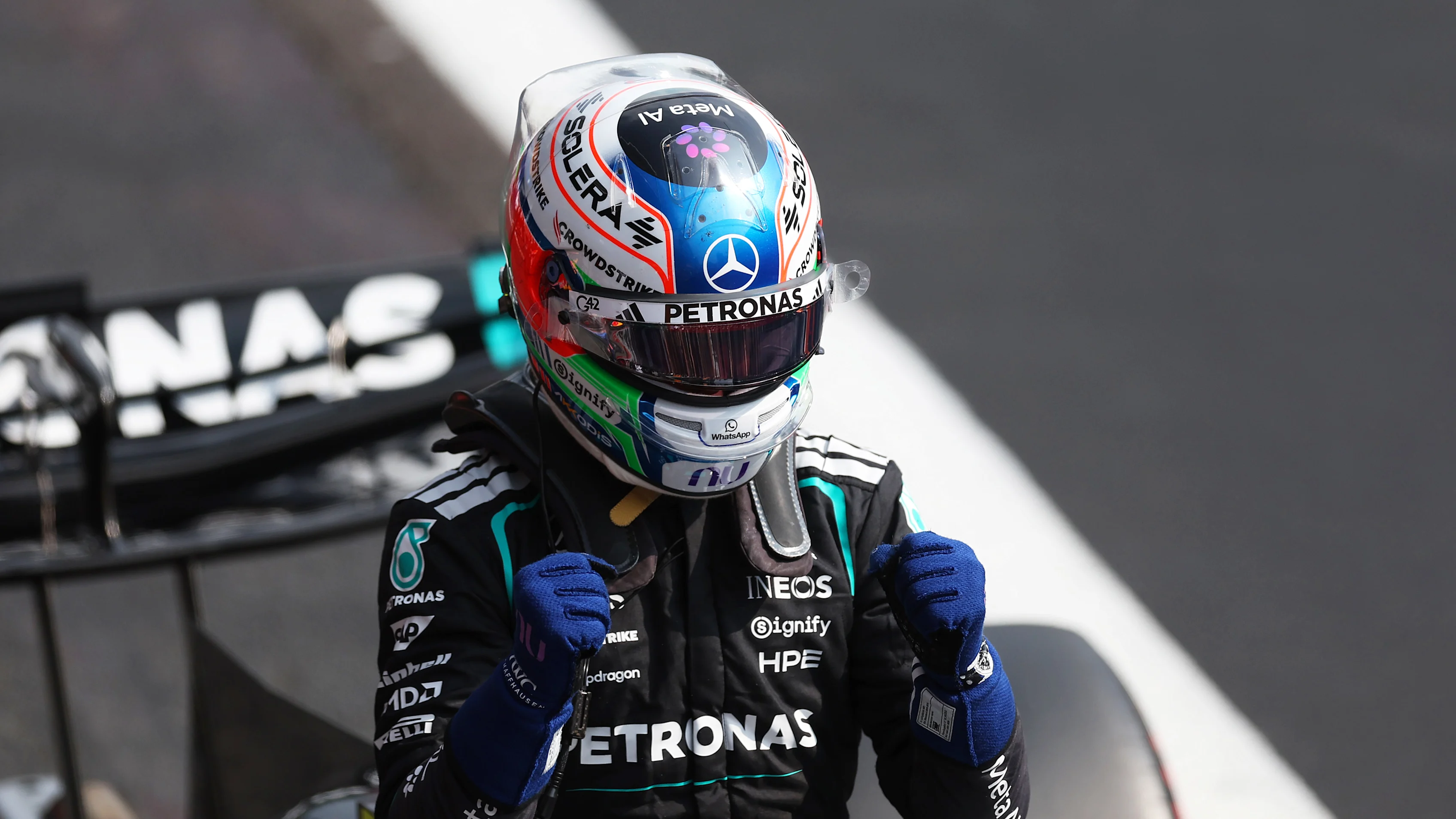
The Belgian Grand Prix grid now gives Mercedes the clean answer it wanted, but not the simple one.
Kimi Antonelli took pole at Spa-Francorchamps with a 1:44.361, according to the FIA’s provisional qualifying classification, beating Max Verstappen by 0.317s. Lando Norris qualified third but carries a 10-place grid penalty, which means George Russell moves into a much more valuable effective starting position despite being more than half a second away from his Mercedes team mate on the stopwatch.
That is why this is today’s Daily Dose of F1. It is not just another Antonelli-is-fast story after Friday’s practice turnaround. The interesting part is what Saturday changed: Mercedes has the best grid position, Red Bull needed teamwork to get Verstappen alongside, McLaren’s best lap is trapped behind a penalty, and Russell’s qualifying gap makes Mercedes’ title control look powerful but uneven.
GearPulse’s view: Spa qualifying turned Mercedes from a team searching for balance into the Sunday reference. It also made the title fight feel more dependent on Antonelli than a championship leader should want.
Why this story rose today
The source trail is unusually clean for a same-day qualifying story.
The FIA published the provisional classification. Formula 1 carried the official session report and team-by-team reaction. Mercedes published its own qualifying report. The FIA post-qualifying transcript put Antonelli, Verstappen and Norris in the same room to explain the lap, the tow and the penalty-shaped race ahead. Motorsport.com, RaceFans and The Guardian all picked up the front-grid tension within hours.
The trend signal is also obvious: Spa qualifying is the live sporting center of the F1 weekend, and this session had three hooks instead of one.
| Saturday hook | Why it matters |
|---|---|
| Antonelli pole by 0.317s | The title leader converted Mercedes’ Friday recovery into confirmed grid control. |
| Verstappen front-row tow | Red Bull used Isack Hadjar strategically and still could not match the Mercedes lap. |
| Norris third, penalty applied | McLaren had speed but not starting position after its power electronics change. |
| Russell fourth on time | Mercedes has two cars near the front, but not two identical confidence levels. |
| Ferrari fifth and sixth | The Spa upgrade story is alive, but Ferrari did not own the front row. |
That combination made it stronger than a narrower Ferrari yellow-flag item or another Norris penalty follow-up. The qualifying result changed the race shape for all of them.
Antonelli has the cleanest case for control
Antonelli’s weekend has now moved from promising to strategically commanding.
On Friday, the useful caveat was that Mercedes had found a better setup direction but still lacked a clean long-run read. On Saturday, the caveat changed. Pole is real. A three-tenth margin at Spa is not a rounding error. On a 7.004 km lap, it still has to be treated carefully because tow, battery deployment, track evolution and tyre prep can distort comparisons, but Antonelli did not scrape pole out of chaos. He produced the lap when the session demanded it.
Formula 1’s report and FIA timing agree on the key number: 1:44.361. Mercedes’ own account adds the practical detail that the team focused FP3 on single-lap work after Friday’s balance changes. That matters because the W17 looked much more coherent over one lap today than it did at the start of the weekend.
The championship implication is straightforward. Antonelli already leads Russell by 25 points and Hamilton by 32 in the official standings used by GearPulse earlier this weekend. If he converts pole into a controlled Belgian GP, Spa becomes a reset after Silverstone reliability frustration and Friday uncertainty.
If he does not, the questions become sharper because the car clearly had enough pace to start from the best place.
Russell is the uncomfortable comparison
Russell’s qualifying is not a disaster. After Norris’s penalty is applied, starting third at Spa is strong. It keeps Mercedes in position to pressure Verstappen and protect Antonelli from strategy splits.
But the intra-team number is hard to ignore. Russell was fourth on the road, more than half a second behind Antonelli. Formula 1’s team reaction notes he had been working harder for pace, particularly on the straights, and Saturday did not fully erase the impression from Friday that the two Mercedes drivers are not receiving the same confidence from the car.
That creates a more nuanced Mercedes read:
| Mercedes driver | Saturday evidence | Sunday question |
|---|---|---|
| Kimi Antonelli | Pole, fastest lap of qualifying, clean response under pressure. | Can he control Verstappen into Les Combes and manage Spa’s energy/tyre load? |
| George Russell | Effective P3 start after Norris penalty, but a large team-mate gap. | Can he race as Mercedes’ second weapon rather than just insurance? |
This is the one-car question in the headline. Mercedes probably has the fastest single-lap package at Spa. What is less clear is whether it has two cars operating in the same window. In a title fight, that distinction matters.
If Russell can attack Verstappen or cover Ferrari, Mercedes controls the race with options. If he spends Sunday defending, Antonelli carries the front alone.
Verstappen’s front row was engineered, not accidental
Red Bull deserves credit for making Verstappen’s front-row start happen.
Motorsport.com and RaceFans both highlighted the tow element, and Verstappen acknowledged in the post-qualifying context that Isack Hadjar’s help mattered. That is classic Spa thinking. The Kemmel Straight can make a tidy slipstream worth real lap time, and in a field compressed by the 2026 regulations, the second car can become a tool even if it is not fighting for pole itself.
The interesting part is what the tactic did not do. It did not beat Antonelli.
That is important after recent Red Bull stories around rotating-wing confidence, Verstappen’s future and the team’s need to rebuild trust. A front-row start at Spa is a genuine sporting answer. But needing the tow and still missing pole by more than three tenths keeps Red Bull in the challenger category rather than the favorite category.
For Sunday, Verstappen’s best path is obvious: launch well, make Antonelli defend early, and turn Spa’s long run to Les Combes into a pressure event. If he sits behind after the first lap, Mercedes’ cleaner qualifying pace and track position start to matter more.
Norris had the lap, not the grid
Norris is the most awkward case of the day.
Formula 1’s follow-up piece had Norris calling his qualifying lap one of his best, and the timing sheet supports the pride: third-fastest at Spa with a McLaren already carrying reliability baggage is a serious lap. The problem is that the 10-place penalty from McLaren’s fourth power electronics unit turns a front-row-adjacent qualifying into a recovery race.
GearPulse covered the penalty on July 16, so the fresh point is not that McLaren took the hit. It is that Saturday proved the cost in a more painful way. Norris did exactly the kind of lap McLaren needed, then still lost the starting position.
| Norris read | GearPulse interpretation |
|---|---|
| Third on raw qualifying pace | McLaren is not slow enough to write off. |
| Starts outside the front group | The reliability bill now has a visible sporting cost. |
| Spa overtaking potential | Recovery is realistic, but tyre and energy management must be clean. |
| Piastri lower in the spotlight | McLaren needs both cars to keep Mercedes and Ferrari honest. |
The probability frame, strictly as editorial analysis and not betting advice: a Norris podium from the penalty-hit grid is possible but needs a helpful race shape. Strong points are the more realistic target. A quiet finish would make the penalty look sensible but not painless.
Ferrari’s missed chance is smaller than it looks
Ferrari qualified fifth and sixth on the road with Charles Leclerc ahead of Lewis Hamilton, then gains one place from Norris’s penalty. That is not the breakthrough Ferrari wanted after bringing Spa momentum and upgrade attention into the weekend.
It also is not a failed weekend yet.
Hamilton crashed late in FP3, and Ferrari still repaired the car in time for him to qualify inside the top six. Formula 1’s team reaction noted Leclerc had to lift after seeing a yellow flag connected to a pit-lane incident, costing him time on the final run. Motorsport.com’s wider qualifying coverage and Ferrari’s own recap both point to a team that was close enough to be annoyed, not lost enough to panic.
The caveat is that this is exactly where Ferrari has to be careful. A near miss at Spa can become a good Sunday if the car races well. It can also become another proof point that Mercedes still controls the sessions that set the weekend’s terms.
For Leclerc and Hamilton, the target is not only podium. It is pressure. If Ferrari can force Mercedes and Red Bull into strategy choices, the qualifying disappointment stays alive as context rather than verdict.
Spa makes the grid less settled than it appears
The official Formula 1 race hub lists Spa-Francorchamps at 7.004 km and 44 laps. Those numbers matter because Spa is the rare modern F1 circuit where a compromised grid slot is not automatically a sentence.
Long straights create slipstream opportunities. The Bus Stop and Les Combes create passing attempts. Changeable Ardennes weather can make one sector feel like a different circuit. The 2026 power-unit and active-aero rules add another layer: deployment choices can make a car look strong early in the lap and less convincing later.
Fun fact with a practical edge: Spa is still roughly half the length of the old public-road layout, yet it remains the longest circuit on the current calendar. That makes every setup compromise more visible. A car that is draggy, nervous or energy-limited has more time to confess.
That is why pole is powerful but not absolute. Antonelli has the best position. Verstappen has the most obvious first-lap attack. Russell has Mercedes’ strategic cover role. Norris has the recovery script. Ferrari has enough starting position to turn a Safety Car, weather shift or tyre offset into a problem for the front two.
GearPulse probability board
This is editorial analysis, not betting advice.
| Belgian GP outcome | Likelihood read | Why |
|---|---|---|
| Antonelli controls the race from the front | 45-55% | Pole, Mercedes pace and clean Saturday execution support it, but Spa starts are volatile. |
| Verstappen leads early or forces Mercedes into defence | 30-40% | Front row plus Spa tow dynamics make the opening lap a real threat. |
| Russell becomes a genuine win factor | 25-35% | Starting position helps, but his qualifying gap makes this less automatic. |
| Norris reaches the top five | 45-55% | McLaren pace and Spa recovery potential are real; traffic and tyre wear are the tax. |
| Ferrari finishes on the podium | 35-45% | Leclerc/Hamilton are close enough to profit, but Mercedes and Verstappen start with cleaner leverage. |
The most likely race shape is not dominance. It is Antonelli trying to make pole boring while everyone behind him tries to make Spa complicated.
Bottom line
Mercedes got the result it needed from Belgian GP qualifying. Antonelli put the W17 on pole, turned Friday’s setup recovery into something measurable, and gave the championship leader the cleanest path into Sunday.
But the result also sharpened the team’s weakness. Russell is close enough on the grid to help but not close enough on raw qualifying pace to make Mercedes look fully two-pronged. Verstappen is beside Antonelli because Red Bull used Spa intelligently. Norris showed McLaren speed that his penalty will hide on the grid. Ferrari missed pole but not relevance.
That makes Spa more than a qualifying win. It is a control test. If Antonelli converts it, Mercedes leaves Belgium looking steady again. If he has to fight alone, the title lead will still be real, but the comfort around it will keep shrinking.
Support the site at buymeacoffee.com/gearpulse.site.