
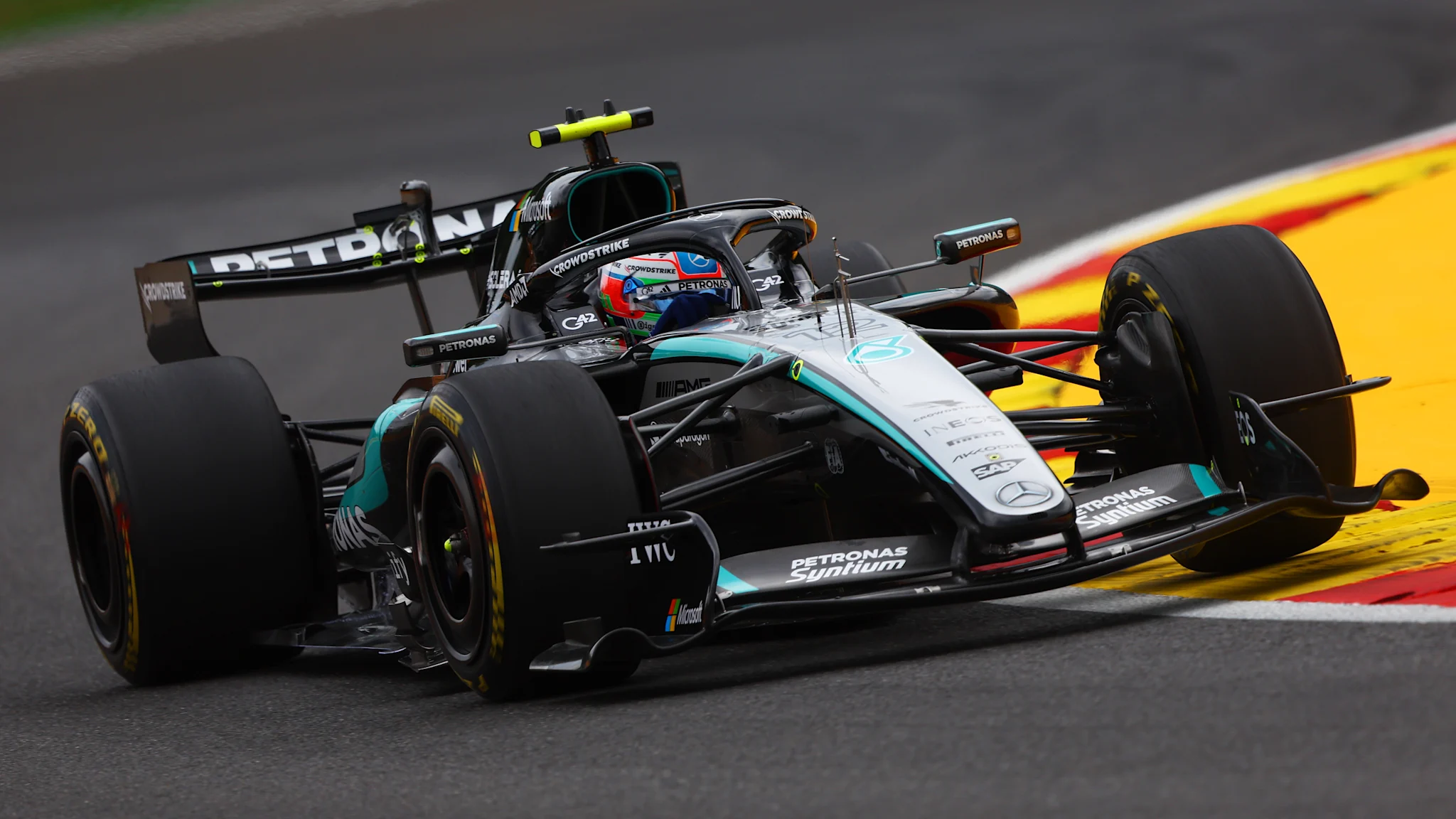
Kimi Antonelli did not win anything at Spa on Friday.
That is the caveat that has to come first. Practice is not qualifying, fuel loads are hidden, tyre preparation can flatter or punish a lap, and two red flags reduced the quality of the long-run evidence. But the reason Antonelli’s FP2 benchmark is today’s Daily Dose of F1 is not the headline lap by itself. It is the shape of the day around it.
Mercedes started the Belgian Grand Prix weekend looking uncomfortable. In its own Friday report, the team said neither driver was happy with the balance in FP1, with Antonelli sixth and George Russell eighth. Between sessions, Mercedes changed enough for Antonelli to top FP2 with a 1:45.944, ahead of Lando Norris and Max Verstappen. Formula 1, Motorsport.com, Sky Sports F1 and RACER all landed on the same core point: Mercedes found a sharp single-lap response, but the red flags left race pace less settled.
GearPulse’s view: that makes this more interesting than a routine practice report. Spa is a title-control test. Mercedes still leads the championship picture, but the field has become awkwardly compressed: Ferrari has momentum, Norris is compromised by a grid penalty but still looked quick, Verstappen put Red Bull at the front in FP1, and Mercedes’ own drivers are not having the same weekend yet.
Why this story rose today
The trend signal was clean: official timing, primary team context, multiple major F1 outlets and immediate Spa relevance.
Formula 1’s official FP2 report put Antonelli ahead of Norris by 0.190s and Verstappen by 0.472s. Mercedes’ report adds the more useful explanation: the W17 was under-winged in FP1 because the team overestimated grip, then improved after setup changes. Andrew Shovlin’s post-session comments framed Russell’s P8 as less representative because he had only one soft-tyre attempt with the tyres not quite in the right window.
That matters because the Mercedes title story has become more complicated than “fastest car, protect the lead.” Antonelli leads the official drivers’ standings on 179 points, with Russell on 154 and Lewis Hamilton on 147. The lead is real. The comfort has gone.
| Friday signal | What it suggests |
|---|---|
| Antonelli P6 to P1 across FP1/FP2 | Mercedes found a setup direction quickly. |
| Russell P8 in both sessions | The second Mercedes is not yet as clean over one lap. |
| Norris P2 in FP2 | McLaren’s pace is still dangerous even with Norris’s Sunday penalty. |
| Verstappen P1 in FP1, P3 in FP2 | Red Bull is not just contract-drama background noise. |
| Red-flagged long runs | Sunday pace remains less certain than the timesheet suggests. |
The Friday result is therefore not proof that Mercedes is back in full control. It is proof that Antonelli and Mercedes can still rescue a messy start quickly. In a season shaped by reliability, active-aero learning and power-unit deployment compromises, that is a meaningful skill.
Antonelli’s lap was the least surprising part
The useful read is not that Antonelli can be fast. Everyone knows that now.
The useful read is that he looked fastest on a day when Mercedes did not begin with the car in the window. That is a different kind of title-leader signal. A championship campaign is rarely protected by perfect weekends; it is protected by turning a P6/P8 first hour into a front-row threat before rivals can turn uncertainty into points.
Antonelli’s own reaction was careful. Formula 1’s follow-up piece and Mercedes’ report both had him stressing that there was still work to do with the car and his driving. That tone is worth taking seriously. Spa can flatter a low-fuel run if the car is switched on at the right moment, then punish the same setup over a stint if it eats tyres, misses deployment, or lacks stability through the long loaded corners.
Mercedes should like the response. It should not trust it blindly.
Russell is the pressure point
The intra-team comparison is what makes this story sharper.
Russell is only 25 points behind Antonelli in the official standings, yet Friday made his weekend look more complicated. Mercedes says his long-run pace was more encouraging than the headline P8, but Spa qualifying can be brutal if a driver is half a step behind on tyre temperature or confidence. The tow, traffic, track evolution and weather can turn a small setup miss into a grid position problem.
That does not make Russell slow. It makes his Saturday more important.
| Mercedes driver | Friday read | Saturday priority |
|---|---|---|
| Kimi Antonelli | Best headline lap, improved confidence after setup changes. | Convert the single-lap pace without over-reading FP2. |
| George Russell | Stronger race hints than one-lap result, but less clean execution. | Find tyre window and avoid letting Antonelli control the narrative. |
For Mercedes, the ideal Belgian GP is not merely Antonelli beating everyone. It is both cars starting near the front. Ferrari has two experienced closers in Hamilton and Charles Leclerc, McLaren has Norris and Oscar Piastri looking for damage limitation and opportunity, and Red Bull has Verstappen and Isack Hadjar showing useful pace. One Mercedes out front and one stuck in traffic is not control. It is exposure.
Ferrari and McLaren are still in the frame
Hamilton’s FP2 fourth place matters because Ferrari’s week has already been framed around upgrades and urgency. GearPulse covered that Spa proof-test on July 15, so the point here is narrower: Friday did not kill Ferrari’s weekend. Hamilton was within three quarters of a second of Antonelli in FP2, while FP1 had Verstappen ahead of both Ferraris. Leclerc’s FP2 position was less eye-catching, but Ferrari’s recent form means it cannot be dismissed from one disrupted session.
McLaren is the stranger case. Norris was second-fastest in FP2, but his 10-place grid penalty changes the value of Saturday. Piastri had a less smooth Friday, and the team’s real target may be giving Norris a race car that can pass without destroying tyres. If Norris qualifies near the front, he still cannot start there. If he has race pace, Spa is one of the few tracks where the penalty can be attacked rather than merely endured.
That makes Antonelli’s Friday more valuable. The cleaner Mercedes stays, the less it has to rely on rivals tripping over their own complications.
Spa makes Friday useful, not decisive
Formula 1’s official race hub lists Spa-Francorchamps at 7.004 km over 44 race laps. It is the longest circuit on the calendar, and that length stretches every strength and weakness. Straight-line efficiency matters through Kemmel. Stability matters through the fast middle sector. Weather can change the grip level by sector. Battery deployment mistakes are expensive because the lap takes so long to reset.
That is why the red flags matter. Pierre Gasly’s FP2 crash and the earlier stoppage reduced the clean long-run evidence. A Friday timesheet at Spa can tell us who found confidence. It cannot fully tell us who can protect the tyres, manage energy, and still pass or defend in dirty air on Sunday.
Fun fact with a serious edge: modern Spa is already a shortened version of the old public-road monster, but at just over seven kilometres it still makes most F1 circuits feel compact. A 0.2s gap here is not the same kind of dominance as a 0.2s gap around Monaco. The lap has more places for the car to be good and more places for the driver to patch over trouble.
GearPulse probability read
This is editorial analysis, not betting advice.
After Friday, Antonelli looks like the most credible Mercedes pole threat, but not a runaway favourite. The more cautious read is that Mercedes has a front-running package if it stays in the setup window, with Ferrari, Norris’s McLaren and Verstappen close enough to punish a messy Saturday.
| Belgian GP scenario | GearPulse read |
|---|---|
| Antonelli qualifies on the front row | Most plausible clean Mercedes outcome after FP2. |
| Russell rebounds into the top three | Very possible if his long-run confidence translates to a cleaner soft-tyre lap. |
| Ferrari splits the Mercedes cars | Still realistic if Hamilton’s momentum and Ferrari’s upgrade direction hold. |
| Verstappen disrupts the front row | Less comfortable to predict, but FP1 showed Red Bull cannot be ignored. |
| Norris qualifies high but starts lower | Likely to make McLaren’s Sunday about recovery, not grid control. |
The most important caveat is that Saturday weather or track temperature could make Friday’s tyre window irrelevant. Mercedes’ Friday was encouraging precisely because it changed so much between sessions. That also means it can change again.
Bottom line
Antonelli’s fastest FP2 was not a trophy. It was a stress test passed early.
Mercedes needed evidence that it could arrive at Spa with an imperfect setup and still find front-running pace before qualifying. Antonelli provided that evidence. The remaining question is whether Russell can join him at the sharp end and whether Mercedes can turn a rescued Friday into a controlled Sunday.
If it can, the title lead looks steadier. If it cannot, Spa may become the weekend where Mercedes’ advantage stops looking like dominance and starts looking like a weekly negotiation.