
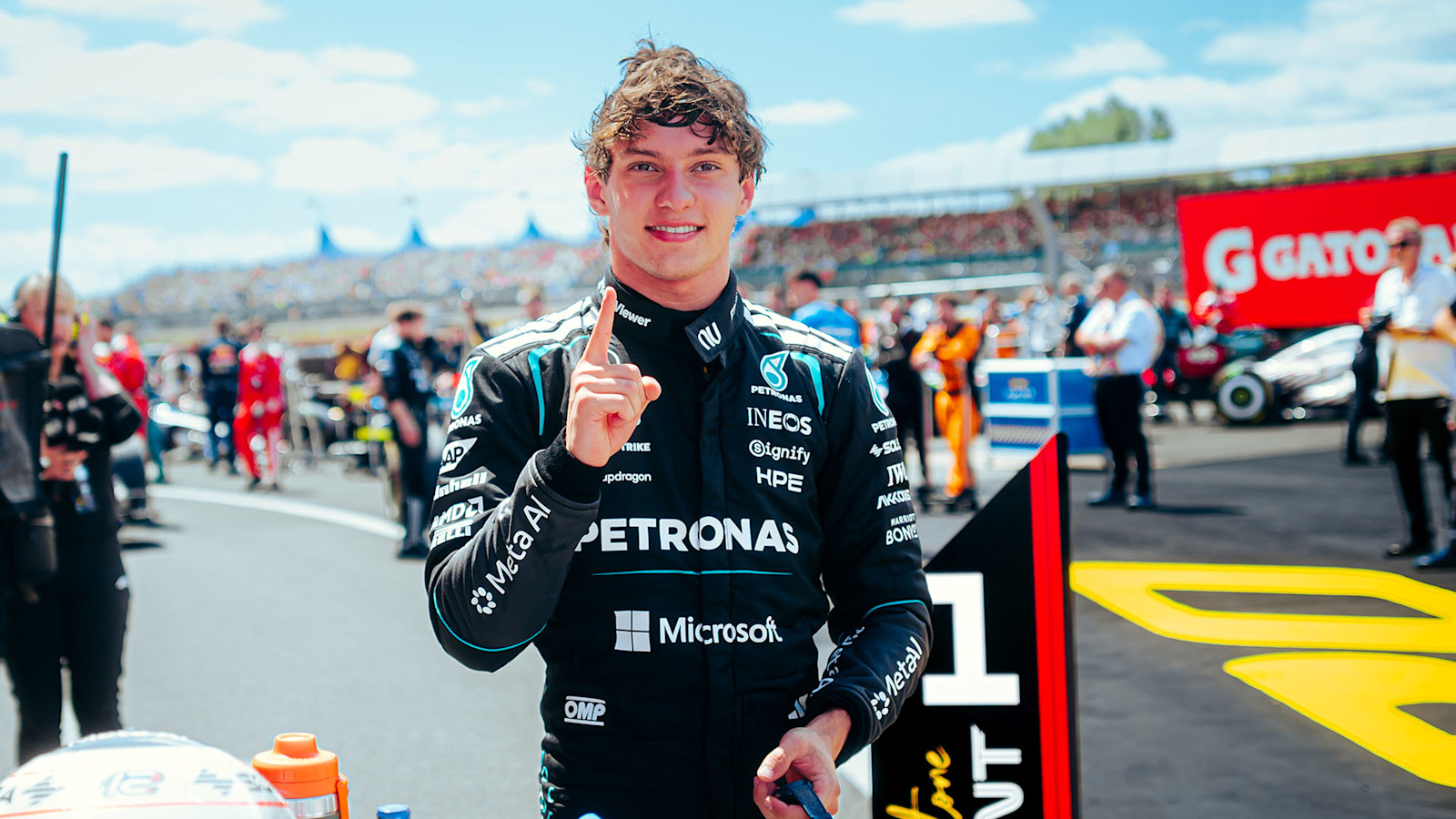
Silverstone’s Saturday did not follow the simple home-hero script. It became a much sharper question: what happens when Ferrari brings enough pace to make Mercedes uncomfortable, and Kimi Antonelli still leaves with the cleanest hand?
The official record is already strong. Formula 1 and the FIA both confirmed Antonelli’s first Sprint victory at Silverstone after he passed Lewis Hamilton, then his Grand Prix pole later in the day ahead of Charles Leclerc and Hamilton. Mercedes’ own report says the team had to fight Ferrari throughout the day, with Antonelli converting the Sprint and then producing his best Q3 lap when it mattered.
That is why this clears the Daily Dose of F1 bar. GearPulse covered Hamilton’s Sprint pole on Friday and McLaren’s upgrade puzzle earlier today. This is not a duplicate. It is the next, bigger development: the championship leader absorbed the emotional weight of Hamilton at Silverstone, the practical pressure of Ferrari’s pace, and the awkwardness of a wind-sensitive qualifying session.
GearPulse’s view: this was not just a good Antonelli day. It was the day Mercedes reminded the field that it can be challenged, adjusted, and still end Saturday as the team everyone has to chase.
The double result changes the tone
Hamilton’s Sprint pole mattered because it made Ferrari look like a live Mercedes problem. Antonelli’s Saturday mattered more because he answered it twice.
In the Sprint, Formula 1’s classification put Antonelli ahead of Hamilton by 2.745s, with Lando Norris third and George Russell fourth. Mercedes’ report adds the useful team context: Antonelli felt he lacked momentum at the start, got back into overtake mode range, made the pass and then had enough pace in clean air to build the gap.
In qualifying, the gap looked different but the message was similar. The FIA lists Antonelli on pole with a 1:28.111, Leclerc second by 0.175s, Hamilton third, and Russell fourth. Motorsport.com and Sky Sports F1 both treated it as a decisive Saturday swing after Ferrari’s earlier momentum, while The Guardian framed Mercedes as still unbeaten in qualifying this season.
| Silverstone Saturday marker | Confirmed signal | GearPulse read |
|---|---|---|
| Sprint result | Antonelli, Hamilton, Norris, Russell | Mercedes had the best race-pace answer even after Ferrari started ahead. |
| Qualifying pole time | 1:28.111 | Antonelli found the lap when the wind and pressure made Q3 tricky. |
| Ferrari grid threat | Leclerc P2, Hamilton P3 | Ferrari is real enough to pressure Mercedes, not merely create a headline. |
| Russell’s position | P4 after a Q1 off and speed concerns | Mercedes has depth, but Antonelli is setting the reference right now. |
| McLaren/Red Bull | Norris P6, Verstappen P7, Piastri P8 | The expected disruptors are close, but not controlling the front. |
That combination is more valuable than either result alone. A Sprint win can be dismissed as short-form execution. A pole can be dismissed as one-lap peak. Doing both on the same day, at Silverstone, against Hamilton and Ferrari, is harder to wave away.
Ferrari is closer, but Mercedes has the cleaner race shape
The best caveat for Mercedes is also the best news for Sunday’s race: Ferrari looked genuinely fast.
Mercedes team principal Toto Wolff said Ferrari had been quick from the first session and that Mercedes had to work to take the fight to them. Antonelli said the team knew qualifying would be a battle with the Ferraris, and warned that Mercedes would need to be at its best on Sunday. That matters because it avoids the lazy reading that Mercedes simply cruised through Saturday.
Ferrari’s threat is different on each side of the garage. Hamilton has the Silverstone gravity, the crowd, and the race craft to make the first stint uncomfortable if he launches well from third. Leclerc has front-row track position and enough one-lap evidence to suggest he is not just there as a Ferrari supporting act.
But Mercedes owns the cleaner shape. Antonelli has pole and fresh Sprint race evidence that his car could follow, attack and then stretch away once in clear air. Russell starts fourth, close enough to pressure Hamilton and cover strategic options. Ferrari has the emotional energy. Mercedes has the easier control board.
Russell is the uncomfortable comparison
This is the part Mercedes will not overstate publicly, but the timing sheet makes it hard to ignore.
Russell’s Saturday was useful, not bad. He finished fourth in the Sprint, recovered from a Q1 off in qualifying, and still put the car on the second row. Mercedes’ report says a heavy gust contributed to the Q1 incident, while Russell also described a straight-line speed issue and tyre-window compromise on his final run.
Those are real caveats. They are also the kind of caveats title fights rarely pause for.
Antonelli had his own imperfect day. Mercedes says he lost some confidence after a Q2 lock-up, changed settings and then put together a tidy final lap. Formula 1’s post-qualifying coverage also noted he was uneasy about being sent out first for the last Q3 run. The difference is that Antonelli turned his complications into pole and a Sprint win. Russell turned his into a respectable but clearly second-best team result.
For the championship, that matters. The Guardian reports Antonelli extended his lead over Russell and Hamilton after the Sprint. The exact margin will move again on Sunday, but the broader pattern is clear: Russell cannot afford many weekends where the explanation is credible and the scoreboard still points toward the other Mercedes.
McLaren and Red Bull lost useful leverage
The McLaren story became harder after qualifying. Earlier in the weekend, McLaren had the most visible front-runner upgrade story and a clear home-race narrative. By Saturday evening, the public evidence was less flattering: Norris third in the Sprint but sixth on the Grand Prix grid, Piastri seventh in the Sprint and eighth in qualifying.
That does not mean McLaren is out of the race. Silverstone can reward race pace, tyre care and clean-air timing, and Norris still has the kind of first-lap aggression that showed up in the Sprint. But McLaren no longer controls the story. It needs Mercedes and Ferrari to open the door.
Red Bull’s position is even more awkward. Verstappen starting seventh is not a disaster at Silverstone, where Stowe and the Loop can create passing chances, but it is a long way from dictating terms. If Red Bull has an energy deployment or balance limitation, Silverstone’s long fast sections will keep exposing it. If it has race pace, Verstappen can still make Sunday messy. The probability of him controlling the race from there is much lower than the probability of him disrupting someone else’s.
Sunday likelihood board
These are GearPulse editorial probabilities, not betting advice and not a claim of inside information. They are based only on public results, official team comments, and the shape of the weekend so far.
| Sunday scenario | Likelihood | Why it fits the evidence |
|---|---|---|
| Antonelli controls the first stint and makes Mercedes the strategic reference | 35-45% | Pole plus Sprint pace is the strongest public case. |
| Ferrari turns front-row pressure into a real win fight | 25-35% | Leclerc starts second, Hamilton third, and Ferrari has been quick all weekend. |
| Russell becomes Mercedes’ second strategic weapon | 20-30% | P4 is close enough if he clears Hamilton or forces Ferrari to defend early. |
| McLaren recovers into podium contention | 15-25% | Norris has race-craft upside, but qualifying exposed grip and pace concerns. |
| Verstappen turns P7 into a chaotic front fight | 10-20% | The driver ceiling is obvious; the starting position and car evidence are not ideal. |
The biggest unknown is tyre behavior in traffic. Silverstone’s 5.891 km layout loads the tyres hard, especially through the high-speed sequences, and the 2026 energy rules have already made deployment part of the weekend conversation. A car that looks calm in clean air can become very different when it is trying to follow through Copse, Maggotts, Becketts and Chapel.
Fun fact with teeth
Mercedes’ official social posts highlighted Antonelli as the first Italian on pole at Silverstone in 73 years. That is a neat stat, but it is not just trivia.
Silverstone has a way of measuring credibility because the place is so exposed. It began as an old airfield, hosted the first Formula 1 World Championship race in 1950, and still asks the same basic thing of a driver: carry speed when the car is loaded, the wind is moving, and the corner has not finished yet.
That is why this Saturday lands harder than a random street-circuit pole. Antonelli did it at a track where hesitation is expensive and where the home crowd was naturally tilted toward Hamilton and Russell. The moment looked historic because it was. The more important part is that it also looked repeatable.
Bottom line
Antonelli’s Silverstone Saturday is the right F1 story tonight because it moved the weekend forward. Hamilton’s Friday pole made Ferrari dangerous. McLaren’s upgrades made the technical picture interesting. But Antonelli’s Sprint win and Grand Prix pole changed the control point of the British GP.
Mercedes is not unchallenged. Ferrari has enough pace to make Sunday uncomfortable, Russell is close enough to matter, and McLaren or Red Bull can still turn the race sideways. But after Saturday, the cleanest argument is simple: if anyone wants to turn Silverstone into a title-race reset, they now have to go through Antonelli first.