
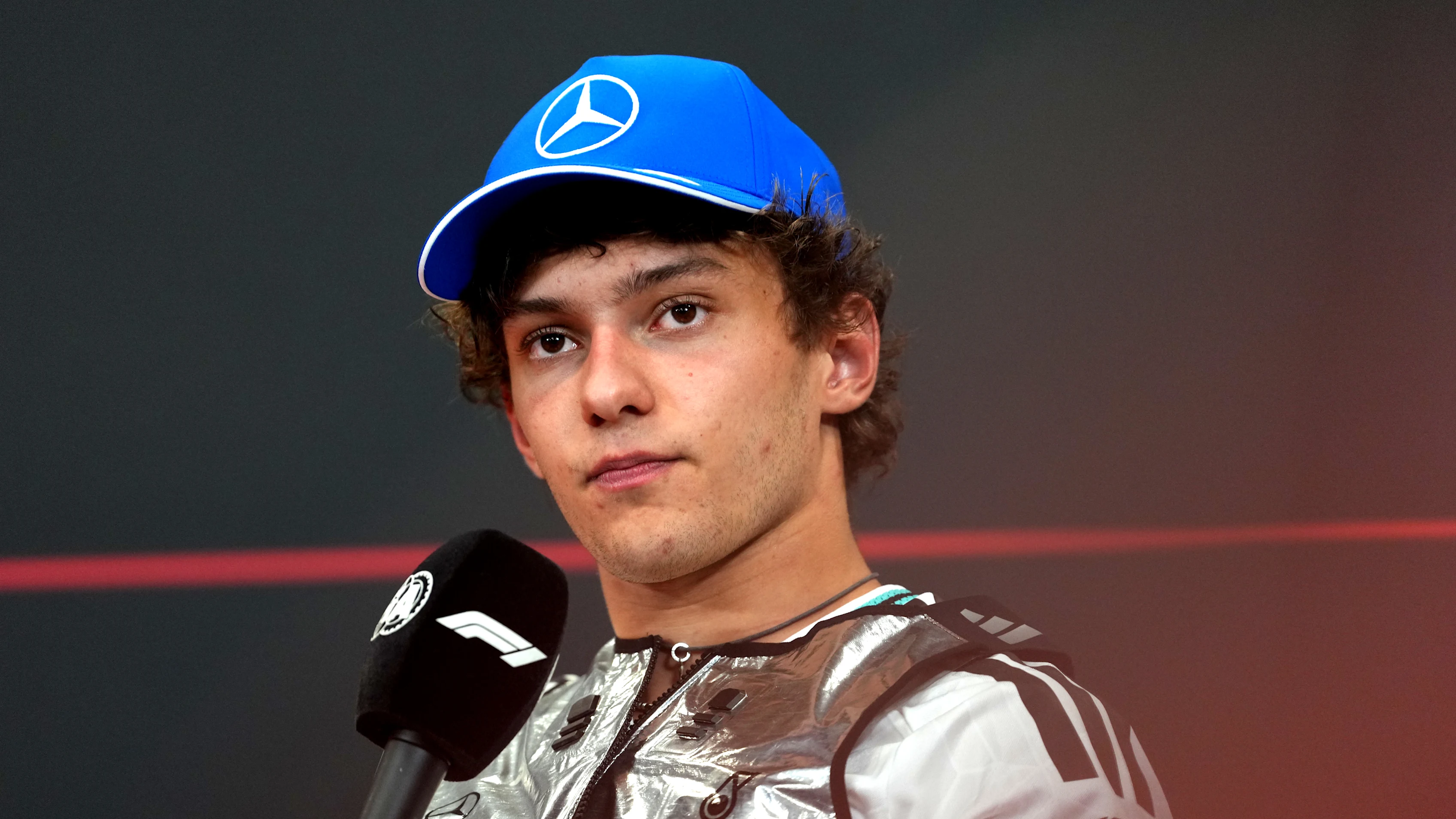
Kimi Antonelli’s most important summer-break quote is not about lap time.
Formula 1 published fresh August 3 coverage of the Mercedes driver’s appearance on SAP’s Significant Figures podcast, where Antonelli reflected on the middle of his 2025 rookie season and admitted that the weight of expectation got to him. Motorsport.com had already pulled out the wider backstory: Toto Wolff had effectively opened the Mercedes door before Antonelli had even raced in Formula 2, which made every early stumble feel less like normal rookie friction and more like a verdict on the decision.
That matters now because the same driver reaches the 2026 break as the championship leader. Official Formula 1 standings have Antonelli on 219 points, 50 ahead of Lewis Hamilton, 59 ahead of team mate George Russell and 91 ahead of Lando Norris. Mercedes also leads the teams’ table on 379 points, 72 clear of Ferrari.
GearPulse’s view: this was the most interesting F1 story of August 3 because it explains the part of Antonelli’s title bid that the timing sheets cannot. Mercedes does not just need the quickest 19-year-old in the field. It needs one who has already learned what overload feels like, what resets him, and what habits keep a fast season from becoming a fragile one.
Why This Rose Today
There were more obvious summer-break subjects available: Lawson’s Racing Bulls future, another half-season report card, Piastri’s recovery path at McLaren, and the continuing question of whether Ferrari can chase Mercedes after the shutdown. Antonelli’s interview beat them because it connects a same-day official source to the central question of the second half.
Formula 1’s own first-half review says Antonelli’s 2026 rise has been one of the season’s defining lessons. It also points to the development war tightening around Mercedes, with five different winners from three teams in the five events before the break. That is the pressure box: Antonelli has the lead, but the car advantage is no longer clean enough to let him coast.
Sky Sports F1’s post-Spa reporting gives the transformation useful context. Antonelli called Spa in 2025 a low point, then returned a year later as a race winner and a calmer championship leader. Wolff’s read was just as revealing: the surprise was not only Antonelli’s speed, but the structure and serenity he had added to his work.
That is why the pressure quote lands differently now. It is not confessional content for its own sake. It is evidence of a driver building a process quickly enough to survive a title campaign that arrived ahead of schedule.
The Mercedes Bet Was Always Psychological
Antonelli was never only a pace gamble. Mercedes knew he was quick. The harder question was whether he could absorb a works-team life that usually takes years to understand.
The Motorsport.com account of the SAP interview underlines how early Wolff’s conviction formed. Antonelli described being told of Mercedes’ plan before Hamilton’s Ferrari move had even been announced publicly, and before he had begun his F2 season. In performance terms, that is a compliment. In human terms, it is a load-bearing wall placed on a teenager.
The 2025 struggles now look less like a warning sign and more like accelerated education. A difficult European stretch taught Antonelli how his body and concentration respond when results collapse. He spoke about learning what helps him get back to full focus and energy through a race weekend. That is exactly the toolkit a title leader needs when the easy wins stop.
There is a useful comparison with Hamilton here. Hamilton’s Ferrari resurgence has also been framed by reset, fitness and emotional comfort after a grim first season in red. The difference is that Hamilton is a seven-time champion rebuilding an environment around known strengths. Antonelli is still discovering his floor while leading the table.
That makes the Mercedes project more impressive and more vulnerable at the same time.
The Numbers Are Strong, But Not Comfortable
Antonelli’s 50-point lead over Hamilton is large enough to make him the clear favourite. It is not large enough to make the championship closed.
The remaining calendar still includes Sprint weekends, high-degradation races, street-circuit risk and the unknown reliability profile of the 2026 power-unit era. GearPulse would put Antonelli’s title likelihood in the 60-70% range from here, based on the points gap, Mercedes’ constructors lead and his repeated conversion of big weekends. That is editorial probability, not betting advice.
The caveat is that his lead has already survived help from circumstance. Russell’s season has been damaged by deployment and reliability issues. Hamilton has left points on the table while Ferrari’s execution has fluctuated. Norris is still only fifth after Hungary, but McLaren’s latest pace gives him the most dangerous underdog profile if the Woking team returns from shutdown with another clean step.
The real comparison is not just Antonelli versus Hamilton or Russell. It is Antonelli’s emotional repeatability versus the late-season randomness of a new regulation cycle. Can he keep making the same clear decisions when Ferrari has a better weekend, when Russell takes points away, when Norris is suddenly the faster car, or when Mercedes has to manage a reliability scare rather than a comfortable podium?
That is where his 2025 experience becomes more than biography.
Russell Is The Internal Stress Test
Russell’s 160 points put him third in the standings, but his deficit to Antonelli is now bigger than Hamilton’s gap to the leader. That is a strange shape for Mercedes. The established driver is still scoring heavily enough to keep the team clear in the constructors’ championship, yet the title momentum sits decisively with the younger team mate.
For Antonelli, Russell remains the cleanest stress test because he sees the same meetings, the same simulator direction, the same factory reaction after weak sessions. If Antonelli’s reset process is real, it should show most clearly inside Mercedes: fewer emotional swings in debriefs, fewer overcorrections after a poor session, and less need to prove authority through risky wheel-to-wheel choices.
For Russell, the second half is about refusing to become supporting context. He does not need to beat Antonelli every weekend to matter. He does need to create enough weekends where Mercedes cannot simply funnel its title story through one side of the garage.
That internal balance could help Antonelli if managed well. A fast Russell takes points away from Hamilton, Norris, Leclerc and Verstappen. A frustrated Russell creates another pressure front.
The Fun Fact That Explains The Stakes
Antonelli was born in August 2006. If he converts this lead, he would not just be a young champion; he would be a champion who absorbed a Mercedes promotion, a difficult rookie season, a regulation reset and a title fight before most drivers have finished learning how F1 politics works.
That is why the “pressure destroyed me” line should not be read as weakness. In modern Formula 1, a driver who can name the problem clearly is often closer to managing it. The dangerous driver is not the one who never felt pressure. It is the one who felt it once, mapped the failure mode, and changed the routine.
Bottom Line
Antonelli’s interview does not win Mercedes the 2026 championship. It does explain why Mercedes can reasonably believe its youngest title leader is more robust than the age line suggests.
The second half will still be decided by upgrades, reliability, tyre windows and the usual blunt mathematics of points. But the psychological question is now part of the technical one. Mercedes has built a fast car and a points lead. Antonelli’s job is to prove the reset that saved his rookie confidence can also protect a championship.