
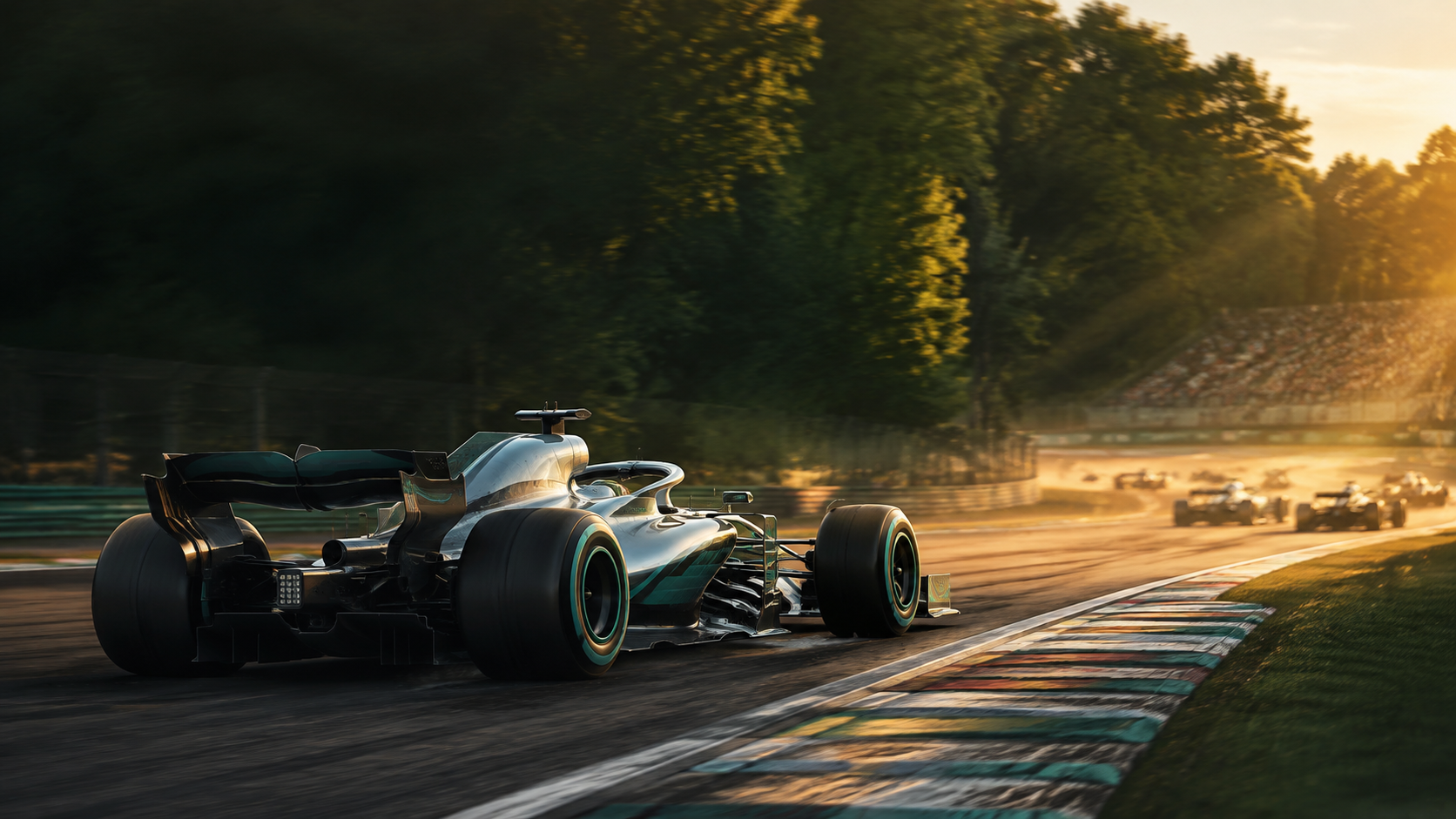
Race spoilers follow.
The numbers make Kimi Antonelli’s Italian Grand Prix sound impossible: 19th on the grid, first at the flag, 53 laps, a home victory at Monza. The useful explanation is less mystical. Mercedes gave its championship leader a fresh-tyre route through a race that became unusually sensitive to timing, then Antonelli did the demanding bit by converting that advantage against George Russell.
Formula 1’s official result records Antonelli first in 1:51:15.281, Russell 3.857 seconds behind and Max Verstappen a further 10.861s back. That is a Mercedes one-two, but not the familiar version in which one car controls the pace from the front while the other tidies up behind. Russell had inherited the lead after Pierre Gasly’s brave pole position unravelled in race trim; Antonelli had to build a victory from traffic, a red-flag interruption and a strategic fork that only became valuable late on.
The result reaches beyond the very good headline. It shows why a grid penalty is not always the same thing as a lost Sunday when a car has enough underlying pace and the race offers a usable neutralisation. It also leaves Mercedes with an awkwardly encouraging problem: its two drivers did not merely finish together; they arrived at the decisive phase on genuinely different plans.
The VSC did not hand Antonelli the race; it changed the terms of it
Antonelli started 19th after a power-unit penalty. By the time Lance Stroll’s stopped Aston Martin brought out a Virtual Safety Car on lap 29, he had already made the recovery credible. Formula 1 and Sky Sports report that Antonelli stopped for fresh medium tyres under that VSC, while Russell remained out on used hard tyres.
That distinction deserves more attention than the romantic image of a driver slicing through Monza from the back. A VSC reduces the time lost in the pit lane, but it does not make a stop free, and it does not manufacture the pace needed afterwards. Antonelli and Verstappen fell behind the leaders when they stopped; both then had to regain track position. Antonelli’s fresher mediums gave him a better attacking phase, while Russell’s choice protected the track position he had worked to secure.
There was a rational case for each car. Russell was leading, and leading at Monza has real defensive value when straight-line speed and slipstreaming can shuffle the order. Antonelli had less to lose from taking the tyre-life upside. The consequence was not a secret team order. It was a proper on-track contest created by two valid but unequal strategies.
Motorsport.com described the race as shaped by the 2026-era power-unit rhythm; Sky noted that the long straights and tow repeatedly altered the picture. That is a helpful caveat. This was not a laboratory-perfect comparison of the Mercedes drivers. But the tyre offset mattered when the race finally settled, and it mattered most precisely because Antonelli was close enough to use it.
The pass mattered more than the recovery statistic
Antonelli caught Russell with five laps remaining, ran wide at the first chicane, regrouped, and made the winning move with three laps to go. The official report places a brief gravel excursion in that late attack; it is a small but revealing part of the story. Fresh tyres create an opportunity, not automatic precision.
That is why the P19-to-P1 line should not obscure the quality of the closing laps. A driver protecting a points lead may settle for the safer second place. Antonelli came back after the error and committed to the opening. Russell, on older tyres, could not hold him indefinitely without taking a risk that might have cost Mercedes much more than one place.
The scale is historic without needing embellishment. Formula 1 says Antonelli became the first Italian winner at Monza since 1966; Sky Sports notes that 19th is the second-lowest winning grid position in championship history. Those are remarkable markers, yet their lasting value lies in what they say about this season’s shape. Antonelli was already the championship leader. Winning at home from a penalty-compromised grid means his lead is now supported by recovery racing as well as front-running speed.
Mercedes has a productive tension to manage
This was a victory for Antonelli, but it is also a sharp test of Mercedes’ internal balance. Russell did almost everything a lead driver should: survived the front-of-race upheaval, held track position after the VSC and forced Antonelli to chase to the last handful of laps. He did not lose because he was anonymous. He lost because his team-mate’s alternate plan became more powerful at exactly the wrong moment for his used hards.
That is not a reason to invent discord. The final result was a maximum team score, and Verstappen was 14.718s behind the winner. Still, it reinforces a point GearPulse made after Mercedes’ fast Monza Friday: the engine penalty was always a tactical disruption, not a simple measure of Antonelli’s competitiveness. Sunday turned it into a different route to the same front-running fight.
The more difficult question comes next. When both Mercedes drivers are in contention and their tyre plans diverge, the team needs clarity without draining the instinct that made Antonelli’s recovery possible. Titles are rarely won by permanently avoiding such decisions. They are won by making them intelligible, defensible and quick enough that the other teams cannot exploit hesitation.
Bottom line
Antonelli’s Monza win was not a fairytale that bypassed the details. It was a brilliantly executed response to a penalty: early overtaking made the VSC stop viable, fresh mediums gave him a late-race tool, and a recovered first-chicane attack converted it into 25 points.
For Mercedes, the one-two is a statement of speed. For Antonelli, it is stronger still. He left his home race with a victory that proves his championship case can survive a bad grid as well as flourish from a good one.