
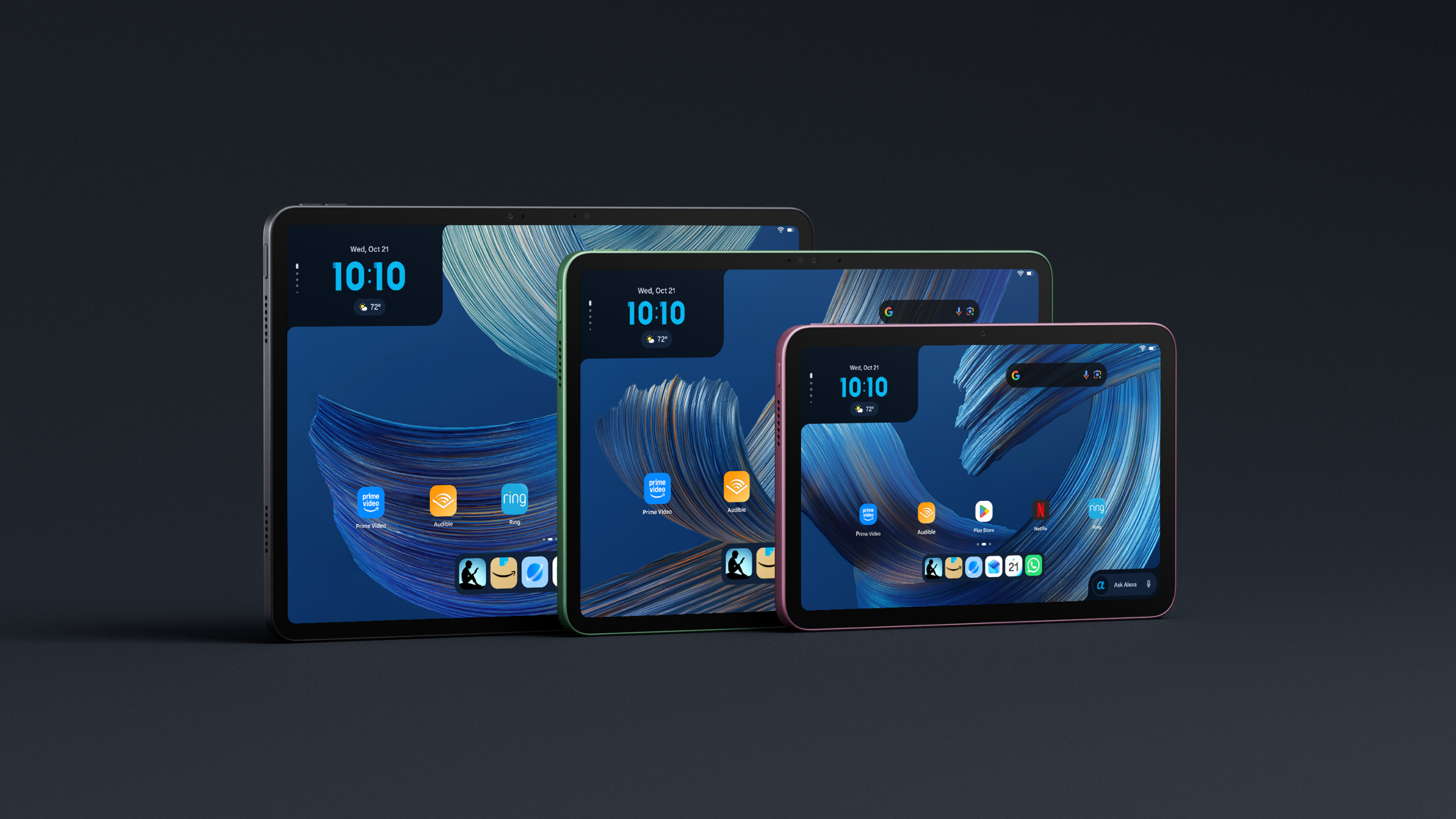
Amazon’s new tablets matter less because they have a new name than because Amazon has stopped asking buyers to live inside a constrained app aisle.
The Alexa Tablet 12 Pro, Tablet 11 and Tablet 8 replace the familiar Fire branding with certified Android and full Google Play Store access. That makes YouTube, Gmail, Google Docs and the rest of the ordinary Android universe first-class citizens, rather than apps users have to sideload, work around or simply give up on. For a product family that has long been cheap enough to forgive but limited enough to outgrow, it is the most consequential reset Amazon could make.
Amazon is not retreating from its own ecosystem. Alexa+ sits at the center of the new line, Amazon services are preinstalled, and the company has built a Kindle-focused reading mode around its apps. The difference is that the tablets are now trying to be useful alongside a person’s existing digital life. That is a much better premise for a modern tablet.
The three tablets, without the launch gloss
| Model | Starting price | Core hardware Amazon specifies | Sensible buyer |
|---|---|---|---|
| Alexa Tablet 8 | $229.99 | 8.7-inch display, 4GB RAM, 64GB storage, Wi-Fi 6 | Someone who wants a compact reading, browsing and streaming tablet |
| Alexa Tablet 11 | $329.99 | 11-inch 2.5K/276ppi, 90Hz display, 8GB RAM, 64GB storage | The practical middle ground for media and casual productivity |
| Alexa Tablet 12 Pro | $499.99 | 12-inch 280ppi, 120Hz, 3:2 display; 8GB RAM and 128GB storage at entry | Buyers who genuinely need the larger screen, keyboard or pen |
The 12 Pro is the ambitious one. Amazon claims a 4nm eight-core chip, Wi-Fi 6E, quad Dolby Atmos speakers and up to 16 hours of video playback. Its $549.99 Nanomatte option adds an anti-glare display treatment; the compatible Pro Keyboard and Pro Pen cost $149.99 and $89.99 respectively. That can turn into a serious outlay quickly, especially once a folio and higher storage are involved.
The smaller models are arguably more interesting. At $229.99, the 8 keeps the one-hand appeal that made Fire tablets useful as casual screens, while the 11’s 90Hz panel and 8GB of memory look like a cleaner answer for streaming, web work and light multitasking. Amazon says the 12 Pro and 11 have aluminum unibody construction, while the 8 is also aluminum and weighs 329g. Those claims need real-world testing for build quality, thermals and sustained speed, but the specifications are no longer an apology for the price.
Android is the feature that changes the recommendation
The old Fire proposition was always a bargain with a footnote. It was fine for Kindle, Prime Video and a handful of familiar apps, but Fire OS’s missing Google layer made the devices awkward when a household needed school software, a work app or the version of a service everyone else uses.
TechCrunch, WIRED and Ars Technica each identify the same pivot: these are new Android tablets with the Play Store, not a superficial Fire rebrand. That means Amazon now has to compete more directly with Samsung, Lenovo and Apple on hardware, software support and price—but it also means a buyer can choose one without first accepting an artificial software boundary.
That is particularly relevant in a home where a tablet changes hands. A device might be a Kindle in the evening, a kitchen video screen at breakfast, a child’s classroom companion after lunch and a travel entertainment screen on Friday. Full Android does not guarantee that every app will be well optimized, but it removes the most predictable incompatibility from the purchase decision.
Alexa+ needs to earn its place on the screen
Amazon’s other big idea is On-Screen Intelligence. With an opt-in, Alexa+ can read the visible page and answer questions about it; Amazon also describes continuous live conversations and context-sensitive help. The company says the screen-sharing feature is off by default, shows an indicator while active, and can be disabled.
Those are the right minimum controls, not a substitute for scrutiny. A screen-aware assistant potentially encounters calendar details, personal messages, shopping research and work documents. The useful question is not whether it can summarize a trail page; it is whether Amazon makes its permissions, retention and failure modes understandable enough that people will know when to invoke it. Until independent testing and policy analysis arrive, treat the feature as a capability to evaluate, not an automatic reason to pay more.
Amazon’s Kindle Mode looks less flashy and perhaps more valuable. Opening the Kindle app silences notifications, reduces blue light and can extend reading time to an advertised 20 hours. That takes a cue from the focused-device appeal we found in the Kindle Scribe Colorsoft: sometimes the best tablet feature is a deliberate reduction in distractions. Here, though, the reader can close the book and still have a normal app ecosystem waiting.
Availability and the buying advice
Amazon says all three Alexa Tablets begin shipping October 14 in the United States, Mexico and Canada, then October 19 in the UK, Germany, France, Italy and Spain. Regional prices, configurations and service availability can differ, so treat the quoted US prices as a starting point rather than a universal comparison.
The Tablet 8 is the one most likely to justify itself quickly if its display and performance hold up in reviews: it has a clear use case and no longer forces a buyer into a limited store. The Tablet 11 appears to be the sensible default for people who want a larger media and browsing screen. The 12 Pro needs a tougher comparison against established Android tablets and an iPad with similar storage and accessories; a premium panel and a promising pen are not enough by themselves.
Bottom line
Amazon has finally made the tablet change that its hardware line needed. By abandoning Fire’s app constraints and embracing certified Android, it has converted the Alexa Tablet from an Amazon-service appliance into a more credible general-purpose device.
That does not make the launch models automatic buys. Battery figures, Alexa+’s practical value, update commitments and performance all need independent testing. But the old deal-breaking question—“will this run the apps I actually use?”—has a much better answer now. For a tablet, that is a bigger upgrade than a new logo.