
Alpine’s 2026 problem is not that the team is slow everywhere. It is more uncomfortable than that: the A526 was good enough early in the season to make fifth place look realistic, then the midfield development race moved faster than Enstone’s car.
That makes Zandvoort more than the first weekend after the summer break. It is the first public test of whether Alpine’s Mercedes-powered reset is still a recovery project or has already become another year of explaining why the future is brighter than the present.
The Race’s August 16 analysis put the tension neatly: Alpine’s Dutch Grand Prix upgrade is not just another bodywork package. It arrives after a run in which Racing Bulls has jumped ahead, Audi has become a points threat, Aston Martin has finally found visible pace, and Alpine left Hungary with no points and two frustrated drivers.
GearPulse’s view: this is today’s most interesting F1 story because it sits below the obvious title-fight noise but says a lot about the 2026 rules. The new era has not simply rewarded the biggest teams. It has punished any midfield operation that paused while rivals kept adding usable performance.
The numbers are the warning
Formula 1’s official teams’ standings, checked August 16, put Alpine sixth on 61 points. Racing Bulls is fifth on 66. Haas is seventh on 21, Audi eighth on 12, Williams ninth on 11, Aston Martin tenth on one point and Cadillac still scoreless.
That table looks comfortable if you only look backwards. Alpine has a 40-point buffer to Haas, which is a lot in a midfield where seventh-place Sundays are rare. But the dangerous number is the five-point gap to Racing Bulls. Alpine did not spend the opening half trying to survive seventh; it was trying to own the “best of the rest” label behind Mercedes, Ferrari, McLaren and Red Bull.
Formula 1’s official Alpine team page adds the shape of the season: 11 Grands Prix entered, 61 total points, one podium, no wins and no poles. Pierre Gasly sits 10th in the drivers’ table on 42 points, while Franco Colapinto is 12th on 19. That is a respectable reset-year return. It is also a warning that one driver is carrying most of the score.
Hungary exposed the trend
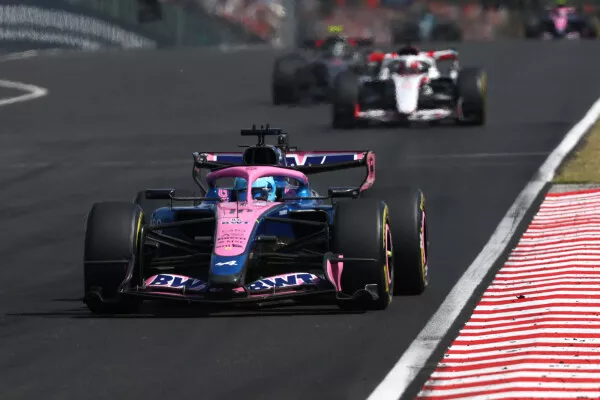
Alpine’s own Hungarian Grand Prix release is the clean primary source here. Gasly started and finished 12th. Colapinto started 13th and finished 15th. More importantly, the team’s post-race quotes did not hide behind strategy, tyres or bad luck.
Gasly said Alpine was not close enough to fight for points and lacked the pace to race Racing Bulls or Audi. Colapinto said the car was far off the pace and difficult to recover after the early laps. Flavio Briatore’s line was even more direct: Alpine lost fifth in the constructors’ championship because Racing Bulls had done a better job in that phase of the season.
That matters because a midfield slump is easy to misread. One bad weekend can be track layout. Two can be tyre window. Four can become a development diagnosis.
Formula 1’s own July analysis called Alpine and Racing Bulls a development war, built around Steve Nielsen’s point that Alpine could not relax while rivals were bringing bigger packages. F1’s half-term report then sharpened the same conclusion: Alpine’s strong start, Gasly’s Monaco podium and Colapinto’s Canada result were real, but recent progress has dwindled.
Why Zandvoort is a sharp test
Zandvoort is not a neutral laboratory. Formula 1 lists the Dutch circuit at 4.259km, 72 laps and 306.587km, with banking, elevation and old-school commitment through the dunes. It is also a Sprint weekend in 2026, which reduces practice time and makes correlation errors more expensive.
That is exactly why this upgrade matters. Alpine does not need the A526 to become a podium car in the Netherlands. It needs the new aero parts to behave predictably enough that Gasly and Colapinto can trust the car across one practice, Sprint Qualifying, the Sprint, Grand Prix qualifying and the race.
If the package works, Alpine can turn the second half into a controlled fight with Racing Bulls, while keeping Audi, Haas, Williams and Aston Martin at arm’s length. If it does not, the team risks spending September chasing explanations while rivals bank small but cumulative points.
The Mercedes switch is part of the story
Alpine’s move away from its own Renault power unit and into Mercedes customer supply was supposed to simplify the competitive problem. The power unit is now the same broad family used by Mercedes, McLaren and Williams. On paper, that should remove one historical excuse.
But 2026 has made customer status more complicated than a badge on the engine cover. The new cars tie power delivery, electrical deployment, straight-line efficiency and active-aero choices together. A customer team can benefit from a strong engine and still lose time if the chassis, cooling, drag level and driveability tools do not meet in the right place.
Alpine’s advantage was supposed to be focus. With Enstone no longer carrying a works power-unit programme, the team could put more energy into the chassis. The Zandvoort package is therefore a referendum on the new operating model: has the team converted simplicity into speed, or just changed the source of its constraints?
Midfield comparison board
| Team | Official points on August 16 | Current pressure |
|---|---|---|
| Racing Bulls | 66 | Protect fifth after jumping Alpine in Hungary |
| Alpine | 61 | Prove Zandvoort aero parts stop the slide |
| Haas | 21 | Turn occasional points into a stronger run |
| Audi | 12 | Keep converting improved pace into evidence |
| Williams | 11 | Make its next update count before the gap grows |
| Aston Martin | 1 | Show Hungary’s step was not a one-off |
| Cadillac | 0 | Find reliability and repeatable race execution |
The table is why Alpine’s moment is awkward. Racing Bulls is close enough to chase. Haas, Audi and Williams are far enough behind that Alpine should not panic. Aston Martin has almost no points but a live upgrade/engine-change story. That combination can tempt a team into defending rather than attacking.
The right response is the opposite. Fifth place is still recoverable precisely because the gap is small. Alpine’s bigger danger is becoming the team everyone else uses as proof that their own upgrades are working.
GearPulse likelihood board
This is editorial analysis, not betting advice:
| Question | GearPulse read |
|---|---|
| Alpine retakes fifth from Racing Bulls | 45-55%, because the gap is tiny but Racing Bulls has the better recent trend |
| The Zandvoort package produces an immediate visible step | 50-60%, because the team and Gasly have pointed to a meaningful aero fix, but Sprint weekends punish imperfect correlation |
| Gasly remains Alpine’s main scoring anchor | 70-80%, given his 42-19 points lead over Colapinto and 9-2 qualifying edge noted by Formula 1’s half-term report |
| Audi becomes a weekly Alpine threat | 35-45%, because its recent points form is improving from a low base |
| Alpine finishes lower than sixth | 15-25%, because the buffer to Haas is still substantial |
The most likely path is not dramatic collapse. It is a tight fifth-versus-sixth fight where two or three clean Sprint weekends decide whether Alpine’s early-season work still counts in December.
Fun fact
Zandvoort’s modern F1 identity is all about banking and rhythm, but its history goes back to 1952, when Formula 1 first raced there and Alberto Ascari led a Ferrari sweep. In 2026, the circuit’s final scheduled Dutch Grand Prix weekend is also a Sprint. For Alpine, that means fewer calm development laps at a venue where aerodynamic stability through loaded, flowing corners can make a driver trust or distrust a car very quickly.
That is the useful irony. A team trying to validate a major aero response gets one of the least relaxed weekends on the calendar to do it.
Bottom line
Alpine’s Zandvoort upgrade is not a miracle button. It is a credibility test.
The A526 already has enough points to show the 2026 reset was not wasted. Gasly’s Monaco podium, Colapinto’s Canada score and Alpine’s early consistency all count. But Hungary showed the current car has drifted out of the points fight just as Racing Bulls, Audi and Aston Martin have become more interesting.
GearPulse’s bottom line: if Alpine’s Dutch GP package works, the team can still make fifth place a serious second-half target. If it misses, the story changes from “best of the rest recovering form” to something more damaging: a Mercedes-powered rebuild that started brightly, then got out-developed before the real 2026 lessons had landed.
Support independent GearPulse articles at buymeacoffee.com/gearpulse.site.